I came for an MSF. I left Villanova with much more.
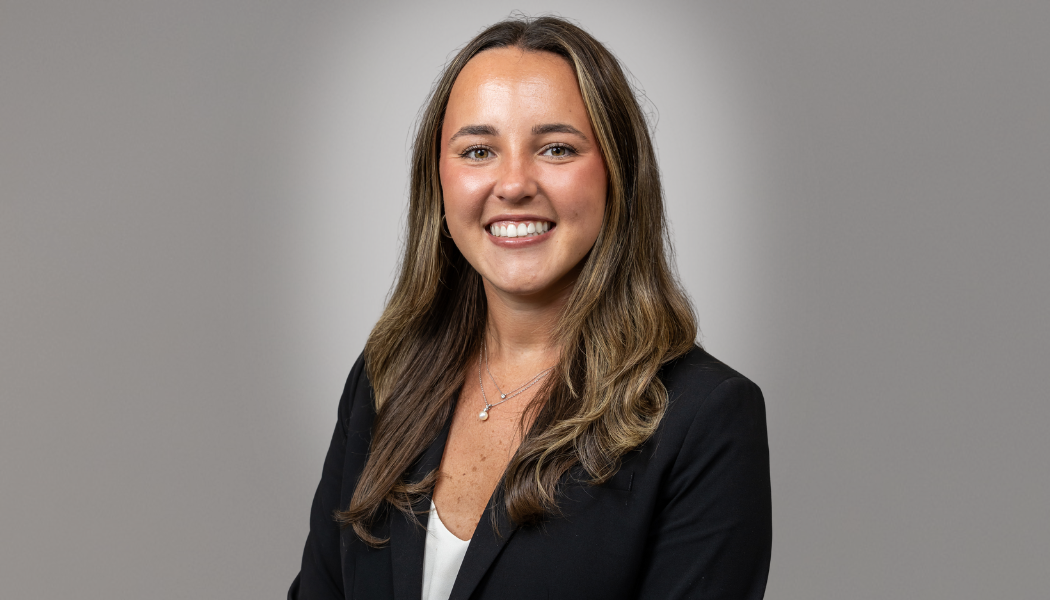
By Caitlin Wolfe, MSF '26
Not long ago, I interviewed for a trading desk job. The hiring manager and I spent nearly the entire time talking about the current state of the markets and the economy when it hit me.
Eleven months ago, I had no business being in that conversation. Now I’ve earned my way into that conversation.
My story began in 2024 when I graduated from Penn State with a risk management degree. I took a job as a relationship manager at a malpractice insurance company, far from what I wanted to do. I had hoped my internship the prior summer in municipal bond research would turn into a full-time role. When it didn’t, I took a job where I gained not only valuable client-facing experience but also the chance to realize where my true interests lie.
I kept thinking about how much I enjoyed that research internship: learning how the economy affected the markets and investments. Risk management was technically adjacent to finance, but it wasn't the same. I wanted to build the models and conduct the analysis, ideally in asset management. More importantly, I wanted to be able to hold my own in conversations with other finance professionals.
Six months into my new job, I was researching master's programs when a family friend told me about his experience in Villanova’s Master of Science in Finance. He took me through the curriculum: the deep dive into investments, the quantitative rigor, the real-world portfolio management experience. It was everything I wanted.
What I expected from the program was a stronger resume and a clearer career path. What I got was all of that plus confidence, community, and uncommon faculty and professional support.
Finance classes taught for the real world
I felt the difference in the classroom instantaneously. The Villanova faculty didn’t just know my name; they knew me: What I wanted to do and where I wanted to go. More on that later.
The environment alone changed how I learned. At Villanova, I asked questions and participated in discussions with my professors and my classmates. The people and the setting together encouraged me to take intellectual risks and be bold. Nowhere did that matter more than in the Portfolio Theory and Application course.
In that class, each student is assigned to cover a specific sector of the real-money Haley Large Cap Equity Fund, a portfolio managed entirely by Villanova MSF students. I covered the Consumer Discretionary sector, where I followed major retailers, leisure products, and luxury goods. I was responsible for researching not only the individual companies but also the macroeconomic forces impacting the sector in order to recommend stocks for the fund. I built my own models, ran my analysis, and pitched my recommendations to the class. My classmates weren’t shy: they asked me hard questions and I’m glad they did. After all, we were responsible for a $400,000 fund.
The confidence I built in that class wasn't just about knowing finance. It was about being able to sit across from someone in an interview or a networking conversation and not hedge every sentence. I went from someone who wanted to get into asset management but wasn't sure she belonged there, to someone who applied for those roles and genuinely believed she could get them. That shift doesn't come from reading textbooks. It comes from doing the work in front of people who challenge you and then rising to the occasion.
At Villanova, cohort and community are synonymous
The very nature and culture of the Villanova MSF program doesn’t allow for anonymity. You can't drift to the edges. You are in it, with everyone, all the time, and somehow that forced closeness becomes something you don't want to leave.
What I didn't expect was how collegial it would be. Finance has a reputation for being cut-throat. But in this cohort, if someone had a connection that could help a classmate, they shared it. No hoarding, no keeping contacts to yourself for a competitive advantage. Someone would say, "Hey, I see someone in your LinkedIn network where I’m applying. Can you introduce us?" and the answer was always yes.
MSF faculty support, from start to finish
That sense of community isn’t limited to the students in the Villanova MSF cohort. It carries over to the faculty, only their contributions complemented what I found among my peers.
I often think about Professor Amy Kratchman, who taught me for three weeks when we first arrived and then kept up with me throughout the 11-month program: asking about my job search and connecting me with colleagues she knew in the industry. She wasn't my advisor; she wasn't assigned to me; she just cared about how I was doing.
Professor Mike Pagano was the same way. He knew and remembered what I wanted to do after Villanova and pointed out opportunities I might want to explore. In a cohort of 45 students, I could develop real relationships with those who taught me. It carried over to our mentors, too. Each Villanova MSF student gets a mentor: mine was an alum who was a few years ahead of me and knew how it felt to be in my shoes. She listened, gave advice, even helped me prepare for Wall Street interviews. Like the faculty, she supported me unconditionally and I plan to pay it forward to MSF students who come after me.
That's the thing about Villanova that I try to explain to people. The curriculum is world-class, taught by highly regarded faculty and industry professionals who make the curriculum relevant to what’s happening in the real world. But the experience goes far beyond what happens in the classroom. It’s the faculty know what you want to get out of the program; the cohort who work alongside you at every step; the mentor who preps you for an interview and then asks how it went. In short, it’s the community and it's either there or it isn't.
At Villanova, it's there.
Caitlin Wolfe is a 2026 graduate of the Villanova School of Business Master of Science in Finance program. She holds a B.S. in Risk Management from Penn State University.
Frequently Asked Questions about the Villanova MSF program
How large is the Villanova MSF cohort?
The program typically enrolls approximately 40-60 students per year, creating a close-knit learning community where students and faculty know each other personally. This intimate class size distinguishes Villanova from larger MSF programs and is frequently cited by students as one of the program's most meaningful differentiators.
Does the Villanova MSF program help with career outcomes?
Villanova students have access to in-house graduate career services, a dedicated career development curriculum, and a one-on-one mentorship program that pairs every student with a Villanova finance alum. The program also sponsors student attendance at professional conferences and networking events in Philadelphia and New York.
What types of careers do Villanova MSF graduates pursue?
Graduates pursue roles across the financial services industry, including investment management and research, banking and capital markets, corporate finance, alternative investments, risk compliance and consulting, fintech, and data analytics. The program's proximity to Philadelphia and New York provides meaningful access to major financial employers and a strong regional alumni network.
How does the Villanova MSF compare to an MBA?
The Villanova MSF is a specialized, 11-month program focused exclusively on finance, making it well-suited for students who want to enter or advance in financial services without the broader scope (and longer timeline) of an MBA. It is particularly well-suited to candidates with 0–3 years of experience who want a fast, focused pathway into finance careers.
What is the Haley Large Cap Equity Fund?
The Haley Large Cap Equity Fund is an equity portfolio managed by Villanova MSF students as part of the Portfolio Theory and Application course. Students are assigned to cover specific market sectors, conduct equity research, and make investment recommendations that affect the actual portfolio, providing hands-on experience equivalent to working as an equity analyst. working as an equity analyst.