
Faculty Spotlight: Andrew Lee Prepares Students for the Future of Aerospace
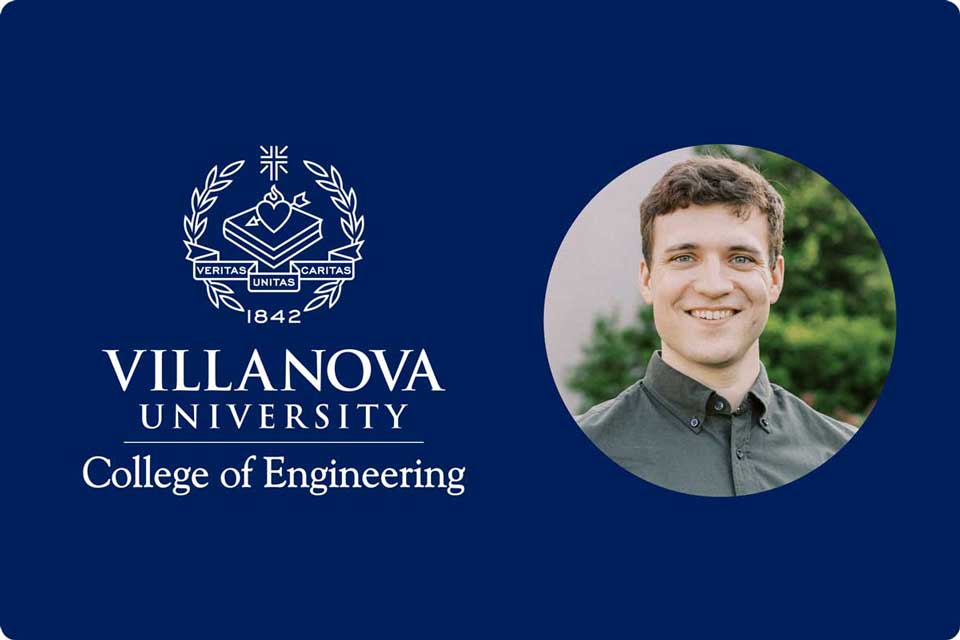
Andrew Lee, PhD, ’19 ME, knows Villanova Engineering from both sides of the desk.
After earning his bachelor’s degree in Mechanical Engineering from Villanova University in 2019, he left to complete a PhD in Materials Science and Engineering at Stanford University. When family ties brought him back to the Philadelphia area, he jumped at the opportunity to return to the College of Engineering as a faculty member.
Today, Dr. Lee brings his expertise in advanced materials, mechanics and manufacturing to the Villanova Master of Science in Aerospace Engineering. His goal is to help graduate students build specialized technical knowledge they can apply directly to aircraft, spacecraft and other complex engineering systems.
“It’s been amazing,” Dr. Lee said of his return to Villanova. “There's something special about being back where I started, now getting to share my expertise with students who genuinely care about the material. It’s also a great time to be teaching Aerospace Engineering with so much excitement and momentum in the field.”
Bringing Advanced Aerospace Materials into the Classroom
Dr. Lee’s primary role in Villanova’s aerospace engineering master’s program is teaching courses focused on advanced materials and structural performance.
“My expertise in the MSAE program is really advanced materials for aircraft and spacecraft design,” he explained.
His courses include Fiber Composite Structures and Fracture Mechanics. Fiber composites—including carbon fiber and fiberglass—are essential to modern aerospace design because they can provide high strength and stiffness while reducing weight. Fracture mechanics examines how cracks form and grow, helping engineers understand why structures fail and how those failures can be prevented.
Dr. Lee likes to incorporate simulation, analysis and project-based learning into his Fiber Composite Structures course. Students choose a fiber-composite structure, analyze its behavior and propose modifications based on what they learn.
The result is a course that combines scientific fundamentals with applications students may encounter in their careers. That individualized approach allows students to explore aerospace systems relevant to their interests, employers or career goals.
“For me, it’s really about connecting the course to what they’re actually going to be working on in the workplace and what they actually care about,” Dr. Lee said.
Learning from Classmates at Boeing, Blue Origin and Beyond
Villanova’s 30-credit MSAE program can be completed online, on campus or through a hybrid combination. Ten eight-week courses allow students to earn the degree part time in approximately 20 months, although longer progression options are also available.
Dr. Lee’s courses combine asynchronous instruction with a weekly live session. Students typically complete approximately an hour of recorded content before meeting for a two-hour class devoted to problem-solving, questions, discussion and collaborative activities.
To make asynchronous learning more engaging, Dr. Lee records lessons using Villanova’s Learning Glass technology. The transparent teaching surface allows him to write and present visual material while remaining visible to online students.

“It looks like a science fiction hologram,” Dr. Lee said, adding that students have told him that the format makes recorded lessons more engaging.
Dr. Lee has also incorporated in-video quizzes, online discussion communities, laboratory demonstrations and peer feedback. Online students appear on classroom screens during live sessions, enabling them to participate alongside students attending in person.
For working engineers, this structure offers flexibility without eliminating faculty interaction or a sense of community. Students can engage with foundational material when their schedules allow, then use live class time to refine their understanding and learn from one another.
A Personalized Master’s Degree in Aerospace Engineering
Students in Villanova’s MSAE program can choose thesis or nonthesis pathways and tailor their coursework to their professional interests. Elective options span aerospace structures and materials, aerodynamics, propulsion, space flight mechanics, computational methods, dynamics and control, systems engineering and related fields.
“You really get to cater it to the specialty that you want,” Dr. Lee said. “If you want to focus on controls and dynamics, there’s a path for you. If you want to focus more on aircraft design or propulsion—or even the computerized side of things and artificial intelligence—those classes are available to you too.”
That flexibility allows students to develop expertise aligned with the problems they want to solve and the roles they hope to pursue.
As both a Villanova alumnus and faculty member, Dr. Lee believes personal attention is one of the College of Engineering’s defining qualities. That commitment is especially important for graduate students balancing coursework with full-time jobs and other responsibilities. Dr. Lee works with students to accommodate professional demands while ensuring they master the essential course material.
“Villanova really values faculty who are here for the students, who want their students to succeed and who are available to help the students in any way possible,” he said.
For Dr. Lee, a combination of technical rigor, flexibility and faculty support defines the value of the Villanova Master of Science in Aerospace Engineering.
“If you really want to hit the ground running in industry—building that foundational skill and making yourself an expert in something—I think that is where the program really shines,” he said.
Ready to advance your aerospace engineering career? Explore Villanova University’s Master of Science in Aerospace Engineering, request more information or begin your application.