Villanova Biology Professor Awarded NIH Grant to Advance Understanding of RNA Decay
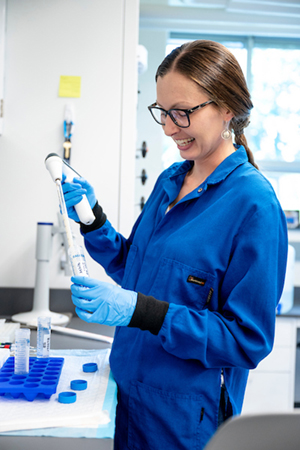
Villanova, Pa—Chores are a normal part of everyday life, even for the tiniest organisms. Cells must take out the trash, too, and Villanova University Biology Professor Sarah Fritz, PhD, studies how they know what to throw away.
Dr. Fritz has been awarded a $396,941 grant from the National Institutes of Health (NIH) to support her research examining how cells identify and eliminate defective RNA, enhancing our knowledge of gene expression regulation and potentially informing the development of advanced therapeutic strategies for genetic diseases.
“Being awarded an NIH grant is a tremendous honor,” says Dr. Fritz. “It is a recognition that our nation’s leading sponsor of biomedical research finds the work being conducted in my laboratory exciting, innovative and capable of advancing our understanding of human health and disease.”
DNA serves as a cell’s genetic blueprint, containing instructions that guide the organism’s functions. DNA is then transcribed into RNA that ultimately determines how genes are expressed and translated into functional proteins. But, like any complex process, mistakes can occur. Mutations in DNA and errors in RNA processing can generate defective RNAs that produce abnormal proteins with potentially detrimental effects on cellular function.
To protect themselves, cells use a surveillance pathway called nonsense-mediated decay (NMD), which recognizes and selectively breaks down faulty RNAs. Dr. Fritz and her student researchers study this quality control process and how cells distinguish between “right” and “wrong” RNA.
“This project focuses on the central commander of the NMD pathway, the RNA helicase UPF1, and how it controls RNA decay target selection,” explains Dr. Fritz. “Specifically, we are investigating how a conserved structural feature within the core of UPF1, known as the regulatory loop, modulates its affinity for RNA and, consequently, determines which RNAs are targeted for decay.”
Because mutations that activate NMD are estimated to contribute to nearly one-third of human genetic diseases, Dr. Fritz’s research could provide valuable insight into the molecular mechanisms underlying these conditions and help guide future research on new treatments.
The NIH grant will also expand opportunities for Villanova students to gain hands-on research experience. Two undergraduate students will receive support to conduct full-time research in the Fritz Lab for three consecutive summers and present their findings at the Annual Meeting of the RNA Society, an international conference for experts in the field of RNA biology.
The grant further supports the development of a course-based undergraduate research experience, providing additional students in Dr. Fritz’s Molecular Biology course with the opportunity to engage in research with real-world impact and learn sophisticated techniques such as RNA sequencing.
“Together, these activities will not only provide the resources needed to advance research in my laboratory, but will also expand and strengthen the research, career development and educational opportunities available to Villanova students,” says Dr. Fritz.
About Villanova University’s College of Liberal Arts and Sciences: Since its founding in 1842, Villanova University’s College of Liberal Arts and Sciences has been the heart of the Villanova learning experience, offering foundational courses for undergraduate students in every college of the University. Serving more than 4,500 undergraduate and graduate students, the College is committed to fortifying them with intellectual rigor, multidisciplinary knowledge, moral courage and a global perspective. The College has more than 40 academic departments and programs across the humanities, social sciences, and natural and physical sciences.

“Boundless” is a publication that illustrates the extraordinary accomplishments of our students and faculty with examples of their collaborative research, innovative teaching and outstanding scholarship.