
VILLANOVA PROFESSORS NAMED TO ENDOWED CHAIRS IN BIOLOGY AND ENGLISH
Villanova, Pa.—From studying coastal ecosystems’ response to environmental change to uncovering the complexities of literature and language, Villanova University College of Liberal Arts and Sciences professors Samantha Chapman, PhD, and Megan Quigley, PhD, are advancing knowledge in subjects that deepen our understanding of the past and inform the future. This fall, both faculty members have been appointed to endowed chair positions in recognition of their scholarly contributions to their fields and in support of their continued research and teaching.

Dr. Chapman, professor of Biology and co-director of the Center for Biodiversity and Ecosystem Stewardship, has been named the Gerald M. Lemole Endowed Chair in Integrative Biology. A coastal ecosystem ecologist, Dr. Chapman studies how sea level rise, warming and nutrient additions affect coastal wetlands. As principal investigator of the National Science Foundation funded project, “The Interplay of Nitrogen Loading and Ecosystem Sustainability in Threatened Wetlands,” Dr. Chapman and an interdisciplinary team of scientists, land managers and environmental educators examine how changing environmental conditions are shaping mangroves and marshes in St. Augustine, Florida. High levels of nitrogen from fertilizer, septic tanks and cities harm fish and manatees, among many other negative effects. Dr. Chapman’s project aims to learn more about the effect nutrient pollution has on these coastal wetlands and how ecosystems can help remove nutrients for a more sustainable future.
“I’m honored to hold the Lemole Chair and plan to use this position to continue to train young scientists to solve our Earth’s problems,” says Dr. Chapman.
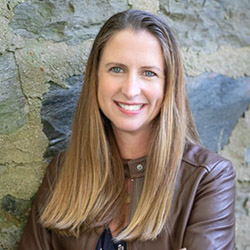
Dr. Quigley, professor of English, has been named the Luckow Family Endowed Chair in English. Dr. Quigley’s scholarship spans literature, language and philosophy, with a focus on literary modernism—a movement in the late 19th to mid-20th century in which experimental forms, structures and styles emerged as writers broke from traditional storytelling. Her current research extends debates in early 20th-century philosophy of language to contemporary questions about impersonality, authorship, and machine learning. As an affiliated faculty in Irish Studies and Gender and Women’s Studies, Dr. Quigley’s research and courses also examine 20th century British and Irish fiction and the relationship between philosophy and fiction. She is the author of Modernist Fiction and Vagueness: Philosophy, Form, and Language (2015), and essays on a wide range of subjects including Ludwig Wittgenstein’s philosophy, Irish modernism, the #MeToo movement, Henry James, and French translations of James Joyce’s Finnegans Wake. She is the co-editor of Eliot Now (2024), a collection of revisionary approaches to the works of T. S. Eliot. Her current book project is titled The Love Song of Modernism: Impersonality and AI.
“I am very grateful to the Luckow Family for this endowed chair that provides the chance to present lectures at University of Oxford and University of Exeter this year,” says Dr. Quigley. “I am also so thankful for the resources to research AI and speculative fiction at a time when AI is transforming our classrooms and our lives.”
At Villanova, Drs. Chapman and Quigley engage students in their scholarship through faculty-mentored research and thesis advising, providing opportunities for students to pursue their intellectual curiosity and develop valuable skills.
About Villanova University’s College of Liberal Arts and Sciences: Since its founding in 1842, Villanova University’s College of Liberal Arts and Sciences has been the heart of the Villanova learning experience, offering foundational courses for undergraduate students in every college of the University. Serving more than 4,500 undergraduate and graduate students, the College is committed to fortifying them with intellectual rigor, multidisciplinary knowledge, moral courage and a global perspective. The College has more than 40 academic departments and programs across the humanities, social sciences, and natural and physical sciences.

“Boundless” is a publication that illustrates the extraordinary accomplishments of our students and faculty with examples of their collaborative research, innovative teaching and outstanding scholarship.