
Villanova Biology Professor Receives NSF Grant to Study Chemical Communication in Lizards
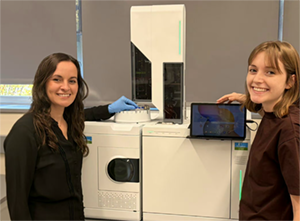 Stephanie Campos, PhD, and research technician Sophie Connolly in front of the gas chromatography-mass spectrometry equipment that was purchased, in part, with funds from the National Science Foundation grant.
Villanova, Pa.—Chemical signaling is one of the oldest forms of communication among living organisms, allowing animals to transmit messages through the air, water and across surfaces. Despite its widespread use throughout the animal kingdom to attract mates, mark territory and ward off potential threats, little is known about how hormones and environmental conditions interact to shape this method of communication. With support from a $423,192 grant from the National Science Foundation (NSF), Stephanie Campos, PhD, assistant professor of Biology, is investigating how hormones and humidity influence chemical signaling in lizards.
Dr. Campos’ project, “Scents and sensibility: The impacts of vasotocin and humidity on chemical communication in lizards,” focuses on arginine vasotocin (AVT), a hormone that regulates both water balance and social behavior. She and her research team are investigating whether humidity affects AVT’s influence on chemical signals, as well as the effects on the receiving animal’s brain and behavior.
“People often ask me, ‘Why lizards?’ Lizards offer a valuable perspective on the evolution of biological systems that humans also share,” says Dr. Campos. “Vasotocin is closely related to mammalian vasopressin or the human antidiuretic hormone. Studying how this ancient family of chemical messengers functions in lizards from contrasting habitats can help us understand how evolution has shaped the connections between basic physiological needs and social interactions.”
The study compares desert spiny lizards and eastern fence lizards, species that inhabit environments with dramatically different moisture levels. Researchers examine whether altering AVT in a male lizard changes other males’ behavioral and brain responses to its scent. The team also manipulates humidity and analyzes the chemical composition of scent secretions to determine how rapidly the signals change, seeking to better understand how animals communicate while adapting to their surroundings.
As a teacher and scholar, Dr. Campos is passionate about mentoring the next generation of scientists and health professionals. The grant supports student participation in her field and lab research, providing funding for six undergraduate summer research experiences and conference attendance to present their work. Six additional undergraduates work on the project during the academic year with opportunities to develop senior theses and coauthor scientific publications. Dr. Campos is also creating a chemical ecology workshop for graduate students to gain hands-on experience analyzing the compounds lizards use to communicate.
“One of the greatest privileges of this work is sharing my fascination with animal behavior with Villanova students,” she says. “This award will help me give them fully-funded opportunities to experience how asking a question can lead to discovery—and to see themselves as contributors to that process. I feel fortunate to build a career exploring the wonderfully strange aspects of biology, and I take seriously the responsibility to make those discoveries accessible and inspire curiosity in others.”
About Villanova University’s College of Liberal Arts and Sciences: Since its founding in 1842, Villanova University’s College of Liberal Arts and Sciences has been the heart of the Villanova learning experience, offering foundational courses for undergraduate students in every college of the University. Serving more than 4,500 undergraduate and graduate students, the College is committed to fortifying them with intellectual rigor, multidisciplinary knowledge, moral courage and a global perspective. The College has more than 40 academic departments and programs across the humanities, social sciences, and natural and physical sciences.
“Boundless” is a publication that illustrates the extraordinary accomplishments of our students and faculty with examples of their collaborative research, innovative teaching and outstanding scholarship.