
In Rome, CLAS Scholars Explore Sustainability Across Disciplines and Through Community
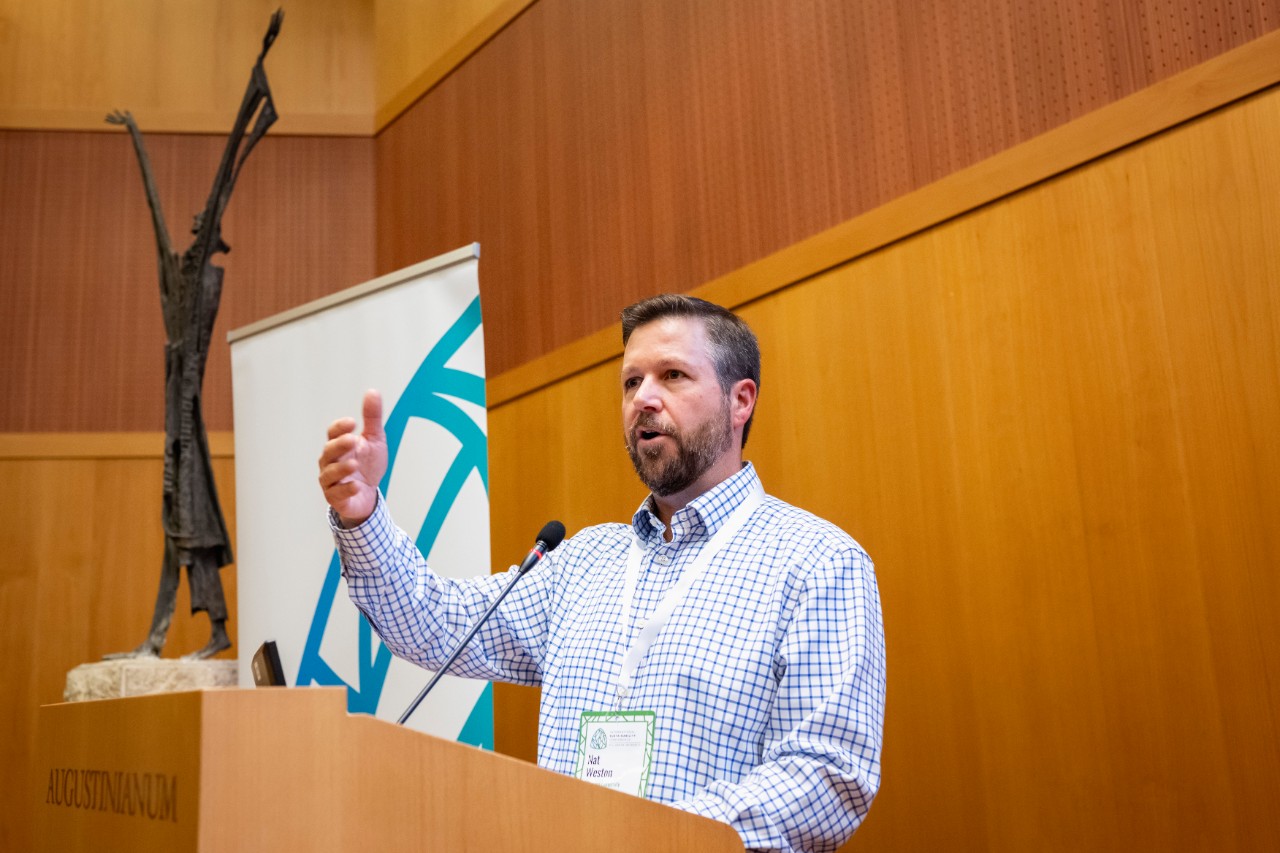 Nathaniel Weston, PhD, speaks at Villanova's International Sustainability Conference in Rome in October 2026.
Villanova, Pa.— What does it mean to care for the planet and the people who depend on it? More than 20 faculty members, current students and alumni from Villanova’s College of Liberal Arts and Sciences joined over 350 scholars, leaders and practitioners from around the world in Rome October 12-15 to explore that question at the University’s International Sustainability Conference.
Grounded in Pope Francis’ writings in both Laudato Si’ and Laudate Deum, and in the teachings of Pope Leo XIV in his call in Dilexi Te to care for the poor and marginalized, the 2026 International Sustainability Conference is framed by the growing convergence of ecological degradation and social inequality.
Held at the Patristicum in Rome under the theme “Responding to the Cry of the Earth and the Cry of the Poor,” the conference’s academic program explored the connections between environmental sustainability, human dignity and social responsibility, bringing diverse perspectives to some of the most pressing challenges facing our world.
For CLAS participants, the gathering offered not only an opportunity to share their work with an international audience, but also to consider how it might contribute to a sustainable future.
Theology doctoral student William Kuncken presented “Bestiae Magnificae: On the Grandeur and Wisdom of the Wild [A Villanova Eco-Theologian’s Response to Magnifica Humanitas].” It’s a paper he developed from a larger essay written under the guidance of the Rev. John Abubakar, OSA, PhD, Villanova’s Chief Sustainability Officer, who serves as a reader on Kuncken’s dissertation committee. “Magnifica Humanitas: On Safeguarding the Human Person in the Time of Artificial Intelligence” is Pope Leo XIV’s latest encyclical.
Kuncken’s work considers how biblical interpretation and Catholic Social Teaching can broaden our understanding of humanity’s place within our natural world.
“I deeply appreciated the interdisciplinary and global perspectives at the conference,” Kuncken said. “The organizers made considerable efforts to include a wide range of expertise from across the global church. I especially appreciated being able to connect with scholars outside of my academic discipline who engage in complementary work that related to my research.”
For example, Kuncken said he spoke with an engineering doctoral student who examined the effects and impact of petrochemicals and microplastics, a key issue related to Kuncken’s dissertation.
For Nathaniel Weston, PhD, professor and Chair of the Department of Geography and the Environment, the conference provided an opportunity to connect years of research on coastal ecosystems with a broader discussion about environmental responsibility and communities affected by climate change.
Dr. Weston presented “Grace Before the Threshold: Ecological Resilience in an Age of Human Disturbance,” which explored how coastal wetlands respond to sea-level rise and what their resilience can teach us about our relationship with the natural world.
He said the conference was personally meaningful because it allowed him to participate in several different ways: as a scientist sharing research developed over many years, as a member of Villanova’s academic community, and as someone helping to organize the conference.
“Sharing my work in Rome was both energizing and humbling,” Dr. Weston said. “I was presenting a specific ecological story about salt marshes, but the conference placed that research within a much larger conversation about justice, human dignity, faith and our responsibility to one another.
“It reminded me that scientific evidence matters most when it helps people understand what is at stake and make better decisions,” he said.
Dr. Weston noted a particular moment that was impactful for him: the remarks of keynote speaker Wanjira Mathai, who observed that science is no longer the central point of dispute and that many of the tools we need already exist.
“The harder challenge is moral: whether we are willing to act, and whether we will allow people who contributed least to environmental damage to bear its greatest consequences,” said Dr. Weston, who also noted keynote speaker Dr. Robert Bullard’s call for more listening, more research in service of communities and more action reinforced that message. Bullard is the founding director of the Bullard Center for Environmental and Climate Justice and a Distinguished Professor of Urban Planning and Environmental Policy at Texas Southern University.
“Together, those remarks prompted me to think more carefully about what scientific work is for and how researchers can connect evidence to action,” he said.
Dr. Weston’s reflections on the relationship between environmental sustainability and human dignity echoed a broader theme of the conference: meaningful change depends not only on understanding complex challenges, but also on how people relate to one another and work together.
For Anne Minicozzi, a part-time faculty member who teaches first-year students in the Augustine and Culture Seminar Program at Villanova and a Theology doctoral student, that idea connected directly to her research. In her presentation, “Lonergan’s ‘Morally Converted Human Being’ as ‘Sustainer’: A Potential ‘Heuristic of Neighborliness',” she drew on the work of Jesuit theologian Bernard Lonergan to explore how personal conversion can deepen our appreciation for our relationships with others and encourage more sustainable ways of living.
Minicozzi found a real-world connection to those ideas during a panel discussion featuring Bill Coble, co-founder of the nonprofit Start With One Kenya. Coble spoke about the challenges of beginning a new partnership and the importance of approaching potential partners authentically. His comments resonated with Minicozzi’s research, which considers how people can move toward more authentic relationships and action.
For Minicozzi, the conference reflected the value of bringing people together across disciplines, institutions and communities.
Referencing Conference keynote speaker and "Father of Environmental Justice" Dr. Robert D. Bullard, Minicozzi observed, “When a Villanova conference held in Rome connects our University and Main Line community and the world, that might be what Dr. Bullard is talking about when he speaks of the benefits of ‘communiversity.’”
CLAS faculty, students and alumni represented numerous academic disciplines at the conference, including Theology, Philosophy, Computing Sciences, Environmental Science, Ethics, Political Science, Biology and Chemistry.
Across the conference, the experiences of members of Villanova’s CLAS community reflected a shared conviction: addressing sustainability requires both a clear understanding of the challenges and a willingness to work together across traditional boundaries.
“I was struck by the sense of shared purpose and genuine joy at the conference, even as we confronted difficult realities,” Dr. Weston said. “Hearing participants from different countries, cultures and fields engage seriously with one another made the work feel less isolated.”
About Villanova University’s College of Liberal Arts and Sciences: Since its founding in 1842, Villanova University’s College of Liberal Arts and Sciences has been the heart of the Villanova learning experience, offering foundational courses for undergraduate students in every college of the University. Serving more than 4,500 undergraduate and graduate students, the College is committed to fortifying them with intellectual rigor, multidisciplinary knowledge, moral courage and a global perspective. The College has more than 40 academic departments and programs across the humanities, social sciences, and natural and physical sciences.
“Boundless” is a publication that illustrates the extraordinary accomplishments of our students and faculty with examples of their collaborative research, innovative teaching and outstanding scholarship.