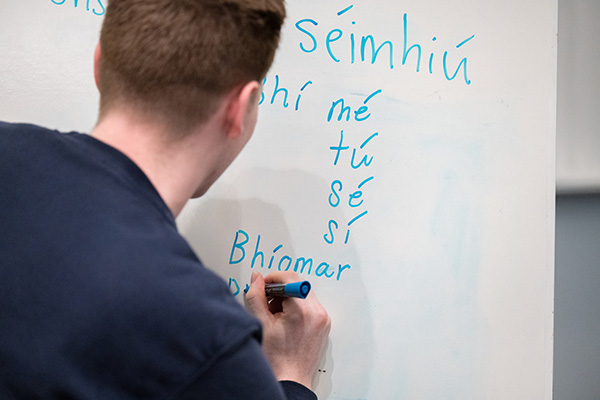
Gaelic is an old language. Scholars theorize it arrived around 500 B.C. before written sources, says Dr. O’Neill. It’s deeply woven into Irish literature, history and culture. However, it is a minority language. In the Republic of Ireland, about 1.8 million people claim to know some Gaelic, but the number of people who speak it daily is much smaller. That number may be as low as 60,000 – 70,000. The language is still compulsory in the primary and secondary school systems in Ireland, because there is value in keeping it alive.
“There are all sorts of knowledge—local knowledge, sustainability knowledge—that can be stored in indigenous languages,” says Dr. O’Neill.
Maeve made this connection, too, at first when she was studying abroad in South Africa.
“I think they have 19 official languages. I couldn't even fathom that they are so different from the Romance languages, and it opened my eyes to how diverse language actually is,” she says.
Maeve took a conservation course as part of her Geography major during the same semester she was taking Gaelic. The course was focused on conserving endangered species using modeling software.
“While people were choosing plants and animals, for my final project I focused on global endangered languages,” she says. She used different techniques to trace the threats to language and identify potential factors, such as environmental factors, that may put some languages at greater risk of extinction.
“That was a novel use of conservation software. It opened my eyes to not only linguistics in general but also how I can diversify the skills that I already have within my major.”
Maeve submitted her final paper to two journals.
Despite its status as a minority language, the diversity of Irish speakers has expanded.
“Modern Ireland is a diverse, multicultural community, and we have many language speakers and language advocates who are coming from new Irish communities,” says Dr. O’Neill. “People are coming from Nigerian Irish backgrounds or Vietnamese Irish backgrounds or any number of other backgrounds.”
This diversity is important for Dr. O’Neill to impress upon his students. Contemporary Irish society is multicultural, and he integrates that into his literature and culture classes as well.
“While of course I welcome students from an Irish heritage, it's important that any student on campus who has an interest in the language can come to class and feel like they are included.”