New Certificate Prepares HR Professionals to Lead the Future of AI in the Workplace
As artificial intelligence continues to reshape nearly every industry, Villanova University’s graduate program in Human Resource Development is launching a certificate designed to help HR professionals guide its implementation responsibly and strategically.
Artificial intelligence already influences how organizations hire, develop and engage their people. As adoption of the technology accelerates and evolves, one question remains unresolved: who is responsible for guiding its use? Villanova’s graduate program in Human Resource Development posits that HR professionals are uniquely positioned to lead AI implementation in organizations.
In Fall 2026, the program will launch the 15-credit Artificial Intelligence for HR certificate, emphasizing both technological literacy and human-centered practice. Courses like Leading Ethics and Governance, Workforce Technology and Strategic Workforce Planning prepare students to understand how AI works while also equipping them to evaluate its impact, guide implementation and align it with organizational values.
Rather than focusing narrowly on tools or coding, the curriculum provides rigorous study of the skills needed to integrate AI into HR functions thoughtfully, and to lead conversations that balance innovation with responsibility.
“Technology will continue to evolve, but the most important decisions about AI will always be human decisions,” said Bethany J. Adams, assistant professor of practice and associate director of program engagement, who led the development of the new certificate. “Our goal is to prepare HR professionals to navigate those decisions thoughtfully, ensuring AI enhances rather than diminishes the human experience at work.”
HRD at Villanova maintains its sharp focus on what contemporary professionals need by mining real world experiences. In a series of focus groups hosted by the program this year, senior HR leaders, consultants, executives and students gathered to reflect on the influence of generative and agentic AI in their workplaces. Participants described a landscape of uneven adoption where decisions about AI are inconsistent and often subjective.
Several leaders expressed a growing tension between how employees and organizations define productivity: employees use AI to complete work more efficiently while maintaining existing expectations, while employers view AI as a means to expand output. This disconnect introduces new questions about performance, fairness and the evolving nature of work—all questions that HR professionals are uniquely positioned to answer.
The certificate addresses these emerging challenges by preparing students to develop AI governance policies, evaluate new workplace technologies and cultivate the human skills that remain essential in an increasingly automated environment, including critical thinking, communication and emotional intelligence.
About Villanova University’s College of Liberal Arts and Sciences: Since its founding in 1842, Villanova University’s College of Liberal Arts and Sciences has been the heart of the Villanova learning experience, offering foundational courses for undergraduate students in every college of the University. Serving more than 4,500 undergraduate and graduate students, the College is committed to fortifying them with intellectual rigor, multidisciplinary knowledge, moral courage and a global perspective. The College has more than 40 academic departments and programs across the humanities, social sciences, and natural and physical sciences.
Office of Graduate Studies
College of Liberal Arts and Sciences
Villanova University
Vasey Hall - Suite 202
SCHEDULE YOUR CAMPUS TOUR
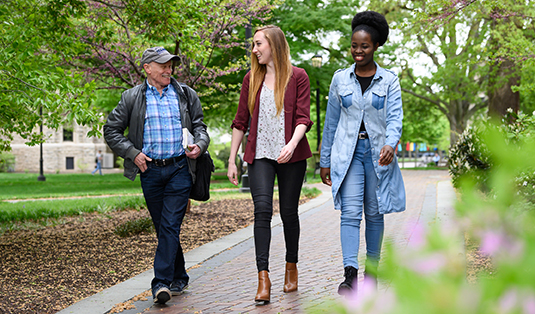
The CLAS Office of Graduate Studies offers personal tours of the beautiful Villanova campus. All tours begin in the Graduate Studies Office, located in Vasey Hall.
Schedule your tour!
FOLLOW GRADUATE STUDIES