
Ecologically Engaged: One Villanovan’s Passion for Environmental Service
A passion for asking questions—and finding answers—has taken Melissa A. Pastore, PhD, ’15 MS from Villanova’s Biology program to a career studying the health and future of America’s forests.

A love of learning can take you to remarkable places. For Melissa A. Pastore, PhD, ’15 MS, it’s a trait that has carried over from her time as a graduate student in Biology at Villanova University to an exciting career as a research ecologist with the U.S. Forest Service.
Some of her clearest memories of graduate school involve a laptop, a question and a quick trip down the hall. Whenever she encountered something unexpected in her research, Pastore would head to the office of her mentor, Professor of Biology Adam Langley, PhD, eager to figure it out.
“I have many memories of running down the hall from the lab to his office, laptop precariously in hand, with a new burning question about my analyses,” she says. “We would sketch back-of-the-envelope calculations and conceptual diagrams or sit together at the computer exploring data.”
Those moments of discovery helped shape the approach to research that continues to guide Pastore today. In her current role, she studies the ways environmental stressors, disturbances and global change affect ecosystems. Pastore works in the Forest Service’s Forest Inventory and Analysis program, often called the nation’s forest census. The program collects and analyzes data on the condition of forest resources across the United States.
Her work includes two primary reporting roles. As the National Soil Quality Indicator Advisor, Pastore helps guide a nationwide program monitoring the physical and chemical properties of forest soils. She also serves as the program’s state analyst for New Hampshire, studying forest conditions and trends and working with state partners on required reports.
Alongside those responsibilities, Pastore conducts independent research, often in collaboration with universities and other partners. Her work has explored forest regeneration, soils, snow refugia and the effects of cold-air pooling on forests.
One project, which began during her postdoctoral work, produced a particularly surprising finding. Pastore studied cold-air pooling, a process in which cooler air settles into valleys and creates localized temperature differences.
“I was surprised by how common and frequent cold-air pooling was across the sites I studied, and how strong some of the resulting temperature gradients were,” Pastore says.
In areas where cold-air pooling was strongest, she found forest composition patterns that were sometimes the reverse of what might typically be expected based on elevation. Those cooler pockets could provide important refuges for cold-adapted species as temperatures continue to rise.
The research may also have broader implications. In addition to supporting vulnerable species, these forest communities can contribute to other ecosystem functions, including carbon storage and recreation.
While her current work is primarily computer-based, involving a mix of meetings, data analysis, reading, planning and writing, Pastore’s path has taken her through a wide range of research environments. That flexibility, she says, began at Villanova.
Her thesis was the first time she led an independent research project at scale, giving her experience with field and laboratory methods, statistical analysis, data visualization, writing and scientific communication.
“Just as importantly, I learned how to develop research questions and think critically about data,” Pastore says.
A statistics course provided a foundation in coding and data analysis that she still uses today. She also gained field and laboratory experience through research at the Smithsonian Environmental Research Center and explored a completely different ecosystem through a tropical field ecology course co-taught by Langley.
Together, those experiences helped Pastore become less focused on studying a single type of ecosystem and more interested in the questions that could be explored across many of them.
“I’ve worked in wetlands, grasslands and a variety of forest types, but the overarching theme of my research has been consistent,” she says. “Overall, Villanova gave me both the technical foundation and the confidence to adapt across different research environments.”
About Villanova University’s College of Liberal Arts and Sciences: Since its founding in 1842, Villanova University’s College of Liberal Arts and Sciences has been the heart of the Villanova learning experience, offering foundational courses for undergraduate students in every college of the University. Serving more than 4,500 undergraduate and graduate students, the College is committed to fortifying them with intellectual rigor, multidisciplinary knowledge, moral courage and a global perspective. The College has more than 40 academic departments and programs across the humanities, social sciences, and natural and physical sciences.
Office of Graduate Studies
College of Liberal Arts and Sciences
Villanova University
Vasey Hall - Suite 202
SCHEDULE YOUR CAMPUS TOUR
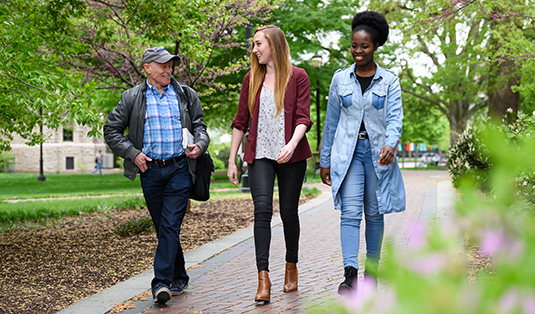
The CLAS Office of Graduate Studies offers personal tours of the beautiful Villanova campus. All tours begin in the Graduate Studies Office, located in Vasey Hall.
Schedule your tour!
FOLLOW GRADUATE STUDIES