
Building Connections: Applied Statistics and Data Science Mentorship Program Opens Doors for Graduate Students
Meaningful faculty relationships are helping APSDS graduate students build confidence, explore career possibilities and find their place in a supportive academic community.

Sometimes a single conversation can change how a student sees the road ahead. Other times, it’s the steady encouragement of someone who takes an interest in the journey along the way.
For Casey Ford ’27 MS, a graduate student in Villanova University’s Applied Statistics and Data Science program, that support comes from a faculty mentor, Jiangtao Gou, Ph.D. Throughout the academic year, Ford explained, Dr. Gou regularly checks in by email to see how things are going, makes time to meet over lunch, and sends internship opportunities that align with Ford’s interests.
“Having someone who is familiar with the field and can point me toward these opportunities is incredibly valuable,” Ford said. “Our conversations also help me become more intentional about my professional development. It can be easy to get caught up in coursework, but having someone who encourages me to think beyond my immediate academic responsibilities helps me stay engaged with my longer-term goals.”
Graduate education is about more than what students learn in the classroom. It’s also about the relationships they build and the guidance they receive that helps them envision what’s possible beyond their degree. In the Applied Statistics and Data Science graduate program, a faculty mentorship initiative is helping students make those connections, pairing graduate students with faculty members who offer individualized guidance, professional advice and support as they navigate their academic and career journeys.
Launched five years ago, the voluntary, yearlong program grew out of something Applied Statistics and Data Science faculty already valued: close relationships with students and the opportunity to provide individual attention. But with classes meeting primarily in the evening, graduate program director Yimin Zhang, Ph.D., recognized that students wanted more opportunities to engage with faculty outside the classroom.
“Our APSDS program at Villanova has always valued close faculty-student relationships and small class sizes that allow us to give students individual attention. This is what ultimately distinguishes our program from many online programs and larger hybrid or in-person programs,” Dr. Zhang said. “However, because our classes meet only in the evening, interactions between faculty and students often occur immediately before or after class.”
It’s common for one of Dr. Zhang’s classes to end at 8:45 p.m., but she continues talking with students until as late as 10 p.m.
“These conversations revealed a strong desire among both faculty and students for deeper engagement beyond the classroom. That inspired us to establish the APSDS mentorship program,” she said.
Each summer, incoming and current graduate students are invited to apply for the program, sharing their backgrounds and interests, along with what they hope to gain from a mentoring relationship. Faculty members also volunteer to serve as mentors for the upcoming academic year. Students review profiles of participating faculty and identify their top two choices, with Dr. Zhang making the final matches based on student preferences and backgrounds.
The program brings together approximately 10 student applicants and six or seven faculty volunteers, with each faculty member mentoring one or two students. Throughout the year, mentors and mentees are encouraged to meet regularly, whether over coffee, lunch or a conversation about academic and professional goals. The program also provides each pair with two meal vouchers per semester to help make those interactions more relaxed and personal.
For graduate student Kyle Nguyen ’27 MS, the opportunity to build a relationship with Dr. Zhang was especially meaningful as he adjusted to graduate school and a new life on the East Coast. Their relationship has become an important source of guidance as Nguyen explores opportunities in his field.
Nguyen said Dr. Zhang helped him secure funding to attend his first biostatistics conference through recommendation letters, and she has encouraged him to think critically about his academic and professional interests.
“There was one time I talked to Dr. Zhang about my intention to apply for a Ph.D. in Operation Research. She spent time helping me break down my interest in the field, and two hours later, she sent me the contact that is in the field and set up a meeting with him,” Nguyen said.
The experience has helped Nguyen gain a clearer sense of his interests and the direction he wants to take after earning his master’s degree. He credits the conversations with his mentor, along with opportunities to meet professionals and attend conferences, with helping him better understand his options.
Ford, who said she did not come to Villanova with a background in mathematics or statistics, was initially drawn to working with Dr. Gou because of his experience in biostatistics, an area Ford hoped to explore.
“It was intimidating to enter graduate school in a program where I felt less prepared than many of my peers,” Ford said. “Having an additional mentoring relationship with Dr. Gou alongside my coursework helped me realize how approachable and supportive the faculty are, regardless of someone’s background or prior experience.”
“Graduate school can sometimes feel a little isolating, especially when students have such different schedules and responsibilities outside of school. Having a mentor gives you a built-in opportunity to stay connected with the department and feel more like part of a community,” she said.
For Dr. Zhang, experiences like these illustrate why mentorship is such an important complement to graduate education. Students are sometimes at a transitional point in their lives, deciding whether to enter the workforce, pursue doctoral study or explore new professional directions. While coursework provides the technical knowledge and skills they need, navigating those decisions often requires a different kind of guidance.
Mentors can help students consider career options, evaluate opportunities, build professional networks and approach an evolving job market with greater confidence. The benefits, Dr. Zhang noted, extend to faculty members as well. Mentors gain a better understanding of their students' experiences, interests and challenges, while those relationships can also help faculty identify opportunities to strengthen the program's curriculum, advising and career support.
Ultimately, the initiative reflects a broader commitment within the program—and graduate studies in the College of Liberal Arts and Sciences as a whole—to creating a graduate experience where students feel supported not only as scholars, but as individuals preparing for what comes next.
“For many mentees, the master’s degree will be their terminal degree. The relationship they develop through our program may be the last ‘unconditional’ non-work-related mentorship they experience. A strong mentoring relationship at this critical stage can therefore have a meaningful and lasting influence on their lives,” Dr. Zhang said.
About Villanova University’s College of Liberal Arts and Sciences: Since its founding in 1842, Villanova University’s College of Liberal Arts and Sciences has been the heart of the Villanova learning experience, offering foundational courses for undergraduate students in every college of the University. Serving more than 4,500 undergraduate and graduate students, the College is committed to fortifying them with intellectual rigor, multidisciplinary knowledge, moral courage and a global perspective. The College has more than 40 academic departments and programs across the humanities, social sciences, and natural and physical sciences.
Office of Graduate Studies
College of Liberal Arts and Sciences
Villanova University
Vasey Hall - Suite 202
SCHEDULE YOUR CAMPUS TOUR
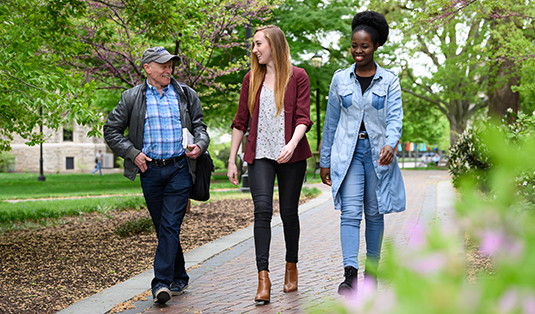
The CLAS Office of Graduate Studies offers personal tours of the beautiful Villanova campus. All tours begin in the Graduate Studies Office, located in Vasey Hall.
Schedule your tour!
FOLLOW GRADUATE STUDIES