
The Psychology of AI: Exploring the Why Behind the Use of Artificial Intelligence
Some turn to AI for answers. Others use it to spark creativity or even find companionship. What motivates these different interactions? Hai-Yan Koenig ’25 CLAS, ’27 MS is researching the psychology behind AI use and what our personalities may reveal about our relationship with this rapidly evolving technology.

These days, the question surrounding artificial intelligence is no longer whether people are using it, but how and why. Tools like Copilot, Claude and ChatGPT are becoming an increasingly familiar part of everyday life, and the motivations behind our engagement with these technologies may reveal something about our personalities.
That’s what Villanova University graduate Psychology student Hai-Yan Koenig ’25 CLAS, ’27 MS is exploring in research she recently presented at the College of Liberal Arts and Sciences Graduate Research Symposium. In “ChatGPT and Me: Validating the AI Use Survey and Identifying Associations with Personality Traits,” Koenig examines the relationship between personality, AI engagement and attitudes toward its use.
“Those who reported being more curious and artistic were less likely to use AI,” Koenig said.
She said the most interesting and unexpected result came from analyzing how AI use related to the three facets of Open-Mindedness: Intellectual Curiosity, Aesthetic Sensitivity and Creative Imagination. Intellectual Curiosity and Aesthetic Sensitivity negatively predicted AI use, while Creative Imagination positively predicted AI use.
“These results were especially interesting given that these are related concepts. However, part of Creative Imagination is finding inventive, original ways to do things,” Koenig said. “To those high in Creative Imagination, AI might be seen as a fascinating new technology that provides new ways to problem-solve and engage in the digital world. To those high in Intellectual Curiosity and Aesthetic Sensitivity, AI may be viewed as a threat to intellectual integrity and human artistry. This could be one interpretation of the results I found.”
To conduct the study, Koenig developed a survey designed to measure not only how frequently people engage with AI, but also the specific ways they use it, from searching for information to generating images and writing academic material. She recruited 249 young adult participants through the online research platform Prolific, who completed the AI Use Survey along with established questionnaires measuring personality traits and attitudes toward artificial intelligence.
Koenig then analyzed the responses to evaluate the survey’s reliability and identify potential relationships between personality characteristics, AI use and attitudes toward the technology.
“I think that the results provide evidence that a person’s interests and values, driven by personality, can influence their AI use,” she said. “For example, those high on Intellectual Curiosity and Aesthetic Sensitivity heavily engage with complex thinking and artistic pursuits- elements of life threatened by AI use. It is thus unsurprising that these same individuals would be less likely to use AI and more likely to feel negatively towards it.”
Koenig said she’s been a staunch advocate against AI, citing environmental harm and intellectual integrity. Since its use is so widespread, Koenig said now is the time to investigate what draws people to AI and what the implications of AI use are for development learning, and social and cognitive skills.
“I think that research should investigate what characteristics outside of personality may motivate specific uses of AI,” she said, noting that individual differences in attention, stress, emotion regulation and social anxiety may all play a role in AI use.
Koenig plans to pursue a Ph.D. in psychology and become a psychology professor. She wants to continue to research development and technology use. Her master’s thesis is examining how student attention problems and beliefs in their own academic abilities (i.e., academic self-efficacy) may motivate using AI for university coursework.
As for her survey, Koenig said she hopes it will, “allow researchers to understand the nuances of AI use and to investigate the psychological implications of specific types of AI engagement, which is a growing topic in the literature.”
“My survey will also need to be revised as new ways of using AI are created and need to be investigated,” she said.
About Villanova University’s College of Liberal Arts and Sciences: Since its founding in 1842, Villanova University’s College of Liberal Arts and Sciences has been the heart of the Villanova learning experience, offering foundational courses for undergraduate students in every college of the University. Serving more than 4,500 undergraduate and graduate students, the College is committed to fortifying them with intellectual rigor, multidisciplinary knowledge, moral courage and a global perspective. The College has more than 40 academic departments and programs across the humanities, social sciences, and natural and physical sciences.
Office of Graduate Studies
College of Liberal Arts and Sciences
Villanova University
Vasey Hall - Suite 202
SCHEDULE YOUR CAMPUS TOUR
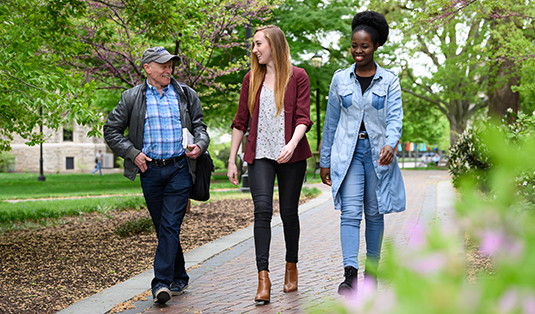
The CLAS Office of Graduate Studies offers personal tours of the beautiful Villanova campus. All tours begin in the Graduate Studies Office, located in Vasey Hall.
Schedule your tour!
FOLLOW GRADUATE STUDIES