
THE CHARLES A. HEIMBOLD JR. CHAIR
The Charles A. Heimbold, Jr. Chair of Irish Studies is held in the spring semester of each academic year by a distinguished Irish writer. Inaugurated in 2000, it has become one of the most prestigious Irish Studies positions in the United States.
The Heimbold Professor teaches students in Irish Studies and Creative Writing during their spring semester residency. Our students have the enriching experience of a close classroom experience with one of Ireland's finest voices—who also give presentation(s) or reading(s) on campus, including as part of the annual Villanova Literary Festival.
MEET THE CHAIR
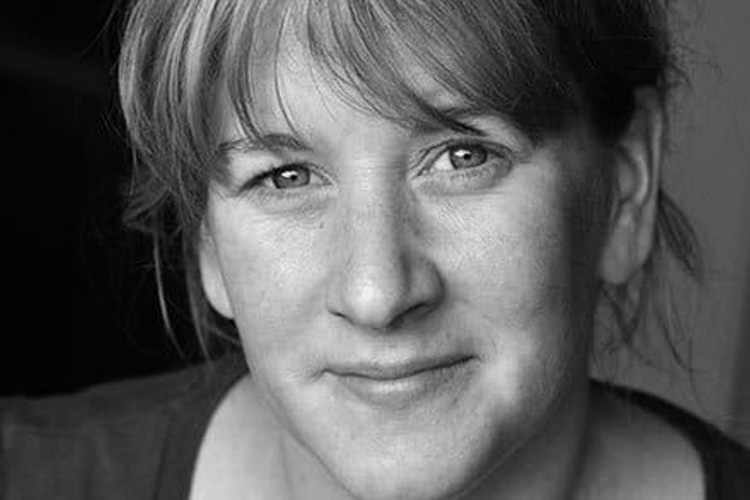
Northern Irish poet Leontia Flynn received her master’s degree from Edinburgh University and her PhD from Queen’s University Belfast. In the spring of 2027, she will serve as the Charles A. Heimbold Jr. Chair of Irish Studies at Villanova. She currently lives in Belfast and teaches at the Seamus Heaney Centre for Poetry at Queen’s University.
This year, Flynn published her selected poems with Carcanet Press—titled Selected Poems. This collection features work from her five poetry collections: These Days (2004), Drives (2008), Profit and Loss (2011), The Radio (2018), and Taking Liberties (2023). Each of her publications has been recognized by the literary community: These Days won the Forward Prize and was shortlisted for the Whitbread Award; Drives received favorable write-ups in The Guardian and other notable publications; Profit and Loss was shortlisted for the T. S. Eliot Prize; The Radio was shortlisted for the T. S. Eliot Prize and received The Irish Times Poetry Now Award. Her most recent volume, Taking Liberties was recognized in the Financial Times Best Books of 2023, the Irish Times Best New Poetry Collections of 2023, and favorably reviewed by many other notable publications. Flynn has also been awarded the Eric Gregory Award, the Rooney Prize for Irish Literature, the AWB Vincent American Ireland Fund Literary Award, and the Lawrence O’Shaughnessy Award for Poetry.
Flynn’s poetry displays her imaginative insights with an even-handed reverence and a light-hearted sense of humor. Her poem “Nina Simone is Singing” (featured in Taking Liberties) moves across time, place, and identity with a formal finesse. It evokes that feeling of singing along to a song that speaks to you. The tone, an even mix of awe and whimsy, emerges in interspersed quotes of Simone’s “long fifth note” that “extends, or rather extrudes”: “In my soli — tuuuuuude.” Like Simone’s delivery of “solitude,” this poem is stretched. This formal choice marks a stylistic shift away from both her earlier, shorter poems and the longer, more formal poems of Profit and Loss and The Radio. In my recent interview with Flynn, she noted that stretching out her poems simultaneously invokes nostalgic meditation and contemporary impressions of temporality—that is, moving indefinitely from one thing to the next like scrolling images on social media.
This poem also holds something that is dear to Flynn: solitude in private, interior spaces. For her, such spaces provide comfort, freedom, and independence. Her poetry examines the boundary between the internal—self, home, family—and the external—community, society, the world—and blends personal, at times confessional, writing with social, political, and literary criticism. Each book also illustrates a momentary way of being by melding personal content with formal preoccupations, like Catullus translations or sonnets.
In her first book, These Days, these themes were emerging. Flynn aimed to sketch a mind by reveling in the seemingly inconsequential. She used short poems to present “snapshots” of her life. In her later book, The Radio, Flynn applies experiments with length and form to these themes. It is organized into three sections, “The Child, the Family…”, “…and the Outside World,” and “Poems Conceived as Dialogues Between Two Antagonistic Voices.” The first section includes poems that reflect on Flynn’s own childhood, poems on her experiences of motherhood, and contemplations on family. “… and the Outside World” is similarly open-ended, including poems for friends and loved ones, tribute poems, political commentary poems, and literary criticism in verse. The final section holds perhaps the most formally experimental pieces in the collection, which lie somewhere between theater, poetry, and social commentary.
In our interview, Flynn spoke with me about her writing process. She said that writing is a child-like pursuit and that in order to do it, one must “keep it alive” and make the deliberate choice to indulge in playing with words. While parenthood means balancing writing with practical concerns, she said the experience had a meaningful impact on her creatively. She noted that, especially when her daughter was very young, being a parent “kept the world at bay” in a liberating way.
Motherhood has deepened Flynn’s fascination with our early relationships with our mothers and the drive to create poetry. During our interview, she conveyed her suspicion that early home experiences (and how we process them) affect our poetic practice more than any teachable techniques. But she does not discount the value of education for developing poets, especially when it comes to studying poetry and discovering why we love specific poems and poets.
She told me that she believes poetry should start from a place of “being excited to exist” that is “informed by the mad experiment in being alive that we all have.” She describes the “numinous” in poetry as an elusive essence that corresponds to a poem’s shape, form, music, pattern, or vibe. For her, it is the starting point around which everything else must fall into place when creating a poem. While her identity—as a mother, a woman, or a Northern Irish poet—has a meaningful impact on her feelings about the world, she says that these qualities do not inform a “pre-described idea” for her poetry. Instead, it is the “interior drive” to respond to these qualities via poetry that is most important.
Flynn has also published a number of essays and articles that study poetry through cultural and critical lenses. She enjoys reading novels—most recently, Ben Lerner’s short novel Transcription (2026)—and well-curated poetry anthologies. She finds tranquility in beginning her day by patiently reading a single poem, such as “Sandpiper” by Elizabeth Bishop, which she recommends that everyone read.
Flynn is excited to come to Villanova and is looking forward to the discoveries, changes, new people, and inspiring change of scenery that the Heimbold Chair position will hold for her.
2025: Stephen Sexton
2024: Emilie Pine
2023: Mary O'Donoghue
2022: Emma Dabiri
2021: Hannah Khalil
2020: Maurice Fitzpatrick
2019: Mike McCormack
2018: Colette Bryce
2017: Owen McCafferty
2016: Glenn Patterson
2015: Claire Kilroy
2014: Eamonn Wall
2013: Mary O'Malley
2012: Hugo Hamilton
2011: Moya Cannon
2010: John McAuliffe
2009: Gerald Dawe
2008: Claire Keegan
2007: Justin Quinn
2006: Sebastian Barry
2005: Michael Coady
2004: Conor O'Callaghan
2004: Vona Groarke
2003: Marina Carr
2002: Eamon Grennan
2001: Nuala Ni Dhomhnaill
2000: Peter Fallon
Director: Joseph Lennon, PhD
joseph.lennon@villanova.edu
Center Administrator: Danielle Redden
d.redden@villanova.edu
Administrative Assistant: Kiersten Ludy
kiersten.ludy@villanova.edu
FOLLOW THE CENTER FOR IRISH STUDIES