Selective Protection: Why State Transgender Athlete Bans Undermine Title IX and the Fourteenth Amendment
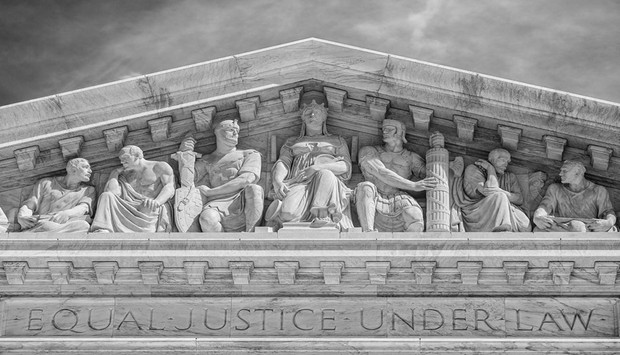
Photo Source: Thomas Hawk, Equal Justice Under Law, Flickr (Dec. 9, 2021) (CC BY-NC 2.0)
By: Skylar Glass* Posted 02/16/2026
On January 13, 2026, the United States Supreme Court heard oral arguments in two significant cases: West Virginia v. B.P.J.[1] and Little v. Hecox.[2] Each case centers on legal challenges to state laws that prohibit transgender women and girls from participating in women’s sports.[3] Each case affords the Justices the opportunity to reinforce the meaning and intent of Title IX and the Fourteenth Amendment to the United States Constitution by striking down such laws and committing to providing transgender athletes the protection guaranteed by each source of law.[4] Nevertheless, the Supreme Court appears likely to uphold the state bans.[5] As a result, transgender women athletes would be forced to either forgo meaningful competition or to play on boys’ teams, which notably conflicts with who they are.[6] Where the law should serve to protect these individuals, accepting these statutes would instead be used to prevent them from accessing the benefits of participating in sports offered by their schools.[7]
Virginia v. B.P.J.
In 2021, West Virginia passed HB 3293 titled “Save Women’s Sports Act” (“West Virginia Act”), requiring athletes at state institutions– including West Virginia’s National Collegiate Athletic Association (NCAA) colleges and public K-12 schools—to participate on teams that correspond with their biological sex at birth.[8] In response, Becky Pepper-Jackson (“BPJ”) brought suit after being told that the West Virginia Act kept her from participating on middle-school sports teams.[9] Specifically, BPJ was prohibited from participating in women’s and girls’ track and field and cross-country, despite her having undergone an estrogen-driven puberty and having never experienced any male puberty symptoms.[10] This fact is particularly relevant to BPJ’s argument because it refutes the commonly referenced critique that allowing transgender women to participate in women’s sports is biologically unfair, as that critique is premised on the assumption that transgender women possess biological advantages from male puberty—an assumption that does not apply to BPJ.[11]
BPJ’s legal arguments allege that the West Virginia Act violates Title IX and the Fourteenth Amendment to the United States Constitution.[12] Her Title IX claim argues that, as applied to her, the West Virginia Act discriminates on the basis of sex by treating her differently than similarly situated students solely because she is a girl who is transgender.[13] On the other hand, the Fourteenth Amendment claim hinges on the Equal Protection Clause, and it argues that the West Virginia Act violates this clause by unfairly discriminating against BPJ based on her status as a transgender female.[14] Conversely, West Virginia argues that Title IX permits designating sports on the basis of biological sex, and that the Equal Protection Clause is not violated because the West Virginia Act treats all transgender girls the same.[15]
Little v. Hecox
In 2020, Idaho enacted HB 500, known as the Fairness in Women’s Sports Act (“Idaho Act”), which bars transgender women and girls from participating on women’s sports teams at public schools and colleges.[16] Shortly after the Idaho Act’s passage, Lindsay Hecox, a transgender woman and Boise State University student, together with an anonymous cisgender female athlete from a public high school (“Jane Doe”), filed suit contesting the law.[17] Among other arguments, Hecox alleges that the Idaho Act creates too broad a categorical exclusion to satisfy any state interests, and Jane Doe argues that the Idaho Act subjected female athletes to potential scrutiny and stigma based upon physical appearance.[18]
Both plaintiffs contend that the Idaho Act violates the Equal Protection Clause.[19] Under the Fourteenth Amendment, the plaintiffs assert that the Idaho Act impermissibly targets transgender women for disparate treatment without a persuasive justification that such treatment justifies a state interest.[20] In response, Idaho maintains that its Act serves important governmental interests in promoting fairness and safety in women’s sports and therefore complies with Equal Protection principles.[21] Both this case and B.P.J. pose the following question: “Does Title IX or the Equal Protection Clause prohibit a state from assigning students to girls’ and boys’ sports teams based on their biological sex as determined at birth?”[22]
Sex, Sports, and the Cost of Classification
These cases illustrate a form of selective protection in which statutes ostensibly enacted to preserve fairness instead deny transgender athletes the very educational opportunities the spirit of Title IX was intended to safeguard.[23] Resolution of the Title IX claims turns largely on the meaning of discrimination “on the basis of sex,” a phrase whose interpretation has shifted in recent years.[24] Prior to the Trump Administration—and particularly its recent executive orders addressing transgender athletes—federal agencies and courts generally understood sex-based discrimination to encompass discrimination against transgender students, aligning with BPJ’s argument that excluding her because she is transgender is inherently sex-based.[25] By contrast, the definition advanced during the Trump Administration narrows “sex” to biological characteristics at birth, allowing states to justify exclusionary policies under the guise of neutrality.[26] That interpretation is inconsistent with Title IX’s legislative history, which reflects Congress’s broad remedial purpose to eliminate barriers to societal participation rooted in sex-based stereotypes and assumptions.[27]
Additionally, in both cases, the states’ reliance on the intent and spirit of Title IX is fundamentally misplaced because the statute was enacted to expand educational opportunity, not to restrict it.[28] Title IX’s core promise is improving the accessibility of programs, resources, and experiences that were historically denied on the basis of sex.[29] Requiring transgender girls and women to either participate on boys’ teams or forgo athletics altogether does not further that promise.[30] Instead, it presents transgender students with a false choice between participating in a setting that denies their identity and being excluded from school sports entirely.[31] Such an outcome transforms a statute designed to eliminate barriers into a mechanism for imposing them.[32]
The Equal Protection Clause analysis also reinforces the Acts’ discriminatory structure and intent.[33] Although the states argue that their bans treat all transgender girls the same, equal treatment among a historically disenfranchised group does not cure a classification that singles that group out for exclusion.[34] By targeting transgender girls as a class, these statutes trigger heightened scrutiny and demand an exceedingly persuasive justification.[35] Assertions of fairness and safety fail to meet that standard where the state relies on speculative harms rather than individualized assessments.[36] The categorical exclusion of athletes like BPJ, who lack the traits the laws purport to regulate, demonstrates the overinclusive nature of these bans.[37]
The Future Rests with the Supreme Court
The Court’s resolution of these cases will determine more than just the future for transgender athletes; it will define the scope of opportunity in educational athletics itself.[38] Ultimately, B.P.J. and Hecox test whether civil rights statutes designed to broaden access can be repurposed to justify exclusion.[39] If upheld, these laws risk transforming guarantees of equality into tools of selective denial.[40]
*Staff Writer, Jeffrey S. Moorad Sports Law Journal, J.D. Candidate, May 2027, Villanova University Charles Widg
[1] 98 F.4th 542 (2024).
[2] See Supreme Court Concludes Oral Arguments in Historic Transgender Rights Hearing, ACLU (Jan. 13, 2026, at 13:00 ET), https://www.aclu.org/press-releases/supreme-court-concludes-oral-arguments-in-historic-transgender-rights-hearing (summarizing status of cases); see also B.P.J., 98 F.4th at 542 (2024) (debating legitimacy of Save Women’s Sports Act); Hecox v. Little, 79 F.4th 1009 (9th Cir. 2023) (debating legitimacy of Fairness in Women’s Sports Act).
[3] See Amy Howe, The Transgender Athletes Cases: An Explainer, SCOTUSblog (Jan. 8, 2026), https://www.scotusblog.com/2026/01/the-transgender-athlete-cases-an-explainer/ (outlining state laws and federal and constitutional provisions at issue in two cases).
[4] See Joshua Vlecher-Cohen, Praveen Fernandes & David H. Gans, CAC Release: Supreme Court Hears Oral Argument in Cases Implicating Constitution’s Fundamental Guarantee of Equality for All Persons, CAC (Jan. 13, 2026), https://www.theusconstitution.org/news/cac-release-supreme-court-hears-oral-argument-in-cases-implicating-constitutions-fundamental-guarantee-of-equality-for-all-persons/ (reiterating “Constitution’s promise of equality for all persons” and noting inconsistency of states’ bans with such purpose); see also Education Amendments of 1972, 20 U.S.C. §§ 1681–1688 (2018) (seeking to prevent sex-based discrimination and ensure equal opportunity); U.S. Const. amend. XIV, § 1, cl. IV (providing equal protection to “all persons”).
[5] See Amy Howe, Supreme Court Appears Likely to Uphold Transgender Athlete Bans, SCOTUSblog (Jan. 13, 2026), https://www.scotusblog.com/2026/01/supreme-court-appears-likely-to-uphold-transgender-athlete-bans/ (explaining majority of justices indicated agreement with states’ arguments).
[6] See Supreme Court Concludes Oral Arguments in Historic Transgender Rights Hearing, supra note 2 (framing choice between boys’ sports or non-participation as illusory one because it causes exclusion from community).
[7] See Hannah M. Coulter, Flushing the Circuit Split: The Title IX and Equal Protection Implications of Gender-Affirming Bathroom Bans, 66 B.C. L. Rev. 1959, 1961 (tracing recent history of Title IX and Fourteenth Amendment to advancements in LGBTQ+ protections). But see The Impact of Transgender Sports Participation Bans on Transgender People in the US, UCLA Williams Inst. (Feb. 2025), https://williamsinstitute.law.ucla.edu/publications/impact-trans-sports-ban-eo/ (arguing practical implications of state bans would be to force participation with sex assigned at birth and thus exacerbate bullying and harassment).
[8] See H.B. 3293, 2021 Gen. Assemb., Reg. Sess. (W. Va. 2021) (limiting sports participation to team corresponding with biological sex at birth).
[9] See Mark Walsh, 11-Year-Old Challenges West Virginia Law Barring Transgender Girls from Female Sports, Educ. Wkly. (May 26, 2021), https://www.edweek.org/policy-politics/11-year-old-challenges-west-virginia-law-barring-transgender-girls-from-female-sports/2021/05 (explaining school principal informed BPJ that HB 3293 prevented her participation in girls’ school sports).
[10] See John Fritze & Devan Cole, This High School Sophomore Is Aiming for a Supreme Court Upset in Transgender Sports Case, CNN (Jan. 11, 2026), https://www.cnn.com/2026/01/11/politics/becky-pepper-jackson-supreme-court-transgender-sports (clarifying BPJ has no “biological advantages” states seek to regulate because she “never experienced the effects of testosterone on her body”).
[11] See id. (stating BPJ experienced no male puberty symptoms). But see, e.g., Grant Atkinson, Why Male Athletes Who Identify as Transgender Should Not Compete in Women’s Sports, All. Defending Freedom (July 17, 2025), https://adflegal.org/article/why-male-athletes-who-identify-transgender-should-not-compete-womens-sports/ (arguing primary reason to disallow transgender women’s participation in women’s sports is because they possess “immense physical advantages” over female athletes due to testosterone levels). Nevertheless, the study used to support that argument references instances where at least some part of male puberty has already occurred. See id. (claiming “no amount of testosterone blockers can compensate” for advantages stemming from effects of male puberty).
[12] See Katelyn Campbell, When WV Republicans Bully Trans Kids Like Becky Pepper-Jackson, Don’t Take the Bait, W. Va. Watch (Jan. 14, 2026, at 17:55 ET), https://westvirginiawatch.com/2026/01/14/when-wv-republicans-bully-trans-kids-like-becky-pepper-jackson-dont-take-the-bait/ (referencing merits of BPJ’s argument).
[13] See Steven D. Schwinn, West Virginia v. B.P.J., ABA (Jan. 8, 2026), https://www.americanbar.org/groups/public_education/publications/preview_home/west-virginia-v-bpj/ (“B.P.J. counters that excluding her from girls’ sports team because she is a girl who is transgender is differential treatment of a ‘person’ on the basis of sex under Title IX.”) This argument is similar to a settled holding in a different case dealing with Title VII of the Civil Rights Act of 1964. See Bostock v. Clayton Cnty., 590 U.S. 644 (2020) (holding discrimination based on sexual orientation or gender identity constitutes illegal sex discrimination).
[14] See Schwinn, supra note 13 (explaining Equal Protection claim argues transgender-status classification is similar to sex-based classifications and thus warrants intermediate scrutiny).
[15] See Howe, supra note 3 (highlighting state’s claim that case is unlike Bostock and law does not treat BPJ differently than cisgender males).
[16] See H.B. 500, 65th Gen. Assemb., 2nd Reg. Sess. (Idaho 2020) (creating explicit designations for public school teams based on biological sex and allowing dispute as to sex to be resolved by school).
[17] See Steven D. Schwinn, Little v. Hecox, ABA (Jan. 15, 2026), https://www.americanbar.org/groups/public_education/publications/preview_home/little-v-hecox/ (explaining origin of case).
[18] See id. (outlining several key arguments posited by Hecox); see also Meaghan Slattery, Transgender Athletes’ Rights and Opportunities: Idaho Tests the Bounds of the Supreme Court’s Transgender and Heightened Scrutiny Decisions, U. Balt. L. Rev. (Nov. 10, 2025), https://ubaltlawreview.com/2025/11/10/transgender-athletes-rights-and-opportunities-idaho-tests-the-bounds-of-the-supreme-courts-transgender-and-heightened-scrutiny-decisions/#_ftn3 (referencing Doe’s fear “that her sex would be disputed under the [Act] due to her masculine presentation”). Jane Doe’s arguments are now moot. See Little v. Hecox: Our Challenge to Idaho’s Anti-Trans Sports Law, Legal Voice, https://legalvoice.org/hecox-v-little/ (last visited Jan. 25, 2026) (explaining Doe moved out of state).
[19] See Scott Bomboy, Unpacking the Transgender Athletes’ Case at the Supreme Court, Nat’l Const. Ctr. (Jan. 21, 2026), https://constitutioncenter.org/blog/unpacking-the-transgender-athletes-case-at-the-supreme-court (identifying arguments before Court).
[20] See Howe, supra note 3 (detailing Hecox’s legal arguments).
[21] See Idaho Defends Fairness in Women’s Sports Act at U.S. Supreme Court, Idaho Off. of Att’y General (Jan. 14, 2026), https://www.ag.idaho.gov/newsroom/idaho-defends-fairness-in-womens-sports-act-at-u-s-supreme-court/ (quoting Senator Risch’s description of courtroom arguments, which frame Idaho’s Act as “common-sense” protection of women’s sports).
[22] See West Virginia v. B.P.J., Oyez, https://www.oyez.org/cases/2025/24-43 (last visited Jan. 25, 2026) (providing issue to be resolved in Supreme Court).
[23] See Tekla Taylor, Equality for All: Trans Discrimination and the Supreme Court, A4TE, https://transequality.org/resources/equality-all-anti-trans-discrimination-and-supreme-court (last visited Jan. 25, 2026) (describing pillars of Title IX and Equal Protection Clause include equal participation, equality, and protection, yet anti-trans arguments about “fairness” often involve exclusion of trans youth from sports).
[24] See Jared P. Cole & Madeline W. Donley, Gender and School Sports: Federal and Legal Challenges to State Laws, Congress.gov (Aug. 13, 2025), https://www.congress.gov/crs-product/R48448 (emphasizing courts’ division over whether policies referencing gender identity constitute discrimination on basis of sex and thus splits’ potential to control decision).
[25] See, e.g., Selena Simmons-Duffin, ‘Whiplash’ of LGBTQ Protections and Rights, from Obama to Trump, KUOW (Mar. 2, 2020, at 12:12 ET), https://www.kuow.org/stories/whiplash-of-lgbtq-protections-and-rights-from-obama-to-trump (acknowledging Obama administration’s recognition that trans people were encompassed in language “on the basis of sex,” resulting in protections within school settings). But see Exec. Order No. 14201, 90 Fed. Reg. 9279 (Feb. 5, 2025) (declaring sex only includes male and female categorizations as assigned at birth).
[26] See id. (explaining Trump’s departure from previous understanding that transgender status was protected under laws referencing “on basis of sex”).
[27] See Synopsis of Purpose of Title IX, Legislative History, and Regulations – Title IX Legal Manual, Justia, https://www.justia.com/education/docs/title-ix-legal-manual/synopsis-of-purpose-of-title-ix/ (last visited Jan. 25, 2026) (describing one goal of Title IX passage was broadly to “avoid use of federal resources to support discriminatory practices”).
[28] See id. (describing purpose of Title IX includes prevention of discrimination in education environment because discrimination was linked to less opportunity).
[29] See Gender Equity/Title IX, Cal. Dep’t of Educ., https://www.cde.ca.gov/re/di/eo/genequitytitleix.asp (last visited Jan. 25, 2026) (explaining Title IX promotes fairness and equal opportunity in various settings, including transgender students).
[30] See Fulfilling Title IX’s Promise: Let Transgender and Intersex Students Play, Nat’l Women’s Law Ctr. (June 14, 2022), https://nwlc.org/resource/fulfilling-title-ixs-promise-let-transgender-and-intersex-students-play (“Discriminating against transgender and intersex girls and women in sports only perpetuates the very stereotypes that Title IX was enacted to combat.”).
[31] See Brenda Alvarez, Fair Play for Trans Girls and Women in School Sports, neaToday (June 21, 2021), https://www.nea.org/nea-today/all-news-articles/fair-play-trans-girls-and-women-school-sports (explaining schools would have only male, female, and co-ed sports teams, with transgender females disallowed from participation on female teams, leaving only male and co-ed options); see also Ursulat, The Lack of Coed Sports on a High School Level, Publ’g Haus (Dec. 18, 2021), https://publishinghaus.wordpress.com/2021/12/18/the-lack-of-coed-sports-on-a-high-school-level (acknowledging even when schools have co-ed teams, chance to compete is minimal because few schools field co-ed teams generally). Given the limited competitive co-ed opportunities and failure to allow transgender women to play on women’s sports teams, many athletes will choose not to play. See Allie Reynolds & Alireza & Hamidian Jahromi, Transgender Athletes in Sports Competitions: How Policy Measures Can Be More Inclusive and Fairer to All, NIH (July 14, 2021), https://pmc.ncbi.nlm.nih.gov/articles/PMC8316721/ (“Transgender women have previously stated that the primary barrier to their participation is the lack of an environment that is both inclusive and comfortable, and this could contribute to their decreased participation in team sports.”).
[32] See Supreme Court Concludes Oral Arguments in Historic Transgender Rights Hearing, supra note 2 (arguing “choice” between boys’ sports or non-participation is no choice at all).
[33] See Equity in School Sports for Transgender, Gender-Diverse, and Intersex Students, ELC (Aug. 2025), https://www.elc-pa.org/wp-content/uploads/2024/09/Equity-in-School-Sports-2024.pdf (criticizing state bans for relying on “discriminatory stereotypes” in contradiction to established law). For further discussion of West Virginia and Idaho’s Acts’ potential to be seen as discriminatory and not as ensuring fairness, see supra notes 23–32 and accompanying text.
[34] See Jessica A. Clarke, Scrutinizing Sex, 92 U. Chi. L. Rev. 1, 7 (supporting notion that laws classifying individuals by transgender status may be detriment to such group).
[35] See id. at 5 (contending there should be no “exception” that allows state laws addressing transgender individuals to escape heightened scrutiny).
[36] See Trans Women in Sports: Facts Over Fear, SF.gov (Mar. 27, 2025), https://www.sf.gov/trans-women-in-sports-facts-over-fear (asserting critique of trans athletes is actually scapegoat mechanism used to propagate specific political narrative).
[37] See id. (citing British Journal of Sports Medicine study finding no massive advantage exists for transgender athletes despite trending political narratives).
[38] See Auden Perino, What the Supreme Court Sports Ban Cases Could Mean for Trans Students and Gender Justice, Nat’l Women’s Law Ctr. (Nov. 17, 2025), https://nwlc.org/what-the-supreme-court-sports-ban-cases-could-mean-for-trans-students-and-gender-justice/ (describing issue as impacting all genders).
[39] See BPJ and Hecox: Two Supreme Court Cases Impacting Transgender Student Inclusion in Sports, Nat’l Women’s Law Ctr. (Jan. 8, 2025), https://nwlc.org/resource/bpj-and-hecox-two-supreme-court-cases-impacting-transgender-student-inclusion-in-sports/ (acknowledging cases are part of effort to narrow protections against sex discrimination and deteriorate protections of laws).
[40] See Perino, supra note 38 (arguing state bans “erode longstanding civil rights protections” instead of ensuring equality).