CAPSTONE
Tell Me a Story
Neuroscience student explores how children learn science through talking animal characters
By Yasmine Iqbal
1. The Spark
By the time Katie Van Dusen ’24 CLAS enrolled in a Human Development class as a Villanova sophomore, she’d spent plenty of time observing how young minds develop. As a church teaching assistant and a swimming coach, she had realized her passion and talent for working with children.
While a student of Deena Weisberg, PhD, associate professor of Psychological and Brain Sciences, Van Dusen began to understand how children learn to read, think and reason.
“Preschoolers are constantly absorbing information from their environment that impacts how they’re going to learn,” she says. “I loved the idea of studying cognition in its most basic form.”
2. The Study
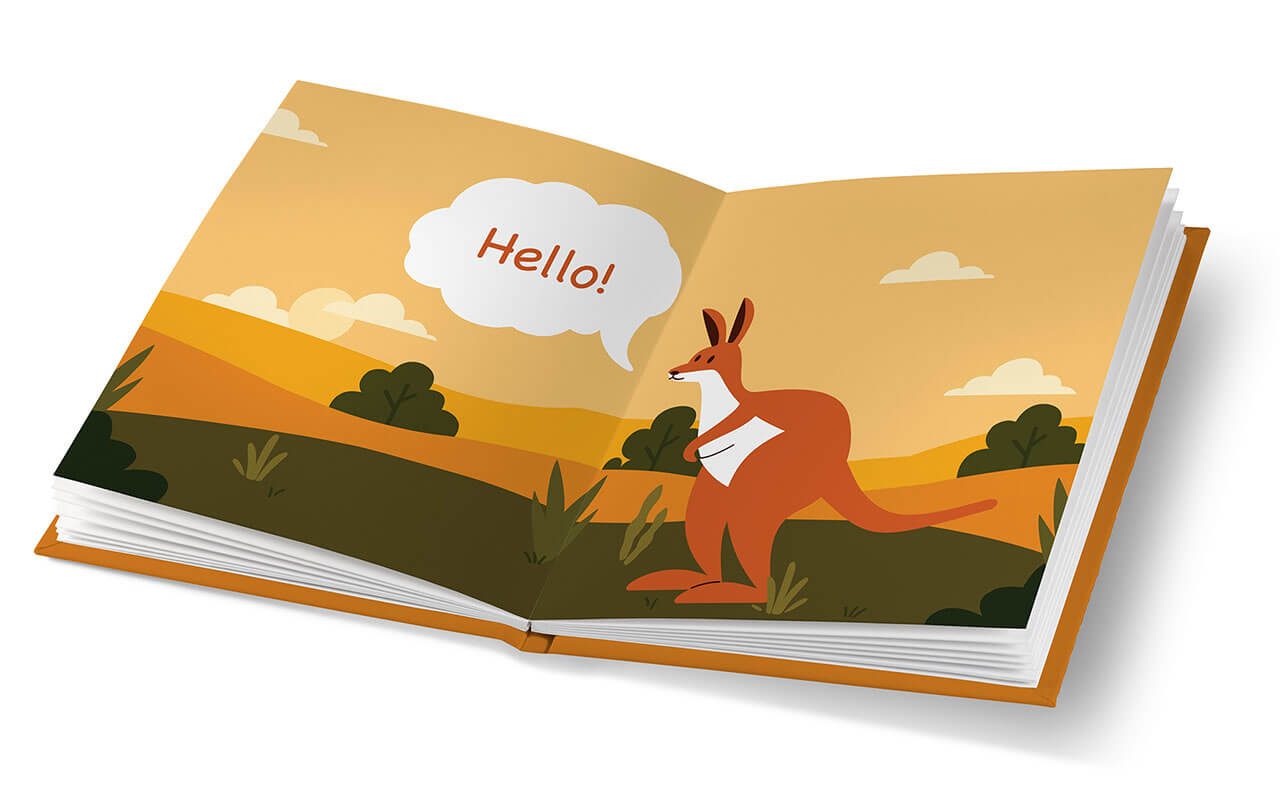
Van Dusen began working at Dr. Weisberg’s Scientific Thinking and Representation (STAR) Lab, which studies imaginative and scientific reasoning abilities, including how children learn from fictional stories. Her senior thesis examined how anthropomorphic characters, those that display human characteristics, such as talking animals, affect children’s ability to learn scientific principles and facts.
The study involved reading a story designed to teach the principle of acquired traits versus inherited traits to groups of 4- to 6-year-old children. Some versions of the story had narrators and characters that were animals with humanlike characteristics, such as talking kangaroos or animals wearing clothes. In other versions, the narrators and characters were realistic. Van Dusen also created a parent survey to investigate how frequently children engaged in imaginative play and what kind of media and TV shows they preferred.
The study, which has been submitted to a scientific journal, revealed that children were equally likely to absorb an abstract principle like inheritance regardless of whether the characters were anthropomorphic. However, their comprehension and recall of the biological facts in the story were slightly better when the story was narrated by humans.
“We know that kids may be drawn to anthropomorphic characters, but they might be distracted by them as well,” Dr. Weisberg says. “There’s probably an optimal level of fantasy that’s the sweet spot when teaching science.”
3. The Sequel
Van Dusen is now a PhD student at American University in the Behavior, Cognition, and Neuroscience program, studying cognitive processes in infants and young children. Her Villanova research has given her invaluable insights and strategies as she continues her work..
“Alyssa has been invaluable in helping me realize the vision for this project,” says Brandt, whose book will be published in late 2025 or early 2026.
“I learned about how to ask questions specifically and with intention, and how to apply that information,” Van Dusen says. “If I want to ask a question, there has to be a reason for that question.”