FIND YOUR SEAT
From Page to Stage
An introductory Theatre course invites students from across the University to discover every step of the production process
By Meg Maxwell
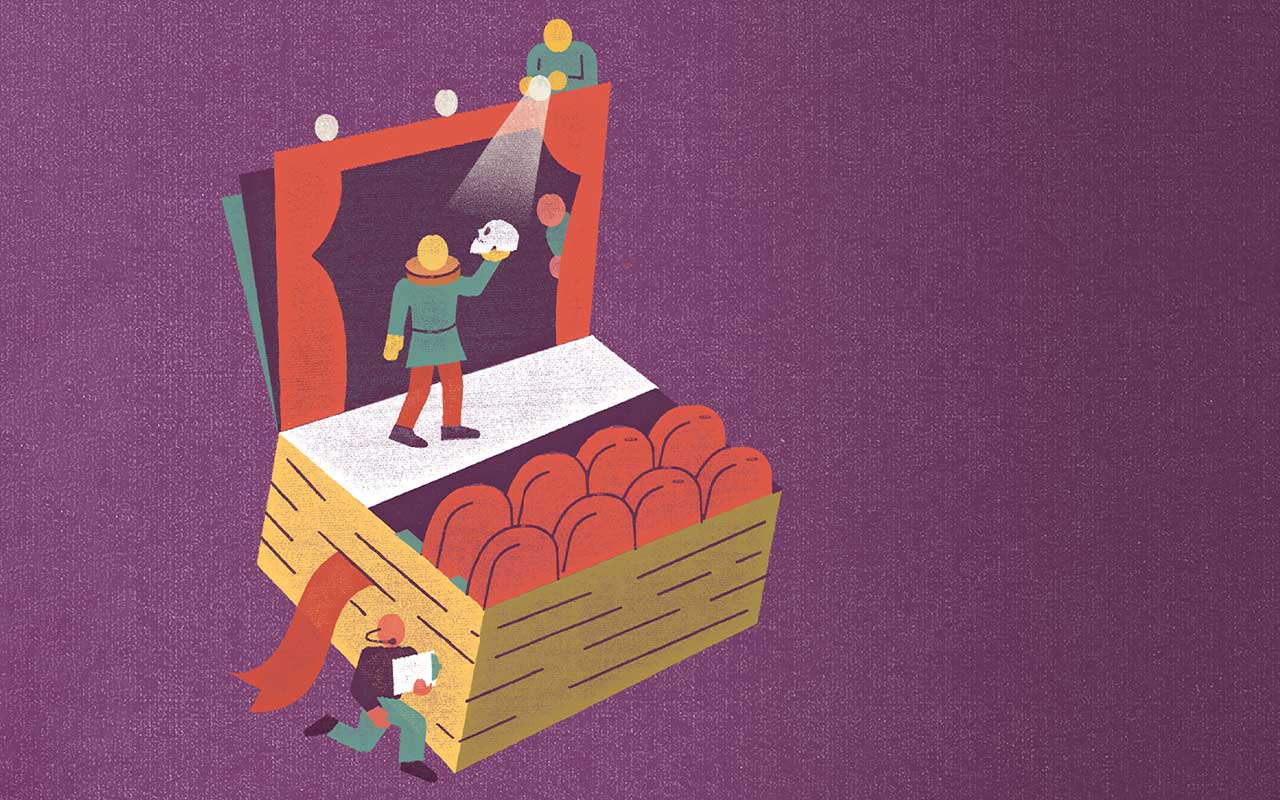
On the first day of The Theatrical Experience, an elective in Villanova’s Department of Theatre and Studio Art, students are asked to share if they have ever been involved in a theatrical production. While a few in the class might be passionate Theatre minors, some last stepped onstage in middle school and most have no theatre background at all.
“We have Nursing students, Business students, History students–the whole gamut,” says Theatre Department Program Coordinator and Adjunct Professor Kevin Esmond ’17 MA, who has taught the course for more than five years. “I stress that all entry points are valid and all previous experiences with theatre are valuable, and I invite students to take risks and immerse themselves in what is truly a community art form.”
Professor Esmond leans heavily into the “experience” part of the course title. Students sharpen their theatrical acumen by reading and analyzing four scripts, and they attend and critique two on-campus productions in the John and Joan Mullen Center for the Performing Arts. But they don’t just examine other artists’ work. Every two weeks, they switch roles and take turns becoming playwrights, set and costume designers, actors, directors, and theatre marketers. The culminating project of The Theatrical Experience unites all those skills, as small groups of students write, cast, act, direct, design and market original 15-to-20-minute plays.
Professor Esmond observes that, in the midst of an AI revolution, theatre is one area where the human element remains essential. Ideas for scenes are generated in class, collaboratively, relying on students’ own observations about the world. Set designs can be submitted as Lego brick creations, dioramas or watercolor paintings–but not as AI art. Students pull costume pieces from their closets and build props out of cardboard boxes, establishing new realities in countless ingenious ways. As actors, students make themselves vulnerable, stepping into the lived experience of their characters.
Amber Thompson-Quartey ’28 VSB, an Accounting major with a Criminology minor, reflects, “Directing really pushed me outside of my comfort zone. I had to be comfortable with telling other people what to do so that the final piece matched my vision. That’s a skill that I’ll be able to draw on throughout my professional life.”
Professor Esmond emphasizes that, whether or not his students ever walk onstage again, a primary aim of the course is to teach students to engage with art. He says, “We're a scrolling society now, and we swipe left on things that we don’t immediately find accessible. But I want students to be able to sit with new experiences, to continue to watch, to interact, to engage and to meet art where it is. Then they can apply that in the workplace, in conversation, in their neighborhoods and communities. When confronted with something that initially sits outside their comfort zone, they can ask, ‘How can I stop and engage and find where I fit into this?’”
NEXT IN NOVA-WORTHY
New research and global Church recognition highlight St. John Henry Newman’s lasting impact