
ARTIFICIAL MADE REAL
Villanova Engineers harness AI to transform research into solutions that shape the future
By Andrew Faught

Artificial intelligence is reimagining the world as we know it. The technology curates online content, pilots self-driving cars, manages supply chains and helps to predict heart attacks.
None of it would happen without an engineer.
At the College of Engineering, faculty and students are helping to reshape industries, economies and everyday life. They’re building systems that could lead to exciting new drug treatments, protect communities from extreme weather and find new clean energy sources.
The next wave of innovation will be the result of thousands of engineering decisions involving hardware, systems design, optimization and reliability—decisions that will transform mathematical ideas into real-world tools.
These Villanova faculty members are showing us the way.
COMBINING DATA, SCIENCE AND MACHINE LEARNING
In Villanova’s Multiscale Modeling of Materials and Machine Learning Laboratory (M4L Lab), students use AI to create and validate computational models that address diverse challenges, such as identifying next-generation materials for fusion energy applications, predicting stress fractures in athletes and designing advanced dental implants.
As principal investigator of the lab, David Cereceda, PhD, associate professor of Mechanical Engineering, reminds his charges not to lose sight of the bigger picture.
“I combine both the physics-based models developed over the past couple of centuries with modern data-driven approaches,” he says. “I tell my students that we don’t want to treat AI and machine learning as a black box. We want to build on the knowledge we already have and use AI tools to expand our understanding and accelerate discovery.”
It’s an approach that has served Dr. Cereceda well in his own work on materials engineering for nuclear fusion, a potential clean energy source that scientists hope could power cities with minimal carbon emissions. In 2022, he was Villanova’s first-ever recipient of the US Department of Energy’s prestigious Early Career Award, for his project “Unraveling transmutation effects in tungsten-based plasma facing materials: a computational approach that integrates nuclear transmutation, first-principles, calculations and Machine Learning.”
Fusion reactors must operate under extreme conditions: temperatures reaching thousands of degrees, intense magnetic fields, and bombardment from high-energy neutrons. Such an environment can degrade materials quickly, making durability a persistent challenge in fusion technology. By combining physics-based simulations with machine learning models, Dr. Cereceda can predict which materials are most likely to withstand such extreme environments.
His AI work also has a deeply human dimension. Inspired in part by personal experiences that strengthened his commitment to translational research with real societal impact, he collaborates with clinicians to develop decision support systems that analyze patient data and reveal patterns that might otherwise go unnoticed.
One project uses machine learning to predict spontaneous preterm birth, a major cause of infant health complications worldwide. In another, he works with the Gait Lab at Nemours Children’s Hospital to develop a clinically informed machine learning framework that enhances decision support tools for ambulatory youth with cerebral palsy. The team’s approach integrates patient-specific data and clinical expertise to predict gait kinematics, identify key predictors and characterize treatment responsiveness across different interventions and age groups, from early childhood through early adulthood.
“These systems are tools,” Dr. Cereceda says. “They help clinicians identify risks earlier, but the final decisions always belong to the medical professionals.”
TRACKING THE SPREAD OF DISEASE AND DISRUPTIONS
When COVID-19 emerged in China in December 2019, it took just nine months for the virus to spread to every corner of the globe.
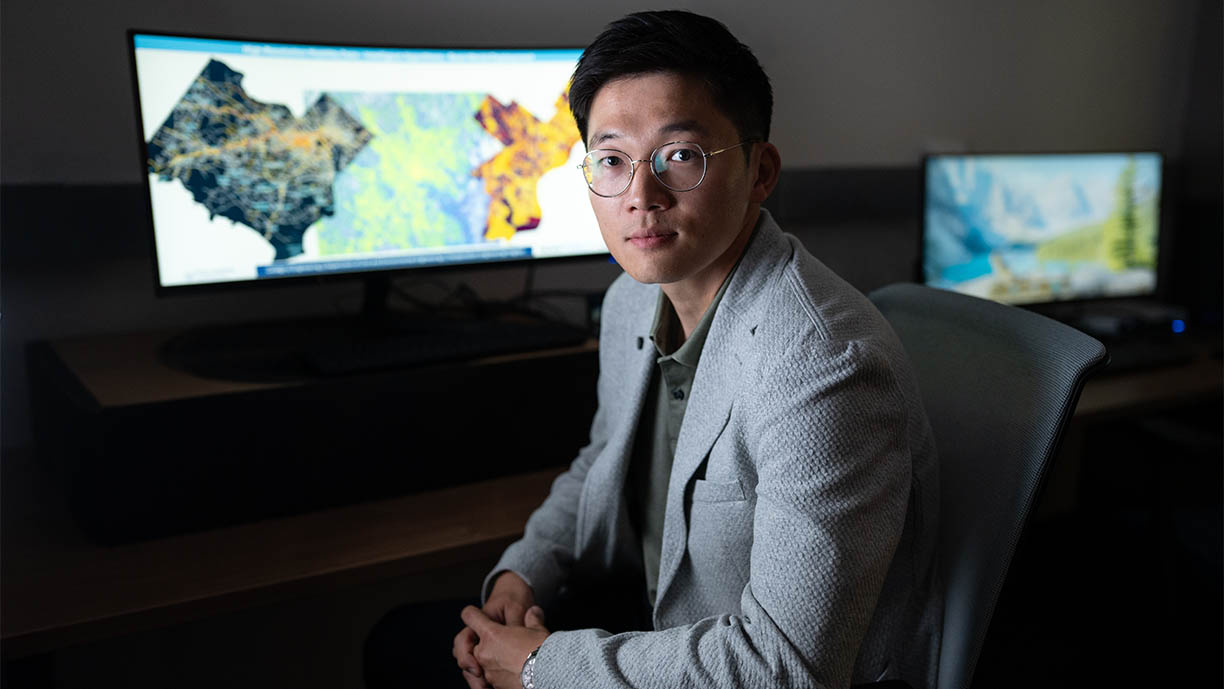
Chenfeng Xiong, PhD, assistant professor of Civil and Environmental Engineering, is using AI to study transportation big data, human mobility research and travel behavior modeling to better prepare communities and governments for future pandemics and disasters.
Dr. Xiong is developing models to re-create the daily movements of nearly 20 million people in Lagos State, Nigeria. He’s attempting to predict how diseases, disasters and disruptions spread through human populations, in an attempt to stop them and save lives in a timely manner. Dr. Xiong is also building models around American air traffic.
“We’re envisioning an increase in situational awareness, especially for those areas that are not as data-rich as the United States,” he says. “They can then provide a more timely response, instead of sitting in the dark and waiting for the rest of the world to take action.”
Beyond air travel data, Dr. Xiong is using railway station and bus hub counts, road traffic measurements and anonymized smartphone location data to build his models.
At the center of the system is AI-driven deep learning, including large neural networks—a machine learning model inspired by the human brain. The technology uses algorithms to predict a person’s likely daily itinerary, including when they leave from home and return, and by what mode they travel.
“Before AI, we could never model all these factors in one step,” Dr. Xiong says. “Now, deep learning allows us to handle extremely complex patterns.”
By combining AI with real-time information sources, the model could detect an emerging disease threat, simulate its spread and identify hotspots before an outbreak, Dr. Xiong adds.
Authorities could then take targeted actions, such as local lockdowns, healthcare deployment or vaccination drives, focused on areas of greatest need.
“I think in five years, this simulation model will work within hours or minutes to make predictions,” Dr. Xiong says. “We’re trying to promote accurate information with AI’s growing power.”
PREDICTING—AND PREVENTING—URBAN FLOODING
As extreme weather becomes more frequent and intense, urban flooding is becoming a growing threat. But AI algorithms—problem-solving rules fed to a computer—could translate into decreased stormwater damage, increased infrastructure longevity and improved equity in how government agencies protect their communities.
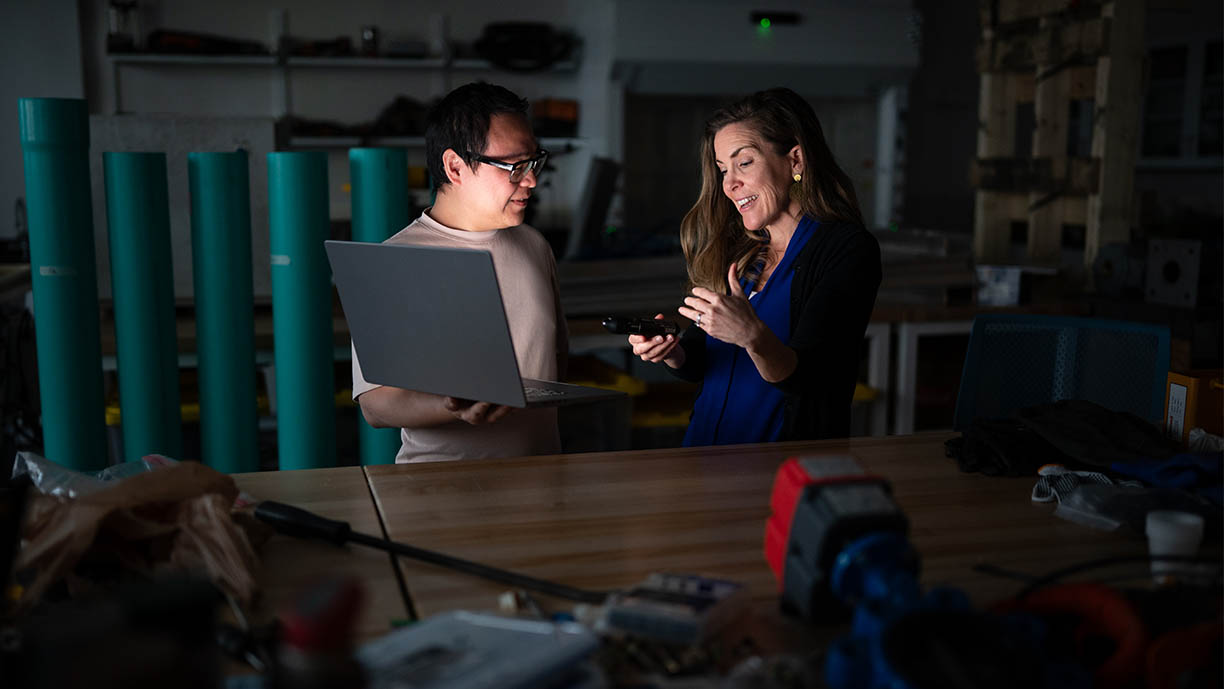
In a multidisciplinary partnership, Virginia Smith, PhD, associate professor of Civil and Environmental Engineering, is working closely with Xun Jiao, PhD, associate professor of Electrical and Computer Engineering, to investigate how green stormwater infrastructure (GSI)—from porous paving to sidewalk planters and “rain gardens,” which filter pollutants and help to replenish groundwater—can be managed to minimize risks before destructive weather hits.
“We’ve been using AI to predict the performance of GSI under various conditions, and we’ve basically asked, ‘Is this GSI functioning well under various conditions, or does it need maintenance soon?’” Dr. Jiao says.
To date the team, with support from a pair of National Science Foundation grants, has collected weather data and geographic features from Philadelphia, Washington, D.C., and Austin, Texas. Dr. Smith is using the data to help answer a foundational question: If a storm hit tomorrow, would a system fail?
“As cities face this increasing burden of how to manage their stormwater effectively and efficiently, we try to take a comprehensive view of the challenge,” Dr. Smith says.
Dr. Jiao’s models, still in their early stages, could be transformative for urban planning because they consider risks alongside income levels on a block-by-block basis. Impoverished communities, for example, could lack plants that slow the movement of floodwaters. Precise data could put planners in a better place to prevent damages with pinpoint interventions.
As with many AI projects, solutions are the result of diverse expert perspectives. “I’m an AI guy, meaning I know the math and I know the algorithms,” Dr. Jiao notes. “But I don’t have insights into socioeconomic factors, and without that we don’t have data to start with.”
That’s where other teammates come in. Besides Dr. Jiao and Dr. Smith, the GSI project’s co-principal investigators include Villanova colleagues Bridget Wadzuk, PhD, of Civil and Environmental Engineering and Peleg Kremer, PhD, of Geography and the Environment in the College of Liberal Arts and
Sciences. The quartet meets weekly or biweekly with sociologists, computer scientists and graduate students to develop insights and solutions into GSI system management.
Even before starting the project, Dr. Smith notes, the team interviewed municipal leaders, community members and engineering firms about stormwater interventions to better inform AI algorithms and create plans for communities.
“We want to create actionable information that the common person can understand,” she says.

ANALYZING PROTEINS TO TREAT ALZHEIMER’S DISEASE
By the time Alzheimer’s disease begins stealing a person’s memory, the biological damage has often been unfolding silently for more than a decade. Proteins accumulate in the brain, neurons struggle to communicate and the disease disrupts the neural circuits that allow people to think, remember and function.
For Zuyi “Jacky” Huang, PhD, associate professor of Chemical and Biological Engineering, AI could be a gamechanger. His work uses machine learning, a subset of AI, to analyze enormous biological datasets. The human body contains more than 20,000 genes, thousands of proteins and intricate biochemical pathways that interact inside every cell. Any of them can play a role in Alzheimer’s disease.
“Our job is to use AI to study how those proteins interact with each other and identify the best drug target,” Dr. Huang says. “You want to stop the protein. If you stop the protein, we can stop some diseases.”
His work could also aid treatments for other progressive neurodegenerative illnesses, such as Parkinson’s disease. Additionally, Dr. Huang has used AI in work with Aimee Eggler, PhD, associate professor of Biochemistry in the College of Liberal Arts and Sciences, on an antioxidant response for anti-neuroinflammation.
With the help of machine learning models, Dr. Huang and students in his upper-level Biochemical Data Analysis course screen millions of chemical compounds against a target protein in search of promising drug interventions. Instead of manually testing thousands of possibilities in the lab, AI narrows the field to the most promising candidates.
Once a potential compound is identified, Dr. Huang’s research laboratory conducts experiments to determine whether it is effective. Dr. Huang has already developed several promising compounds that have attracted attention from other researchers. The ultimate goal is ambitious: He hopes to advance a candidate drug far enough to enter preclinical testing, and eventually human clinical trials.
“I really want to help people, and community service is part of the mission of the University,” he says. “There are 6.9 million Americans living with Alzheimer’s disease, and the number may double by 2060.”
DEVELOPING A TECHNOLOGY BEHIND 6G
Thanks to advances in AI, Mojtaba Vaezi, PhD, is exploring how wireless networks could do more than just transmit data: They could also sense and interpret their surroundings—and potentially keep you safe.
Through a new technology that combines two legacy transmission systems—wireless and radar—your cellphone could one day alert you to a fast-approaching car that you can’t see, while also finding more reliable coverage in
areas dense with trees, buildings or people.
“In future networks, the same signals used for communication may also provide information about the surrounding environment,” says Dr. Vaezi, an associate professor of Electrical and Computer Engineering who works on integrated
sensing and communications, or ISAC. The emerging technology is expected to play a key role in sixth-generation (6G) wireless systems, though practical use is still several years away.
“It would be as if you have another eye at the back of your head,” he adds. “Right now, when I’m walking or driving, I can see only my front. What if I want to see what’s going on behind me? Those signals are going to provide that
information.”
Today’s wireless systems—such as cellular networks and Wi-Fi—are designed primarily for a single job: to transmit information from one place to another. In contrast, radar systems are used to sense the physical environment by analyzing reflected signals to estimate properties such as distance, speed and location. Radar helps forecast weather, track aircraft and guide self-driving cars.
These two functionalities have traditionally been developed separately, but ISAC aims to unify them within a single framework. In such a setup, a cell tower wouldn’t just communicate with a user’s device; it would also extract useful information from the surrounding environment.
At the same time, this new capability would enhance communication performance: By being more aware of its surroundings, a network can better adapt its transmission to maintain reliable connections, even in challenging conditions like dense urban areas.
“Traditionally, these adaptations have relied on mathematical models and optimization,” Dr. Vaezi says. “With AI, we can learn efficient strategies directly from data and adapt more quickly to changing environments.”
Combining sensing and communication is no easy feat. Researchers are still addressing key challenges, including signal design, hardware constraints and real-time algorithm development. For his part, Dr. Vaezi is working to develop theoretical foundations and practical techniques needed to make ISAC a wireless reality.
PREPARING ENGINEERS FOR A FUTURE WITH AI
Xiaofang “Maggie” Wang, PhD, knows firsthand the promise of artificial intelligence. The associate professor and chair of Electrical and Computer Engineering researches how the technology can generate hardware circuits tailored to specific applications—a future in which machines design machines.
Thanks to planned curricular additions being shepherded by a College-level AI task force that Dr. Wang is leading, Villanova Engineering students will be at the leading edge of inquiry.
“AI is revolutionizing every engineering discipline at an unprecedented pace and scale,” Dr. Wang says. “Driven by our deep commitment to educating future engineering leaders with technical excellence and Augustinian values, we will lead the integration of AI into our curriculum and research across all engineering majors.”
Formed in spring 2025, the eight-member AI task force is composed of two faculty members apiece from each of the College’s four departments: Electrical and Computer, Civil and Environmental, Chemical and Biological, and Mechanical Engineering. Members have met intermittently in the past year to create multiple initiatives—including an AI Engineering minor, which will debut in the fall.
Other plans in the works include a Master of Science in AI Engineering, a graduate certificate in AI Engineering, an AI Makerspace in Drosdick Hall and professional development for faculty. (A “Teaching With AI” workshop was held in January, providing a glimpse at what could lie ahead.)
The minor is open to students across all engineering disciplines and reflects growing demand from students who recognize AI as a critical career skill. The minor requires five courses, including Fundamentals of AI and Machine Learning, offering a deeper dive into the technology’s concepts and applications.
Also in the planning stages is a 1,500-square-foot AI makerspace, a hub where students would be able to experiment with cutting-edge tools and technologies. The space could include high-performance GPU servers, robotics platforms, autonomous vehicle kits, virtual reality systems and advanced sensors.
The College, meantime, is also exploring partnerships with industry leaders such as Nvidia.
“They’re interested in understanding our needs—both for teaching and research,” says Dr. Wang, who joined Villanova in 2006 and specializes in computer hardware and embedded systems. “It could lead to meaningful support.”
The task force isn’t working in isolation. An industrial advisory board—composed of industry experts and alumni—provides ongoing feedback, ensuring that the curriculum aligns with workforce demands.
In Mechanical Engineering, for example, AI is being used to optimize design processes and predict system performance. In Civil Engineering, it can analyze infrastructure data to improve safety and efficiency. In Chemical Engineering, it plays a role in drug discovery and process modeling.
Graduates are entering a job market that expects them to have at least a working knowledge of AI, Dr. Wang says. For some roles, it’s already a requirement.
“That’s why students are so motivated,” she adds. “They see it in job descriptions. They know it matters.”
Next in Features
From environmental impact to student collaboration and transparency, the College tackles the thorny ethical issues surrounding artificial intelligence