
INNOVATION EXPANDS
New cutting-edge labs in Drosdick Hall advance research in brain science, human-centered transportation and next-generation communications
By Kiera Daly Soltis

The ZenoMetrics mat inside Drosdick Hall’s Brain Laboratory allows Meltem Izzetoglu, PhD (right), and her research team to analyze a subject’s stride, balance, footfalls and overall cognitive control of their gait.
Although Drosdick Hall opened to students nearly two years ago, Villanova Engineering continues to add laboratory spaces to its new home, demonstrating the College’s ongoing commitment to innovative and groundbreaking research. Learn more about three of these state-of-the-art spaces that opened during the 2025-26 academic year.
BRAIN LABORATORY
Meltem Izzetoglu, PhD, is a visionary. A biomedical researcher with expertise in brain signals and systems, Dr. Izzetoglu has many research interests, initiatives and accomplishments, including her hope to someday improve students’ learning with real-time feedback from wearable brain sensors.
“Imagine students wearing small sensors that light up, notifying a teacher that they understand the material being taught,” says Dr. Izzetoglu, an associate professor of Electrical and Computer Engineering and director of the Biomedical Engineering and Cognitive Neurosensing (BEACON) research group. “It may sound futuristic, but it’s my next dream to realize. If we can identify whether a lesson is resonating with students right then and there, we can adjust class accordingly. The same can be done for an elderly person who wants to drive to the grocery store. Are they able to drive safely? My hope is they can quickly and easily test their cognitive ability with an at-home brain sensor before they get behind the wheel.”
Thanks to Drosdick Hall’s new Brain Laboratory, Dr. Izzetoglu’s vision can become reality. The facility provides faculty and students with a unique space to further study the functioning of the human brain and body in areas including cognitive aging, sports and performance studies, and brain injury detection and monitoring.
Inside the lab space, a new 20-foot-long ZenoMetrics mat equipped with pressure sensors measures movement and mobility in healthy and aging adults, as well as in adults with injuries and mild cognitive impairments, such as Alzheimer’s disease, multiple sclerosis or cerebral palsy. Subjects walk along the mat, which simultaneously records their stride, balance, footfalls and overall cognitive control of their gait.
“The ultimate goal is to run initial mobility tests in the lab, and then send individuals home with small, wireless, light-based wearable sensors that record their movements and cognitive activity in an app while doing rehabilitation exercises specific to their needs,” Dr. Izzetoglu says. “After a few months, we bring them back in to measure improvements in their mobility and brain cognition.”
Dr. Izzetoglu is also working in the lab on the development of a handheld battery-operated brain-bleed detection device for use in a variety of settings, including in the military, at sporting events and in ambulances. In less than five minutes, the device can scan the brain to determine whether there is a bleed, swelling or a concussion, allowing for early detection and eliminating the need for a CT scan or an MRI.
“We hope to make brain imaging an affordable, noninvasive and easy-to-use tool that can be used by people every day to improve their lives,” says Dr. Izzetoglu.
“Years ago, brain monitoring during active, on-the-ground walking was just a dream, but our pioneering work made that dream come true, which allowed the research community to perform studies previously deemed untenable. What we envision—with science, engineering and the great minds of students and faculty collaborators—we can realize. The possibilities are endless.”
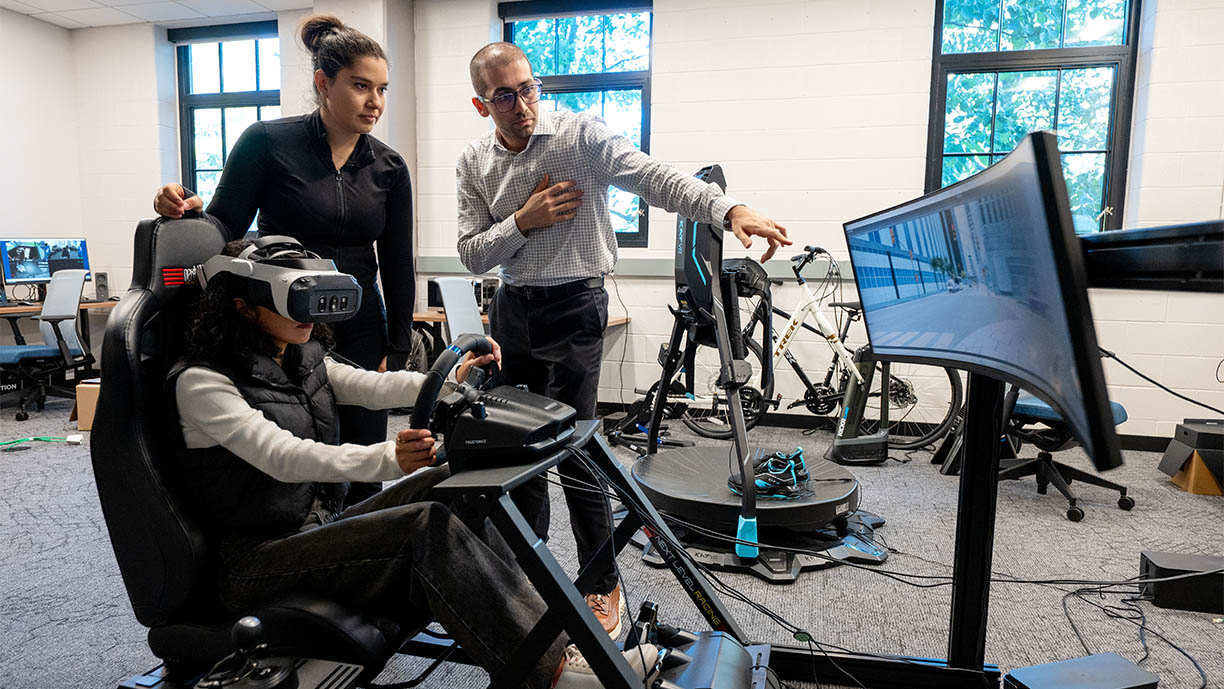
A multimodal simulation system in the Smart Transportation Lab enables Arash Tavakoli, PhD, and his team to evaluate how a driver, a pedestrian and a cyclist all simultaneously experience a transportation system.
SMART TRANSPORTATION LABORATORY
In the new world-class Smart Transportation Laboratory, human experience is at the heart of faculty and students’ research. Their innovative work on transportation systems focuses on the creation of virtual civil infrastructure prototypes to improve the safety and well-being of pedestrians, cyclists, drivers and other road users within our transportation infrastructure.
“From our phones to the clothes we wear, prototypes exist for everything we use,” says Arash Tavakoli, PhD, assistant professor of Civil and Environmental Engineering and director of the Human-Centered Cities Lab, one of two research groups housed in the new space. (Chenfeng Xiong, PhD, leads the other.) “However, prototypes aren’t typically created for civil infrastructure transportation systems that we all use daily. Now, in the lab, we can study the impact of various modes of transportation on users, and how they interact with one another when traveling in the same environment.”
Equipped with an omnidirectional treadmill to mimic the pedestrian experience, a stationary bike simulator for cyclists and a car simulator for drivers, the Smart Transportation Lab enables three users to simultaneously experience and interact with a transportation system. While wearing virtual reality glasses depicting the same immersive environment and sensors to measure their level of stress, users move through the infrastructure, while their heart rate, brain activity and overall physiological stimulation is tracked.
Dr. Tavakoli, together with second-year PhD student Shiva Azimi, built the multimodal transportation simulation from the ground up. “We are one of the first to study the realistic interactions among all road users under controlled and repeatable conditions within one unified environment, and we are sharing it open access so others can replicate the simulator,” Dr. Tavakoli says. “We can now not only better understand the safety and dynamics of diverse traffic scenarios, but we also have a better sense of the human experience, so we can rethink future infrastructure.”
Also in the lab, a separate standalone driving simulator enables the study of how behavioral data can help predict driver performance at different levels of vehicle autonomy. The driver is outfitted with eye-tracking glasses, brain activity sensors and research-grade wristbands to track heart rate and skin responses. Sensors on the vehicle measure behavioral metrics such as acceleration and braking speed. In a recent experiment led by Yasaman Hakiminejad, a third-year PhD student, the vehicle switches to automated mode, and simulated obstacles force the driver to react and take over the vehicle. Driver response, reaction and takeover time is recorded and analyzed.
“For so long technology has been put first,” says Dr. Tavakoli, whose research is partially funded by the National Science Foundation’s Civil Mechanical and Manufacturing Innovation Division. “It’s time to refocus on the human who uses the technology and is affected by it. Our goal is to develop environments that promote human well-being, so we can eventually create healthier and happier communities.”
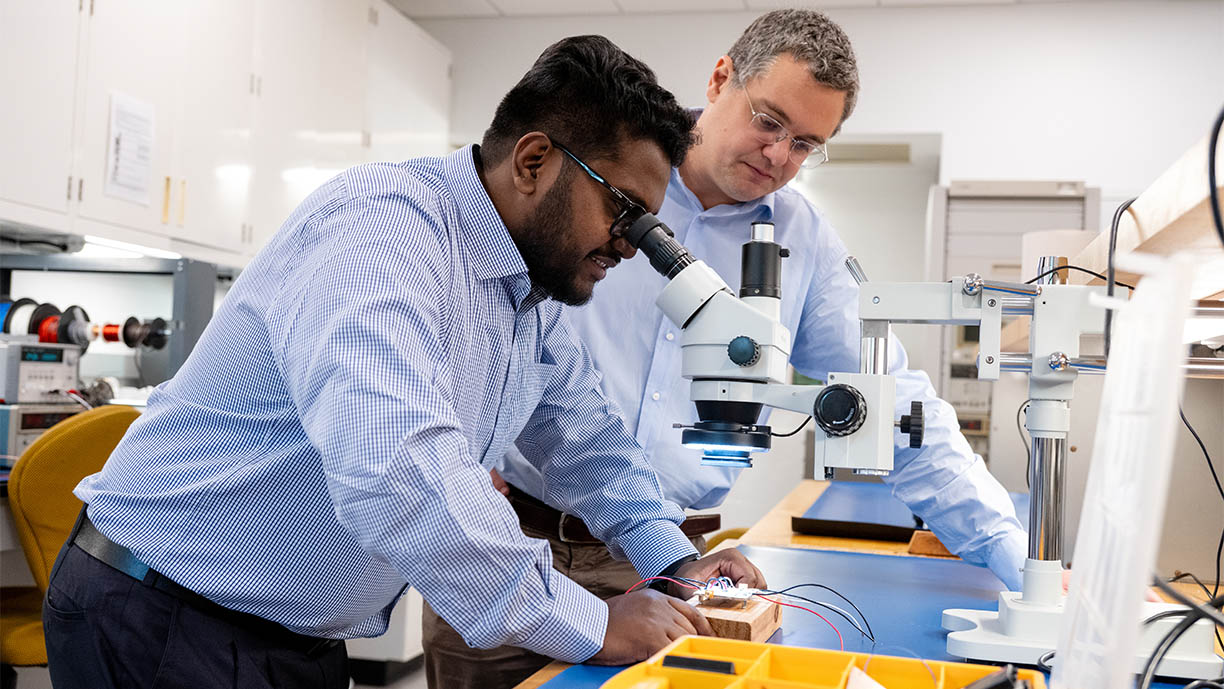
In the Microwave/Computational Engineering Lab, the High-Performance RF group led by Tommaso Cappello, PhD (right), can “do it all,” from theory to prototype.
MICROWAVE/COMPUTATIONAL ENGINEERING LABORATORY
“In engineering, radio frequency is called the black magic of electronics,” says Tommaso Cappello, PhD, assistant professor of Electrical and Computer Engineering. “It’s complex and a little mysterious, but key for wireless communication.”
In the College’s new Microwave/Computational Engineering Lab facility, Dr. Cappello and his students are dedicated to researching high-performance radio frequency (RF) and microwave circuits to improve future communication systems. Often taken for granted by everyday users, RF and microwaves are essential for smartphones, Wi-Fi routers, radios, satellites, radar and much more.
“Our current focus is power amplifiers, which are an important component of the transmitter,” says Dr. Cappello, director of the High-Performance RF research group. “The power amplifier takes a small signal and makes it much stronger, boosting the signal to the required power level before it is radiated through the antenna.”
Working with PhD students, Dr. Cappello uses the lab to design, characterize and model radio frequency, microwave and power electronic circuits for efficient and linear transmitters. “One of the strengths of the lab is that we can do everything under the same roof,” Dr. Cappello says. “From the theory down to the simulations, the fabrication and the prototype, we can do it all. And, we have very quick turnaround time from the design to testing circuits up to 26 GHz. There aren’t many labs that can do that.”
Industry partners have noticed. Dr. Cappello’s cutting-edge and specialized research is highly sought after by instrument, semiconductors and telecommunications corporations that are looking to improve their products. He and his students collaborate with companies to create technology-ready prototypes; in turn, the companies support the lab with state-of-the-art equipment, including test and measurement instruments, in addition to rapid prototyping tools.
“In the lab, students learn industry-relevant skills,” Dr. Cappello adds. “When they graduate, they have a lot of knowledge and experience with the programming and manufacturing of radio frequencies. They are highly qualified and ready to begin in a specialized field that has a steep learning curve.”
Next: Student Profile
Kate Hamel ’26 ChE combines cutting-edge research with a commitment to real-world impact