Canary Islands Immigration Symposium Aligns with Pope Leo Visit
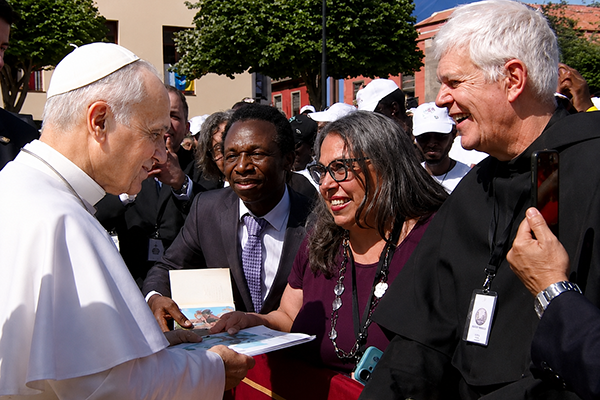
In his recent encyclical Pope Leo commented, “A litmus test for social justice today is the treatment of migrants, refugees and those forced to move due to poverty, violence, climate change and environmental disasters. The way a society treats them reveals whether its sense of justice is driven by fear or by the spirit of fraternity.”
The importance of the theme of migrants and refugees was underscored by his decision to end his pastoral visit to Spain by going to the Canary Islands, one of the main arrival points of migration from Africa to Europe. Once this visit was announced, the Mother Cabrini Institute on Immigration at Villanova University decided to sponsor a symposium, united to and in solidarity with the focus of the Pope’s visit, to continue its initiative of promoting a “global constellation of universities” (in the words of Pope Leo), to lead teaching and research to address critical challenges faced by the world’s migrants and refugees. This initiative was originally launched in October 2025 in Rome, where more than 200 representatives from 40 countries participated. In addition to the symposium organized in the Canary Islands, the Mother Cabrini Institute also held an African Regional conference in Nairobi, Kenya, in June 2026, and is planning a Latin American conference in Bogota, Colombia, in November 2026.
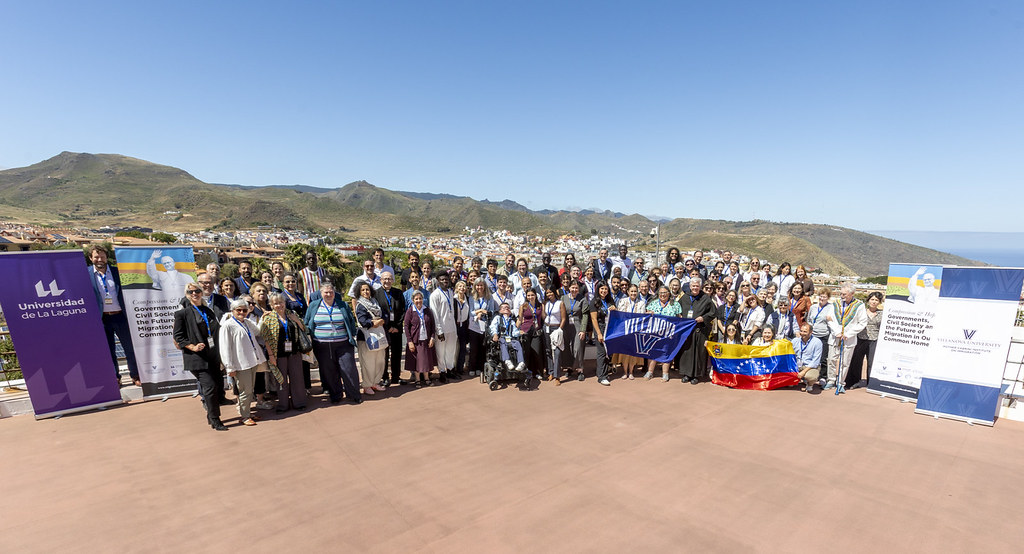
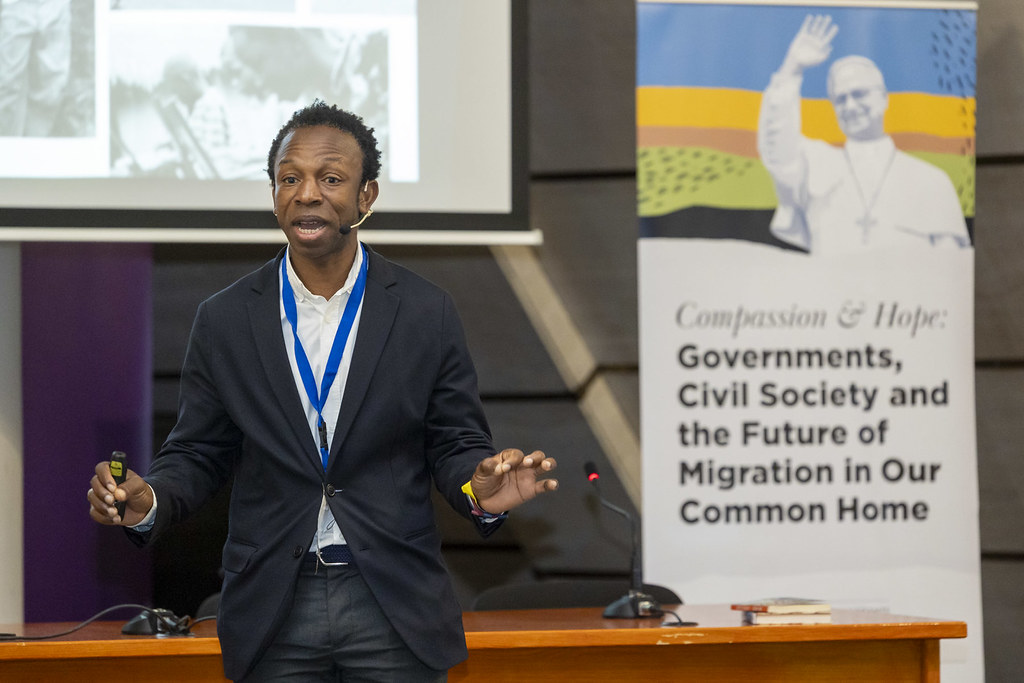
Almost 100 participants from 20 countries gathered for the Canary Islands event, which began the day before the papal visit with a video presentation and conversation by Ousman Umar, who related his five-year trek through eight countries in order to arrive at the Canary Islands, beginning when he was only 12 years old. Umar said that 80% of those who began the journey with him died along the way. Eventually, he went to Barcelona, where several people helped him to integrate into this new place. He finished his studies and currently leads NASCO Feeding Minds, an NGO that promotes educational opportunities in his home village in Ghana so that other youths don’t feel the need to migrate.
Later that afternoon, symposium attendees visited three different organizations that assist migrants. Many shared their own migration stories, all of which were deeply moving examples of the human spirit overcoming all forms of obstacles and prejudices while at the same time moving hearts to hear of the many who died along the way.
The following day was dedicated to the visit of the Holy Father. The Pope met with hundreds of people who work or volunteer in several church organizations that attend to the many immigrants who arrive on the beaches of the Canary Islands. The Holy Father spoke clearly of the Church’s mission to be a prophetic voice in society concerning the migrant phenomenon. He challenged everyone to think differently, as he said: “A human conscience, and even more so a Christian conscience, cannot remain indifferent in the face of these graveyards of the sea, to the victims of shipwrecks and the lack of aid. Every life lost on these routes is a failure for the human family. Nevertheless, there is also a silent shipwreck that occurs after arrival: being left alone in a city, without a voice, without ties, work or a sense of security, and exposed to those who take advantage of vulnerability. Integration means preventing that second shipwreck. It means helping those who arrived wounded not to remain forever stuck in their pain, but to be able to get back on their feet, recognize their gifts and offer them to the community.”
Saturday’s focus was the academic portion of the symposium, themed Compassion and Hope: Governments, Civil Society and the Future of Migration in our Common Home. The Rev. John Lydon, OSA, Director of the Mother Cabrini Institute, opened the symposium and invited the co-sponsors to share initial remarks. These opening words of welcome were first expressed by the Rev. Eloy A. Santiago, the bishop of the diocese, then by María Candelaria Delgado Toledo, the health and welfare secretary of the state government, and finally by the Vicente Blanco, vice-rectorate of the University of La Laguna, which was co-hosting with Villanova the event. It was noted that history was making a full circle because almost three centuries ago, the Augustinians established the first university in the Canary Islands, precisely a few blocks away from where this present state university sits.
Michele Pistone, Faculty Director of the Mother Cabrini Institute, then explained the brief history and methodology of this university project, ending by introducing the keynote speaker, Ousman Umar, who expanded on the theme that he addressed on the first day. The Rev. Baltazar Porras and the Rev. Diego Padrón, cardinals from Venezuela, one of the countries with the largest immigrant populations in the Canary Islands, then spoke about the causes of Venezuelan migration and the need to respond to it from the perspective of faith and the cause of human dignity countering the negative images often promoted by social media and political figures.
After a brief break, the participants divided into four classrooms to have a total of more than 30 “lighting talks” in which professors could present their research and work on diverse immigration themes and numerous front-line immigration organizations could explain how they concretely responded to the migration challenges.
In the afternoon, the Rev. Victor Ndione, the bishop of Mauritania, along with the Rev. Steve Youm, a priest from Senegal, joined by the Rev. Fernando García Cadiñanos, the bishop who heads the Commission of Human Development for the Spanish episcopal conference, and Fernando Redondo Pavón, the director of migration for the same episcopal conference, shared their experience of building together bridges of mutual support called the Atlantic Episcopal Hospitality Network. This network of dioceses of West Africa and Spain endeavors to help migrants in the countries where they are transiting or after arriving at their final destination to help reduce the number of people who lose their lives on these journeys. Finally, attendees heard testimonies of Paul Takande and Mbake Ndiaye, two young African men who made the perilous journey to the Canary Islands, but whose lives were transformed by being received in a parish organization called the Buen Samaritano (Good Shepherd). The director of that organization, the Rev. José Felix Hernández (Padre Pepe), related how he began this organization, which has helped thousands with food, shelter and educational opportunities in order to integrate into Spanish society.
Symposium attendees left moved, inspired and grateful to continue their work in a global priority of the Catholic Church.
The Mother Cabrini Institute on Immigration
Villanova University
610 King of Prussia Road
Radnor, PA 19087