What’s That Racket? One Student's Journey from Courts to Clinics
One last season of tennis opened the door to research, mentorship and a future in medicine for Sophia Edwards ’26 MS.
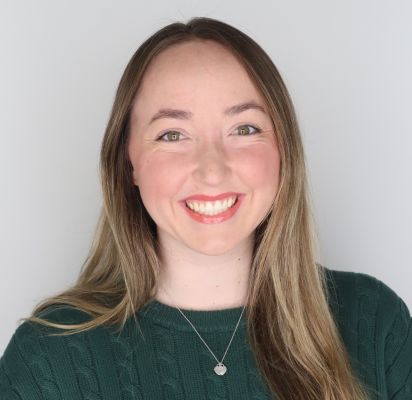
When Sophia Edwards ’26 MS arrived at Villanova University, she came with a racket in hand and a plan to play one more year of college tennis. What she didn’t anticipate was how a two-semester biology certificate—and the academic community that came with it—would reshape her goals beyond the sport.
“I wasn’t sure if I wanted to do one or two years,” Edwards said of her graduate study. “But as I came into the [Biology] program and I got to take courses with professors and do research with them, I realized how much I loved it here.”
What Edwards expected to be a brief set turned into so much more and put her on a path to better realize her career goals. So, in other words, she found her match in Villanova.
Edwards decided to pursue a master’s degree in biology, extending her time at Villanova by a year. This allowed her to deepen her connections with faculty, staff and fellow students—an opportunity that she raves about.
“I feel so lucky. I enjoy the people the most,” Edwards said, noting mentorship from Associate Teaching Professor Joseph Comber, PhD, and Associate Professor Louise Russo, PhD.
“They are the best. I am so lucky to work with them, and I just find them to be so inspiring,” Edwards said. “They’re also such positive people, and I feel like they’ve really helped shape my path at Villanova.”
Both Russo and Comber have been instrumental in Edwards’ growth towards medical school, a goal that began to come into sharper focus as Edwards navigated through the graduate program. She cites them as faculty mentors who have truly connected with her and who have provided counsel and encouragement whenever needed.
Her histology and virology courses, in particular, are providing her with a strong foundation for medical school and laying out the groundwork to advance her research interests, which are focused on staining tissues. This practice increases cell visibility, allowing her to engage in a deeper study of tissue structures.
“In terms of knowledge, in terms of medical schools, I've really gotten to pick their brain on a lot of topics,” Edwards said. “I've gotten really close with them, and they’re preparing me to be the best doctor I can be for my patients in the future."
Edwards emphasizes the sense of community she’s found at Villanova, built through academics, athletics and through her role as the communications officer for the Graduate Student Senate. As she prepares for the next step in her academic journey to medical school, she imparts some crucial advice to future students.
“Really get involved as much as you can [and] meet everyone,” Edwards said. “I've received help from faculty and staff who I haven't even had any classes with before.”
After all, what began was a one-year opportunity on the court became the foundation for a future shaped by mentorship, community and a renewed sense of direction.
About Villanova University’s College of Liberal Arts and Sciences: Since its founding in 1842, Villanova University’s College of Liberal Arts and Sciences has been the heart of the Villanova learning experience, offering foundational courses for undergraduate students in every college of the University. Serving more than 4,500 undergraduate and graduate students, the College is committed to fortifying them with intellectual rigor, multidisciplinary knowledge, moral courage and a global perspective. The College has more than 40 academic departments and programs across the humanities, social sciences, and natural and physical sciences.
Office of Graduate Studies
College of Liberal Arts and Sciences
Villanova University
Vasey Hall - Suite 202
SCHEDULE YOUR CAMPUS TOUR
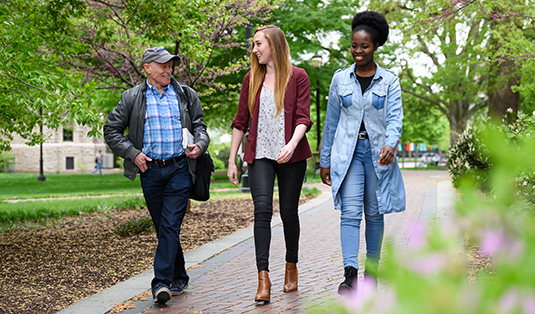
The CLAS Office of Graduate Studies offers personal tours of the beautiful Villanova campus. All tours begin in the Graduate Studies Office, located in Vasey Hall.
Schedule your tour!
FOLLOW GRADUATE STUDIES