
Tracing Generational Memory: Anastasiia Chulkova ’26 MA Wins Villanova 3MT
The Theatre graduate student won the University’s Three-Minute Thesis competition with research on the “embodied transmission of memory,” exploring how everyday actions can quietly pass down patterns across generations.
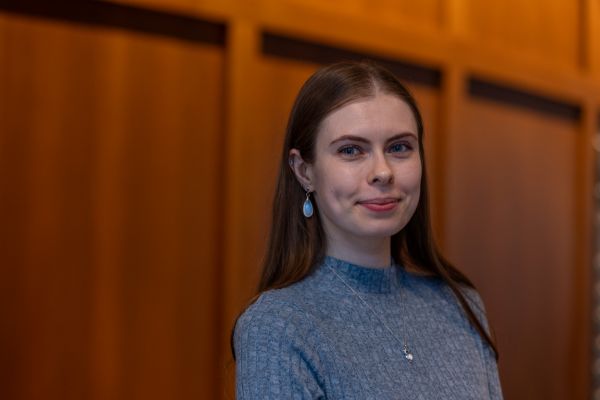
As a child, Anastasiia Chulkova ’26 MA wanted to be anything but a teacher.
Chulkova’s mother and grandmother were teachers, and so she would watch them come home, exhausted, and then spend the night grading papers, preparing for the next day’s class and sometimes talking with their students’ parents on the phone.
To be clear, it was never an expectation for Chulkova to follow in their footsteps. But despite the wishes of her younger self, that’s exactly the path she’s chosen. A graduate student in the Theatre program at Villanova University, Chulkova has worked as a theatre educator, teaching acting, improvisation, storytelling, movement and theatre history across Russia, China, Spain and the United States. She’s directed multiple productions with her students and is a Teaching English to Speakers of Other Languages (TESOL)-certified ESL teacher with more than a decade of experience.
So, was this choice unknowingly passed down to her? Perhaps.
In witnessing her mother and grandmother continue their work after the school day, Chulkova said, “These were small, everyday actions that I observed repeatedly during my childhood. I think they played a role in why I eventually became a teacher myself.”
The concept is known as “the embodied transmission of memory.” It’s the idea that knowledge about life and behavioral patterns, especially collective or historical ones, are passed down through ordinary, mundane actions and movements rather than only through written or spoken narratives and cultural traditions.
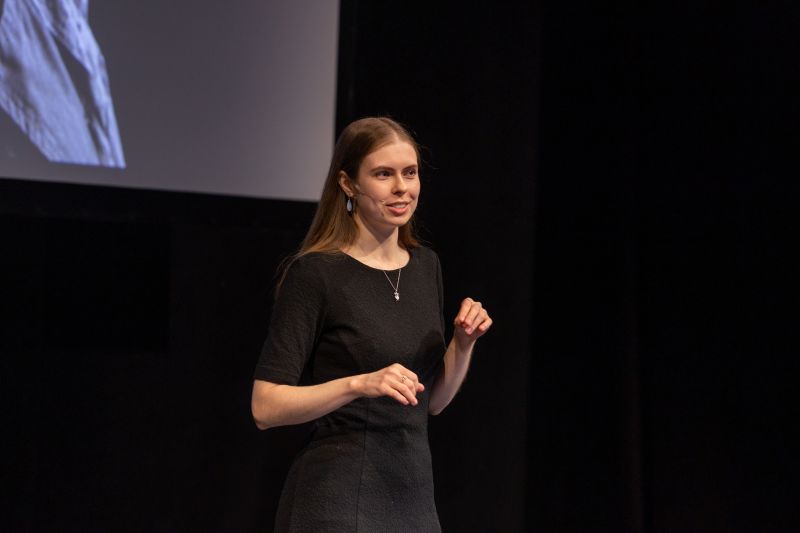
Chulkova explored the embodied transmission of memory for a research project that earned her a win at Villanova’s annual Three-Minute Thesis (3MT) competition on Feb. 20, 2026. She’s the latest in a line of 3MT winners from the College of Liberal Arts and Sciences (CLAS), who have taken Villanova’s top 3MT prize since its inception in 2020. Next, she will participate in the Northeastern Association of Graduate Schools 3MT Competition on April 22.
For her research, Chulkova studied the play, Elliot, A Soldier’s Fugue, a 2007 Pulitzer Prize for Drama finalist by Quiara Alegría Hudes. In the play, which Chulkova said she has read at least 100 times, Elliot is a third generation soldier whose family never encouraged him to enlist.
“I became very curious about how that happens and how people end up continuing patterns they were not explicitly pushed toward, which eventually led to my research,” Chulkova said.
For example, in the play, there is a detail that describes the very disciplined way a military person makes a bed and tucks in a mattress. And if a soldier returns home to civilian life but continues to tuck in their mattress the same way because they are used to doing it—and not because they are trying to teach their children to be soldiers—they may unintentionally pass along that routine.
“Tucking in a mattress seems like an action that can’t really carry knowledge, but I think it can,” Chulkova said. “When such actions are repeated every day, they communicate a certain lifestyle. Combined with other behaviors and knowledge, they can make following a military lifestyle and choosing to become a soldier feel natural and familiar to those who observe this action and quietly absorb the knowledge it carries.”
One powerful moment in the play occurs when Elliot lies wounded on an Iraq battlefield, drifting in and out of consciousness as he hallucinates members of his family surrounding him. In the stage directions, they methodically wrap barbed wire around his legs throughout the scene, a powerful metaphor suggesting that while his family offers emotional support, they also represent the forces that led him to become a soldier.
Chulkova said her research isn’t about identifying a strict list of behaviors to watch for, but about paying closer attention to how knowledge can live inside ordinary routines. Repeated everyday actions can communicate values and ideas that people inherit over time. The ideas from her research could be useful in education, psychology, and family and trauma studies because they offer another way of looking at generational connections.
Theatre has allowed her to explore these concepts deeply because it’s an art form centered around the human body.
“Creating a particular physicality is always a big part of an actor’s character exploration and creation. And as bodies become the point of focus on stage, I think theatre highlights these habits, behaviors and ways of moving, and helps us examine them,” she said.
As for her 3MT win—which her family watched via livestream in the middle of the night in Russia—Chulkova welcomed the challenge.
“I’m an international student doing my research and presenting it in my second language, so winning this competition feels like confirmation that decades of hard work are paying off,” she said.
She added that she hopes her achievement inspires her students, many of whom are just beginning to learn English or explore theater.
“With my example, I’m always trying to show my students that anything is possible. If they are consistent, dedicated and patient, they can develop any skill they wish,” Chulkova said.
About Villanova University’s College of Liberal Arts and Sciences: Since its founding in 1842, Villanova University’s College of Liberal Arts and Sciences has been the heart of the Villanova learning experience, offering foundational courses for undergraduate students in every college of the University. Serving more than 4,500 undergraduate and graduate students, the College is committed to fortifying them with intellectual rigor, multidisciplinary knowledge, moral courage and a global perspective. The College has more than 40 academic departments and programs across the humanities, social sciences, and natural and physical sciences.
Office of Graduate Studies
College of Liberal Arts and Sciences
Villanova University
Vasey Hall - Suite 202
SCHEDULE YOUR CAMPUS TOUR
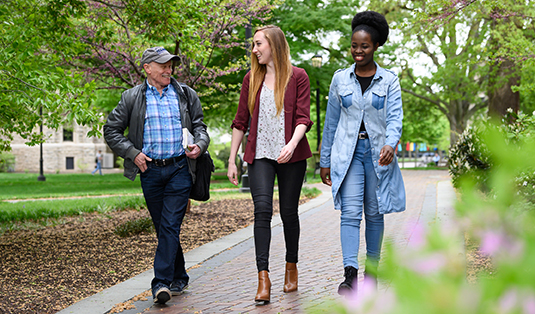
The CLAS Office of Graduate Studies offers personal tours of the beautiful Villanova campus. All tours begin in the Graduate Studies Office, located in Vasey Hall.
Schedule your tour!
FOLLOW GRADUATE STUDIES