
Gabrielle Piccirilli ’25 CLAS, ’26 MA Awarded Graduate Research Prize
Her paper, “‘An Author’s Voice and the ‘Wounds That Speak’: Creative Writing as Emotional Processing and Public Communication,” appears in the 49th edition of CONCEPT, the interdisciplinary graduate research journal in the College of Liberal Arts and Sciences.
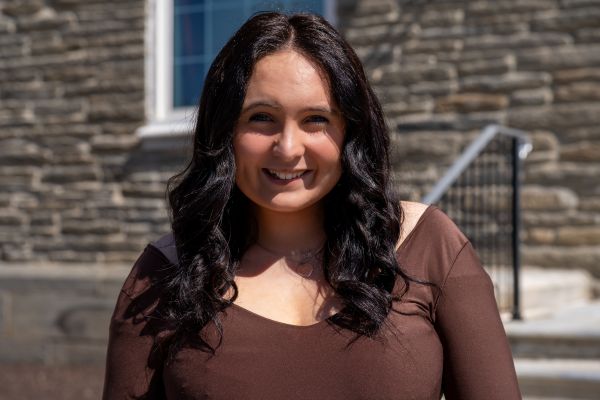
Writing is often a solitary and very personal experience that can be shaped by memory, emotion and life events. But as one graduate student’s research reveals, what begins in private reflection rarely stays there once a work is published, inviting readers along for the journey.
“There’s emotional labor in creative writing that isn’t really studied a lot,” said Gabrielle Piccirilli ’25 CLAS, ’26 MA, a combined BA/MA student in Communication who will complete her master’s degree this spring.
Piccirilli is the recipient of the 2026 Graduate Research Prize for her paper, “An Author’s Voice and the ‘Wounds That Speak’: Creative Writing as Emotional Processing and Public Communication.” It will appear in the 49th edition of CONCEPT, the peer-reviewed graduate research journal of Villanova University’s College of Liberal Arts and Sciences.
Piccirilli’s research explores writing as a cathartic process, something not always explored in classrooms that tend to focus on writing composition. The idea grew from her own experiences.
“If I'm dealing with something emotionally, I always find that writing is how I get through it, kind of processing on the page,” she said.
That instinct led her to ask a broader question: do other writers experience the same thing? To find out, Piccirilli conducted interviews and observed authors in public settings, including during a study abroad trip to Northern Ireland.
Across her research, she found that writers often channel personal experiences—sometimes subconsciously—into their work. Even in fiction, she discovered, the line between imagination and lived experience is rarely clear.
“Almost all of [the authors she observed] were putting autobiographical elements into fiction,” Piccirilli said. “I was really interested in exploring that, because a lot of people—I wouldn't say hide behind a character, but they put themselves into a character.”
Piccirilli based her work on “A Cognitive Process Theory of Writing” by Linda Flower and John R. Hayes, which describes writing as a complex mental activity rather than a linear or even mechanical task.
“I think it’s a big concept I was already familiar with as a writer,” Piccirilli said. “Once you put it on the page, you're confronting it. It's tangible and not just spinning around in your head.”
For Piccirilli, that’s the essence of her research: writing as an act of meaning-making that resonates. As she looks ahead and continues work on a novel of her own, she remains inspired by a lesson from her research: “You carry a story that needs to be told.”
CONCEPT seeks to honor and highlight not only exemplary papers within their respective disciplines but also scholarship with wide interdisciplinary appeal. It is published in partnership with the Office of Graduate Studies and the Falvey Memorial Library. The annual recognition ceremony was Friday, April 24, 2026, in the Driscoll Atrium.
The following is a list of authors, in addition to Piccirilli, whose papers appear in print and online in this year’s edition.
Papers appearing in print:
Deanna Hagman, History
“Parking on the Sidewalk: Retrofitting Old Cities for the Automobile”
Gina Imperiale, Human Resource Development
“Linking Green Space and Natural Light Access to Organizational Outcomes”
Julia Linde, History
“Triumph Rather than Tragedy: The Wheelchair of Justin Dart”
Guadalupe Martinez, English
“Education, Relationships, and Movement in Female American and Woman of Colour”
Hoang Thi Thu Hoa Nguyen, Theology
“The Aesthetic Silence at the Empty Tomb in Mark 16:1-8”
Papers appearing online:
Daniel Galal, History
“Political Ecology, Early America, and Novel Approaches to Environmental Histories”
Lucy Horton, Theatre
“Brechtian Binary Terror in The Threepenny Opera”
Carly Johnson, English
“Publicity, Power, and Perception: Research in Entertainment PR”
Griffyn Leeds, English
“Tuberculosis and Incest in The Fall of the House of Usher”
Megan Odland, Theatre
“Italian-American Dialect as a Semiotic Sign in Arthur Miller’s View from the Bridge”
Justin Robbins, Biology
“Patterns of Mangrove Expansion along Florida’s Northeast Coast”
About Villanova University’s College of Liberal Arts and Sciences: Since its founding in 1842, Villanova University’s College of Liberal Arts and Sciences has been the heart of the Villanova learning experience, offering foundational courses for undergraduate students in every college of the University. Serving more than 4,500 undergraduate and graduate students, the College is committed to fortifying them with intellectual rigor, multidisciplinary knowledge, moral courage and a global perspective. The College has more than 40 academic departments and programs across the humanities, social sciences, and natural and physical sciences.
Office of Graduate Studies
College of Liberal Arts and Sciences
Villanova University
Vasey Hall - Suite 202
SCHEDULE YOUR CAMPUS TOUR
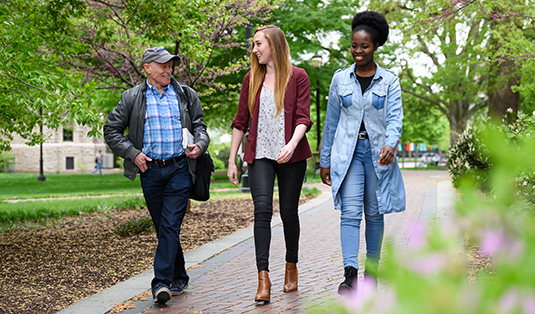
The CLAS Office of Graduate Studies offers personal tours of the beautiful Villanova campus. All tours begin in the Graduate Studies Office, located in Vasey Hall.
Schedule your tour!
FOLLOW GRADUATE STUDIES