
Stress from the Inside Out: Derick DeCamp ’26 MS Earns Top Thesis Honor in Psychology
By exploring how neuroticism can shape the body’s response to stress, DeCamp sheds new light on the connection between physical and mental health.

What happens in your body when you’re stressed—and why some people react differently than others—are questions that may have far-reaching implications for understanding mental and physical health.
For Villanova University graduate student Derick DeCamp ’26 MS, those questions became the foundation of his award-winning thesis exploring the connection between personality and wellbeing.
DeCamp’s thesis, “Neuroticism and Cardiovascular Stress Response: Differential Effects of Facets and Tasks,” earned him the Ingeborg L. and O. Byron Ward Outstanding Thesis Award, presented annually to the graduate Psychology program’s top master’s thesis.
It explored how neuroticism, a personality trait linked to frequent negative emotions, shapes the way people respond to stress.
“When you're engaging in a challenge or a stressor, you’re supposed to be activated to some degree; your heart's supposed to increase. That's normal, that's what you need,” DeCamp said. “But some individuals can have an exaggerated response, or a blunted response where it’s actually lower than what the average person would experience.”
While researchers have long linked the trait to a range of mental and physical health outcomes, the underlying reasons have remained unclear. To better understand that connection, DeCamp examined how the body reacts to stress at a more detailed level. Rather than treating neuroticism as a single trait, though, he focused on more specific facets, such as anxiety, depression and emotional volatility, helping to clarify why past research has produced mixed results.
Participants in DeCamp’s study completed a series of activities, including a simple resting period, a timed word challenge and recalling an anger-inducing memory, while their blood pressure was monitored.
The study found that people with higher levels of anxiety showed stronger immediate stress responses, while neuroticism overall did not. However, neuroticism, anxiety and emotional volatility were all linked to higher blood pressure after the task, suggesting a slower recovery. The type of task also mattered for anxiety.
Together, the findings help explain inconsistencies in previous studies and point to new ways of understanding (and potentially improving) stress-related health outcomes.
Those patterns could have real-world implications.
“If neuroticism is connected with stress dysfunction, it can be used for assessment purposes,” DeCamp said, noting that identifying certain personality patterns could help flag individuals who may benefit from additional support. He’s especially interested in how this work could inform interventions.
The project reflects DeCamp’s broader academic path. With plans to pursue clinical psychology, he became interested in emotion regulation and stress response across mental health conditions.
At Villanova, his interest was shaped through close collaboration with faculty mentors in the Department of Psychological and Brain Sciences, including his mentor for the thesis, Elizabeth Pantesco, PhD, as well as John Kurtz, PhD, and Benjamin Sachs, PhD. He described his thesis as “kind of a merging” of those influences as he drew upon each of their scholarship and expertise.
“All the faculty are very warm and very encouraging,” he said. “They give you so many opportunities to get involved with research, and that’s one of the many strengths of the Psychology program.”
DeCamp said that receiving the Outstanding Thesis Award was both meaningful and motivating.
“It’s very humbling,” he said. “A lot of work was put into it and going forward it just gives me hope that I can keep working hard, my work will be recognized and hopefully it will be helpful and meaningful.”
This fall, DeCamp will begin a PhD program in clinical psychology at West Virginia University, building on the research and mentorship that shaped his time at Villanova.
About Villanova University’s College of Liberal Arts and Sciences: Since its founding in 1842, Villanova University’s College of Liberal Arts and Sciences has been the heart of the Villanova learning experience, offering foundational courses for undergraduate students in every college of the University. Serving more than 4,500 undergraduate and graduate students, the College is committed to fortifying them with intellectual rigor, multidisciplinary knowledge, moral courage and a global perspective. The College has more than 40 academic departments and programs across the humanities, social sciences, and natural and physical sciences.
Office of Graduate Studies
College of Liberal Arts and Sciences
Villanova University
Vasey Hall - Suite 202
SCHEDULE YOUR CAMPUS TOUR
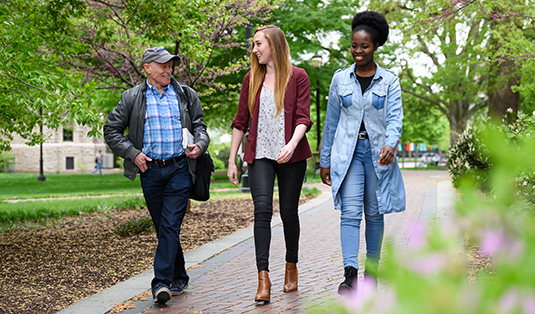
The CLAS Office of Graduate Studies offers personal tours of the beautiful Villanova campus. All tours begin in the Graduate Studies Office, located in Vasey Hall.
Schedule your tour!
FOLLOW GRADUATE STUDIES