
MA IN COMMUNICATION

The Master of Arts degree requires successful completion of at least 33 credit hours of graduate coursework relevant to the study of communication.
As an option, and with program approval, students may substitute up to two graduate courses (up to six credits) from outside of Graduate Studies in Communication that complement program offerings.
Degree requirements include a mix of Core and Focal courses, as well as a Capstone experience. In addition, no more than two independent study courses (up to six credits) will be counted toward M.A. degree requirements, and no more than three one-credit courses will be counted toward MA degree requirements including the required one-credit Orientation.
DEGREE REQUIREMENTS
Communication theory and research are the foundation of graduate study in the department.
After being oriented to graduate study within the program, students are required to engage coursework in strategic communication theory and at least one of the two required courses in methodology, qualitative or quantitative research methods in communication, prior to engaging any other coursework in the program.
Required Courses:
- COM 8008 – Orientation to Graduate Study (1 credit)
- COM 8100 – The Communication Perspective (3 credit)
- COM 8001 – Qualitative Research Methods (3 credit)
- COM 8002 – Quantitative Research Methods (3 credit)
Note: COM 8008, COM 8100 and either COM 8001 or COM 8002 must be completed prior to or concurrent with any other course.
Elective Courses
Upon completion of foundational coursework in the program, students engage focal courses in the discipline, giving them exposure to overarching philosophical, ethical, and methodological issues relevant to the study and practice of communication, strategic application of communication principles to the creation of messages within particular contexts, and the places, spaces, situations, and modalities within which principled communication has significant impact.
List of Elective Courses:
- COM 8003 - Internship in Communication
- COM 8004 - Communication Directed Study
- COM 8005 - Communication Special Topics
- COM 8009 - Personal Promotion*
- COM 8010 – Becoming an Academic*
- COM 8011 - Health Promotion Messages*
- COM 8101 - Performance Studies
- COM 8102 - Persuasion & Advocacy
- COM 8200 - Teambuilding & Small Group
- COM 8201 - Health Communication
- COM 8203 – Org. Research & Consulting
- COM 8204 - Conflict & Negotiation
- COM 8205 - Intercultural Communication
- COM 8206 – Diversity & Organizing
- COM 8207 - Organizational Communication
- COM 8208 - Public Communication Campaigns
- COM 8209 - International Public Relations
- COM 8210 - Leadership Communication
- COM 8211 - Communication & Identity
- COM 8212 - Communication & Advocacy
- COM 8300 - Public Relations Writing
- COM 8301 - Strategic Public Relations
- COM 8302 - Advertising
- COM 8303 - Mass Media Industries
- COM 8304 - Journalism
- COM 8305 - Media Literacy
- COM 8306 - Media Production
- COM 8307 - Visual Communication & Culture
- COM 8308 – Theories & Effects of Mass Com
- COM 8309 - Public Opinion
- COM 8310 - New Media
- COM 8314 - Photoshop*
- COM 8315 - Video Shooting Lab*
- COM 8316 - Audio Production*
- COM 8317 - Basic Web Design*
- COM 8318 - Developing Crisis Communication Materials*
- COM 8319 - Cultural Studies
- COM 8320 - Digital Media Design
- COM 8321 - Critical Studies in Advertising
- COM 8401 - Special Topics in Qualitative Research*
- COM 8402 - Special Topics in Quantitative Research*
- COM 8403 - Special Topics in Applied Organizational Communication*
To complete the MA in Communication degree, students must complete a capstone experience. The capstone can be completed in one of three ways: by successfully completing a comprehensive examination plus 5-6 additional elective credits; by completing the COM 9001 Portfolio course and completing an additional 2-3 credits; or by completing a six-credit Master’s Thesis. The details of the capstone requirement are listed below.
Capstone Requirement Options:
Comprehensive Exam Option: After completing all required courses and a minimum of 21 credits, students may apply to complete a written take-home comprehensive examination. The examination covers two areas: either COM 8001 Qualitative Research Methods or COM 8002 Quantitative Research Methods, and an elective course in the student’s area of specialization. Students may be required to orally defend their written responses to demonstrate sufficient competency. The Comprehensive Exam Option is non-credit bearing, which permits students to take an addition 5-6 credits to complete the degree. This option is ideal for students who wish to make more courses a part of their experience.
Portfolio Option: After completing all required courses and a minimum of 21 credit hours, students may enroll in COM 9001 Portfolio. The Portfolio Option allows students to select, revise, and expand the scope of projects undertaken during their graduate coursework at Villanova. Through these projects, students reflect upon and showcase their application of a communication perspective to real-world aesthetic, business, ethical, intellectual, or social problems. Students are required to publicly defend their work to successfully complete the course. Completing the Portfolio Option earns students 3 credits toward the degree. This option is ideal for students who wish to leave the program with a polished, professional portfolio of their work.
Thesis Option: After completing all required courses and at least 18 credit hours of coursework, students may apply to submit a written thesis and complete an oral defense to satisfy the capstone requirement. The thesis project is designed and completed under the supervision of an advisor, who must be graduate faculty in Communication, and who is assisted by a committee of at least two other faculty members or professional consultants, one of whom must be from Communication. The thesis committee must be formed and approved by the program prior to registering for thesis credits. Work on the thesis earns the equivalent of two courses (6 credits) toward the degree. This option is ideal for students who have a passion project or who wish to continue their graduate studies at the doctoral level.
Upon admission into one of our graduate programs, students are assigned to our Graduate Program Director for advisement. The director will be able to answer questions about the curriculum, degree requirements, and scheduling.
After students have been in the program for two semesters, students (in consultation with the Graduate Program Director) may choose a new academic advisor from our list of graduate faculty. That faculty member will then serve as the academic advisor for the remainder of the student's progress toward graduation. (Students choosing the thesis capstone option will also choose a thesis advisor, but note that this person does not have to be the same as the student's academic advisor.)
Your First Classes in Communication
For students beginning their graduate coursework in the Fall semester, their first classes in the program will be COM 8008 - Orientation to Grad Study and COM 8100 - The Communication Perspective. Students taking more than one course during the Fall will also take COM 8001 - Qualitative Research Methods OR COM 8002 - Quantitative Research Methods as part of their course load. Students taking three courses during that semester will choose a third course from the semester offerings.
For students beginning their graduate coursework in the Spring semester. their first classes in the program will be COM 8008-Orientation to Graduate Study and COM 8001 – Qualitative Research Methods OR COM 8002 – Quantitative Research Methods. Students taking more than one course during the Spring will choose additional courses from the semester offerings. Students beginning in the Spring will be required to take COM 8100 - The Communication Perspective in their second semester in the program, or prior to taking any additional advanced coursework.
MA and certificate students accepted for starting in the Fall semester CANNOT take summer classes during the summer prior to their fall start date (with the exception of COM 8008 - Orientation to Grad Study, a course which is required of all those beginning the degree).
Ready for the Next Step?
Department of Communication
Garey Hall Room 28 Villanova University
800 Lancaster Avenue
Villanova, PA 19085
Tel: 610.519.6434
Director: Dr. Amy Way
Graduate Admin: Sue Knittel
GRADUATE ALUMNI NEWS
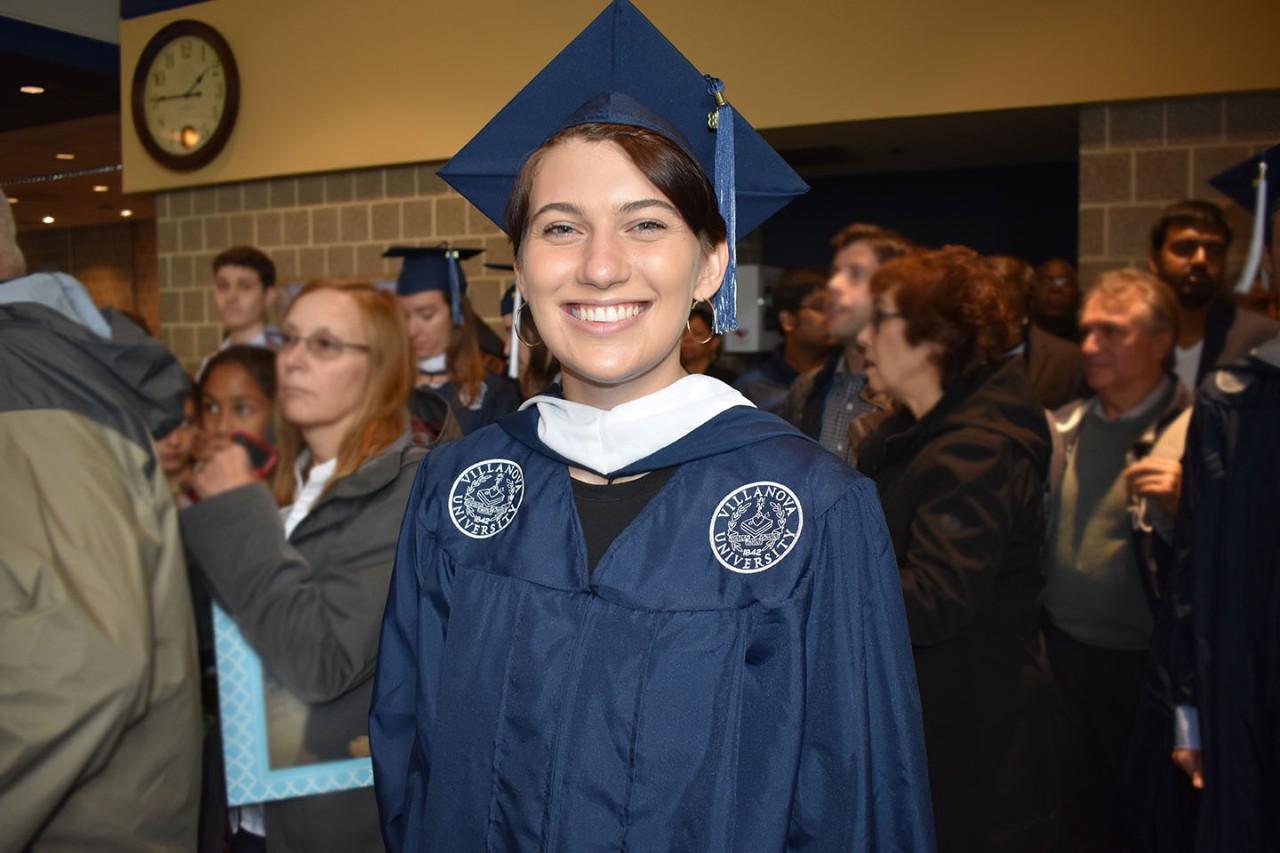
Passion for Social Change and Activism Drives Communication Master’s Student to Pursue Doctorate
Micki Burdick ’18 MA joined the Villanova University Master’s program in Communication with a passion for activism and aspirations to improve her writing and research skills. She is now pursuing a PhD in Rhetoric and Public Advocacy at the University of Iowa.
Follow the Department of Communication