
AWARDS
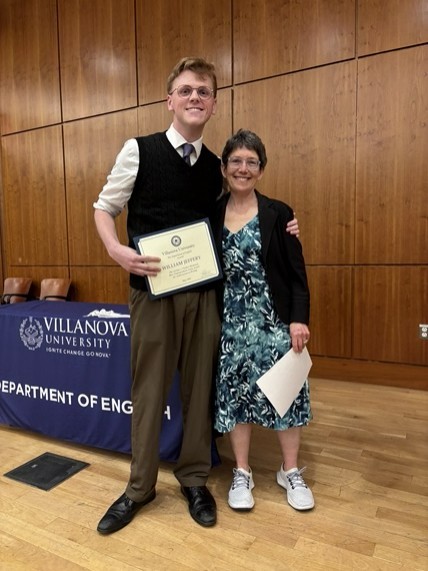
Each year the English department recognizes graduate and undergraduate students for their distinguished poetry, fiction and academic essays.
Congratulations to our 2026 award winners!
Jenna Kosnick '26 MA received the Margaret Powell Esmonde Memorial Award, recognizing the best graduate essay, for their paper, “‘Madmans to Play With’: Asylum Erotica in Dracula.”
William Jeffery '27 CLAS and Rachel Taylor '26 CLAS won the Jerome J. Fischer Memorial Award, recognizing the best undergraduate essay, for their papers, “Why Sly?: Introducing the Audience to Themselves” and "In the Company of Ghosts: Haunting as Restoration."
Majo James ’26 CLAS received the George D. Murphy Award in Creative Writing, Poetry.
Jenine Hazlewood ’26 CLAS received the Addie Fiscus Award in Creative Writing, Prose.
Margaux Barrett '26 CLAS received the English Senior Achievement Award.
Kaitlin Gibson '26 CLAS received the Medallion of Excellence.
You can check out additional coverage of our most-recent awards ceremony on our blog.
2026 LISTING OF AWARDS
The Edward McGrath Medallion, the English Department’s Medallion of Excellence, goes to the graduating senior whom the department selects for outstanding overall performance in the major.
2026 - Kaitlin Gibson
2025 - Mickey Wilcox
2024 - Kylie Horan
2023 - Ava Lundell
2022 - Chloe Mikye Cherry
2021 - Shivani Patel
2020 - Joanne Hwangbo
2019 - Caroline Grace Stagliano
2018 - Elizabeth Eby
2017 - Stephen J. Purcell
2016 - Emma Pettit
2014 - John Szot
2014 - Christine V. Tergis
2013 - Alexa I Pastor
2012 - Theresa Donohoe and Nicole Battisti
2011 - Molly Schreiber
2010 - Max Stendahl
2009 - Joe R. Gonzalez
2008 - Angela S. Allen
2007 - Emily M. Trovato
2006 - Thomas Emerson
2005 - Kathryn M. Rutigliano
2004 - John Durnin
2003 - Mari Grace Crosby
2002 - Michael Foley
2001 - Kristin Suga
2000 - Christine Anderson
1999 - Thomas McKinley
1998 - John Giordano and Megan Norcia
1997 - Lisa Tomaszewski
1996 - Mark Spoonauer
1995 - Kelly Beissel
The Jerome J. Fischer Memorial Award is given annually to the most distinguished undergraduate essay written in a Villanova English course. The Fischer Award honors Jerome J. Fischer, who taught nineteenth-century British literature courses, as well as a variety of other courses, at Villanova from 1947 until his retirement in 1983. He died in 1984.

Jerome J. Fischer, image courtesy of The Villanovan
2026 Winners: William Jeffery is a Junior Education major with an English concentration from West Chester, PA. He is involved on campus as Vice President of Villanova Refugee Empowerment, as an active member of Villanova Student Theatre, and as an RA. He is thankful for the constant support from friends, family, and professors alike.
“Why Sly?: Introducing the Audience to Themselves” argues that Christopher Sly’s framing role in The Taming of the Shrew is central rather than incidental, transforming the play into a critique of social identity and constructed reality. Sly’s manipulation into the belief he is a nobleman exposes class and identity as performative, which, as a theme, is echoed in the disguises and role-playing of the main plot. By paralleling Sly’s deception with Katherine’s “taming,” the essay suggests that both gender and class hierarchies are sustained through language, repetition, and coercive performance. The essay works to discuss how Sly’s story implicates the physical audience as well, challenging them to question the stability of their own social roles and perceptions of reality.
Rachel Taylor is a senior, majoring in psychology with a minor in ethics, who has always been passionate about literature and the places it allows us to discover and create. This essay is special because it allowed Rachel the space to bridge her two educational interests by exploring processes of grief and healing in a way that recognizes and values marginalized ways of knowing.
This essay argues that in Indigenous literature, “haunting” functions not as a source of fear but as a restorative, relational force that reconnects individuals, communities, and ancestors. Through close readings of Hiʻilei Julia Kawehipuaakahaopulani Hobart’s “The Windward View” and José Barreiro’s Taíno, the paper demonstrates how haunting operates across personal, communal, and reciprocal dimensions to heal fragmentation caused by colonial violence. In this way, haunting becomes a mode of Indigenous knowledge and resurgence, guiding both the living and the dead back into balanced relationships with themselves and each other.
Previous Winners:
2025 - Sophia Adams and Juan Tampe
2024 - Emily Hanlon and Charlotte Ralston
2023 - Cynthia Choo and Sarina Sandwell
2022 - Ryan Haggerty and Sarina Sandwell
2021 - Julia Valenti
2020 - Ariana Megerian
2019 - Gracie Stagliano
2018 - Gracie Stagliano
2017 - Blaire Bernstein
2016 - Kevin Madden
2015 - John Szot
2014 - Megan Plevy
2013 - Shanon Welch
2012 - Theresa Donohoe
2011 - Molly Schreiber
2010 - Max Stendahl
2009 - Jamie Kapalko
2008 - Daniel E. Trucil
2007 - Emily Trovato
2006 - Stephen Cornell
2005 - Kristy Wessman
2004 - Mark Napolitano
2003 - Valerie Kate Fernandez
2002 - Rebecca Corcoran
2001 - Michael Foley
2000 - Corinne Welsh
1999 - Jennifer Joyce
1998 - Cara LaColla
1997 - Chris Eagle
1996 - Wendy Anne Tucker
1995 - [not given out]
1994 - Michael DiRuggiero
1993 - Rosemary Scalo
1992 - Mary Kovalchick
1991 - Peter Naccarato
1990 - Sarah Pines
1989 - Anne Marie Ryan
1988 - Jon Lemole
1987 - Jill Stevens
The Margaret Powell Esmonde Memorial Award is given annually to the most distinguished graduate essay written in a Villanova English course. The Esmonde Award honors Margaret Powell Esmonde, who taught at Villanova from 1974 until her death in 1983. She was a specialist in Renaissance literature who also taught courses in science fiction and children’s literature.

Margaret Powell Esmonde, image retrieved from Children's Literature Association Quarterly
2026 Winner: Jenna Kosnick is a second year Master’s student in the English department, currently working on a thesis examining P.G. Wodehouse’s Jeeves novels in the context of queer theory. Their primary research interest is the intersection of sexuality and violence in literature of the long nineteenth century, and they look forward to continuing this work as they move on to a PhD program at the University of Western Ontario.
“‘Madmans to Play With’: Asylum Erotica in Dracula” examines the relationship between John Seward and R. M. Renfield in Bram Stoker’s Dracula. Drawing together existing scholarship on queerness, masculinity, and medicine in Dracula, this paper reframes Seward and Renfield’s tumultuous interactions as being part of a shared erotic game between them. By doing so, this paper is able to not only reveal a new perspective on the space of the asylum in Dracula, but also makes a larger argument for the book’s relationship to perverse and dangerous desire, locating it not in the foreigner, but on England's native shores.
Previous Winners:
2025 - Jaxon Parker
2024 - Sarah Gregory
2023 - Theo Campbell
2022 - Madie Davids
2021 - Anne Jones
2020 - Olivia Stowell
2019 - Avni Sejpal
2018 - Nicholas Manai
2017 - Laura Tscherry
2016 - AJ DeBonis
2015 - Eric Doyle
2014 - Theodora Hermes
2013 - Rebecca Hepp, Cara Saraco
2012 - Alexandra Edwards
2011 - Benjamin Raymond
2010 - James McAdams
2009 - Don James McLaughlin
2008 - John Breedlove
2008 - Rebecca Steffy
2007 - Rebecca Burnett
2006 - Karen Y. Lee
2005 - Marc Napolitano
2004 - Victor Sensenig
2003 - Deborah Gross
2002 - Brian Sweeney
2001 - Patricia Crouch
2000 - Laura Giuliani
1999 - Sharon Cournoyer
1998 - Marc Schuster
1997 - Mary Ann Quigley
1996 - Robert Duggan, Jr.
1995 - Gale White
1994 - Gale White
1993 - Daniel Hipp
1992 - Helen Goff
1991 - Sr. Elaine Marie Glanz, I.H.M.
1990 - Katrien Conlan
1989 - Janet Wallin
1988 - Anne Gallagher
1987 - Gregory Sullivan
1986 - Ellen Wilmot
The George D. Murphy Award in Creative Writing honors a longtime faculty member in the English department. The winner is chosen each year by a panel of Villanova faculty and an outside writer.
2026 Winner: Majo James is a senior political science student with minors in English and Creative Writing. He enjoys reading, writing, and watching movies (follow his Letterboxd for his reviews). He will be attending law school in the fall.
Cashier
The boys place a box before
him, snickering at their irreverence and the
smell they’re determined to smell coming
off my father who doesn’t realize what
he’s ringing up or why
they’re laughing
the Manager watches from a stool nearby so the
poor immigrant’s hands that dip
into the register don’t dip
into his pockets
His English teacher once gave his friend
bonus points for writing don’t not
do not. how proud she would be to see him now
come to the States on his wife’s ticket
not the clever teenage engineer
saving grace of the now-boarded Chennai
technologies but the
funny little brown man at the 7/11
ringing up a box of condoms
2025 Winners: Samuel Sheard, Poetry; and Jenine Hazlewood, Prose
About George D. Murphy
The George D. Murphy Award in Creative Writing honors a longtime faculty member in the English department. George D. Murphy, PhD, received his BA in 1949 and MA in 1951 in English from the University of Notre Dame and his PhD in American Civilization from the University of Pennsylvania in 1964. He joined Villanova’s English Department in 1954 and retired in 2000 after 46 years of service. His scholarly publications focused on American writers of the 20th Century. While at Villanova, he was known for his exquisite sense of humor and a singular gift for recalling and recounting a host of humorous tales. While an undergraduate at Notre Dame, he was on the editorial board of its literary magazine—The Juggler of Notre Dame—and contributed a number of poems, short stories and critical essays. He returned to creative writing at the end of his life as a way of coping with grief over his wife’s death and produced many first-rate poems.
The Addie Fiscus Award in Prose honors an English major and talented creative writer. The winner is chosen each year by a panel of Villanova faculty and an outside writer.
Adelaide “Addie” Fiscus (2005-2025) was an English major, a Tri Delta sorority sister, an avid competitive swimmer, a devoted twin, a dear friend to many Villanovans, and an indomitable spirit who lived her life with joyful resilience. She was a talented creative writer whose wise words and generous acts moved students and professors in her three creative writing classes at Villanova. By writing tenderly about the life and death of her twin sister Maude, and by living vibrantly in her memory, Addie left an indelible mark on the department, the college, and the Villanova community. Addie died of complications from epilepsy in March 2025, and we at Villanova miss her dearly.

Addie Fiscus, image courtesy of the Fiscus family
2026 Winner: Jenine Hazlewood is a senior English major at Villanova from East Orange, New Jersey. Jenine has minors in History, Theology, Africana Studies, Peace and Justice Studies, and Writing and Rhetoric. During her time at Villanova, Jenine has been a lead student researcher and transcriptionist on the public humanities project Taught By Literature: Recentering Black Women Intellectuals. Her plans after senior year include teaching middle school and attending grad school for an MFA in Creative Writing.
“The Art of Concealment”
By
Jenine Hazlewood (an excerpt)
There is a place where all girls and women meet. The day I watched The Lovely Bones, I had to meet my sisters, my mother, and my grandmother where they were. I don’t remember speaking or reacting with my siblings in any way, but there was something spoiled about the reality we returned to outside of the screen. And I think I might have looked around at them with two questions in my eyes: 1) What are we supposed to do with this information? 2) Did these lessons come too late for them, as they did for me?
Then, I think I might have turned to my mom. I thought about the time she slept in our room, falling asleep in my twin bed watching Alice in Wonderland on a Dora box television set, after showing us the mugshot of a criminal on the loose in our neighborhood. I think about her cousin being her first Uncle Johnny. I think about my grandfather being 11 years older than my grandmother, who loved going bowling and going out with her friends until the sun came up before she got pregnant. I think about her telling me to cross my legs even when I had pants on and her chanting “Have fun when you’re young” on a 50-minute facetime call.
So, yes. There is a place where all girls and women meet. It looks like crossroads that stretch many miles and years across different terrains and climates. And if you make it back to tell the tale, of the ancient pilgrimage and your sightseeing – of the largest gathering of women and girls in one area, you will never know how to be quiet again. After meeting Susie Salmon, I spoke more words than I had in all my 6 years. And every year that I lived past Susie’s cursed 14, my word bank grew exponentially because we are our own testimony.
After some time, I stopped watching out for Uncle Johnnies because I knew just about everything about them. And despite, knowing to look at their eyes and read them and watch out for their sick languor in broad daylight, I was smart enough to know they were everywhere, and I was severely outnumbered. I just hoped for a day when I wouldn’t be a child, and I could be wrinkles and river spray.
Something happened that day on the couch. It was the type of experience that thingifies feeling. I tricked my fascination, disgust, and heartbreak into being just that, when really, I had fallen in love with Susie Salmon. I love Susie Salmon because she taught me lessons my grandma could not bear teaching. She repeated what my sisters would not utter. Susie Salmon taught me how to be anadromous; how to survive and navigate an unrelenting sea in my adolescence, so that I may return to fresh and calm waters for the rest of my life. My love for her was like the journey she undertook to reach heaven – disorienting, confusing, beautiful, and degrading. And maybe that is what love is because I would’ve stopped breathing for a while to give her a couple more breaths.
I’m thankful that my dad prepared me for the strange men who yank at zippers in an attempt to unstitch the heart I suture every morning and night. I’m thankful to my mom for giving me a better teacher than she could be at that moment, a teacher who became my third pseudo sister. Despite trying, I think my mom could only teach with a bit of fear, defeat, and guilt. She knows that every Uncle Johnny has a niece. And when a man decides to touch the intimate parts of you, when you are more girl than woman, you stay a girl forever. So, I say it is natural to forget sleep and his cousin. It’s natural to forget safety and his mistress. It is natural to forget justice and his god. I wish you all a long and happy life.
The winner of the English and Honors Award in Creative Writing is chosen each year by a panel of Villanova faculty.
2024 Winner: Justin Badoyen is a senior Philosophy major minoring in Theatre and Creative Writing. He has spent most of his academic pursuits at Villanova focusing on early modern drama and performance philosophy with an eye toward studying aesthetics and the philosophy of art. Justin’s first foray into Creative Writing was through playwriting, which helped him foster an understanding of the various craft elements that make up enjoyable storytelling. Now, as a senior, he hopes to continue exploring and practicing the many genres and forms of Creative Writing so that he may better bring his stories to life.
Ars Requirit Totum Hominem [The Art (of Alchemy) Requires the Whole Person] (An Excerpt)
As Mr. Young sipped his tea, he felt the heat banish the winter air from his lips. It was his particular habit to spend his morning sitting out on the balcony, no matter the weather. His wife would often chide him, claiming he was bound to fall ill lounging about in the cold. Mr. Young silently reveled in the fact that he had yet to prove her right. There was something about the silence that pleased him. The roaming air and boundless skies gave his imagination room to grow, a luxury his job rarely afforded. As the owner and overseer of two coal mines just South of Derbyshire, orders and meetings constantly filled his schedule. His mind was focused on manifests and wages, a hard contrast to his youthful passions. As his tea cooled, he thought about what he would do if his whole day was like this morning: free. Mr. Young imagined riding out in the country with his wife in tow, nowhere to be. He imagined himself hunched over his desk, penning out a story or a short piece on the piano like he used to do in university. Mr. Young laughed at himself quietly, realizing that being stuck at a desk is what he does every day anyway.
Looking down, he saw his cup was empty now and resolved himself to go about the rest of his day. Returning inside, he could hear his wife’s singing coming from the reading room, a piece by Dvorak, “Als die alter Mutter.” He learned how to play the song on piano for her birthday a few years ago. Mr. Young tidied himself and descended the stairs. He watched his two terrier pups chase each other across the foyer and around the corner. He could see something stuck inside the mail slot at the base of the stairs. It was a parcel and a bundle of letters. The parcel looked to be a small box wrapped in brown paper. Mr. Young presumed it had been there for a while as it was cool to the touch. There were five letters tied to the parcel with butcher’s twine. Across the face of the letter on the top of the pile read, “To Damien Young.”
2023 Winner: Dylan McMahon
The English Honor Society is composed of senior English majors with high GPAs both overall and in English courses. Members are selected in the spring of their senior year. (They do not have to apply.)
2026 English Honor Society
Sophia Adams
Maria Andrinopoulos
Margaux Barrett
Maria Therese Barry
Bianca Brucker
Lydia Chandler
Isabel Choi
Mary Kate Farrell
Charlotte Finch
Mackenzee Fritz
Kaitlin Gibson
Abigail Glynn
Madeleine Guiliano
Jenine Hazlewood
Kathleen Lewis
Zachary Murray
Wyatt Oatman
Juan Pablo Tampe
Michael Turner
Ailish Wilson
The Villanova English Department’s Core English Honor Roll recognizes students whom instructors have identified as exceptional students in their Core English courses. This honor is for the one or two students in each Core English course who demonstrated the most aptitude in scholarly writing about literature.
For the spring semester of 2026, the following students made the Core Honor Roll:
Paolo Arcuri
Jake Bellenger
Floresse Bergado
Cali Carss
Quinn Chapman
Addy Emkes
Nina Fanelli
Liam Foley
Daniella Forson
Abigail Gambla
Peyton Gibbs
Nustifafa Gyane
Martha Haile
Guzman Isabella
Molly Jacobson
Charlotte Lee
Nate McClay
Taylor McDonald
Aidan McGovern
Caroline McManus
Sean Montheith
Kyra O'Brien
Jessica Opalka
Julia Prendergast
Owen Roberts
Paulina Sierra
Amelia Simons
Sofia Tomanelli
John Tyndal
Spartan Walker
Raina Wamsley
Cooper Wiseman
Meghan Youngren
Abigail Zbiegien
The Core Literature and Writing Seminar Essay Award has been given to the best papers written for English 1975.
2026 Winner - Shaina Keough
Shaina Keough is a junior from Richmond, Vermont, double majoring in Sociology and Peace and Justice Studies. She is happiest when outdoors, whether that’s rock climbing, playing sports, or lying in the grass with a book and a pint of Ben and Jerry’s ice cream. Shaina has always loved creative writing, and although she hopes to be a Civil Rights Attorney one day, she also aspires to write many more poems and stories in the future.
“Letters Lost, To the Wind” was inspired by Victoria Chang’s book Dear Memory: Letters on Writing, Silence, and Grief. It follows the story of how Shaina felt before, during, and after her dad passed away when she was 14 years old. The letters explore how important it feels to hold onto the memories we have of those we have lost, especially as the darkest memories seem to always want to take over. The wind works as a constant metaphor guiding her through some of the toughest times, at first painfully, but now as a gentle shove, encouraging Shaina to accept her past, present, and future, and to continue down the road of life with all that she has experienced and learned.Previous Winners:
Spring 2025 - Arianna Prior
Spring 2024 - Emma Stecher
Spring 2023 - Madison Rhodes
Spring 2020 - Walter McDonald
Spring 2019 - Jordan McMeans
Spring 2016 - Katie Vaughn
Fall 2016 - Bella Burda
Fall 2015 - Frank Fazio and Ciara Earrey
Spring 2014 - Nicole Conway
Fall 2014 - Sean Campbell and Kevin Madden
Spring 2013 - Roderic Hutton
Fall 2013 - Patrick Ciapciak
Fall 2012 - Paige Kennedy and Danielle Sekerak
The Literary Experience Essay Award has been given to the best papers written for English 1050.
Previous Winners:
Spring 2012 - Nicholas Cho
Fall 2012 - Alissa Foti
Spring 2011 - [not awarded]
Fall 2011 - Monica Solis
Spring 2010 - Anne Stohlquist
Fall 2010 - Lien Trieu
Spring 2009 - Michael Tomae, Nakoya Wilson
Fall 2009 - Ellie Garbade
Spring 2008 - Kailee Fowler
Fall 2008 - Greg Cappa
Spring 2007 - Marissa Zator
Fall 2007 - C J Hodukavich
Spring 2006 - Christina Park
Fall 2006 - Jennifer Latz
Spring 2005 - Christian Skonier
Fall 2005 - Stephanie Cody
Spring 2004 - Emily Trovato and Kerri White
Fall 2004 - John Zurbach
Spring 2003 - Monica Borgone
Fall 2003 - Nadia Nauss
Spring 2002 - Elizabeth Micklow
Fall 2002 - Adrienne Sanetrik
Spring 2001 - Matt Varga
Fall 2001 - Matt Nespoli
Spring 2000 - Andrea Flood
Fall 2000 - Michael Knerr and Ryan Zitnay
Spring 1999 - Jocelyn Trufant
Fall 1999 - Kate Schramm
Fall 1998 - Megan Knecht
The Senior Achievement Award is given to a senior for distinguished contributions to the life of the department, including intellectual leadership, mentorship, and community participation.
2026 - Margaux Barrett
2025 - Riley Nelson
Villanova University
Department of English
St. Augustine Center
Room 402
Department Chair
Professor Jean Lutes
FOLLOW THE ENGLISH DEPARTMENT