
National Science Foundation Awards CAREER Grant to Villanova Engineering Professor
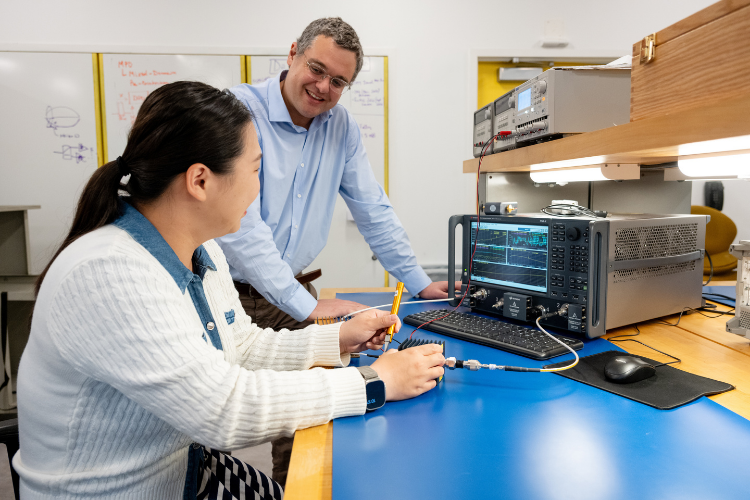
VILLANOVA, Pa. (May 6, 2026)—The National Science Foundation (NSF) has named Tommaso Cappello, PhD, assistant professor of Electrical and Computer Engineering and director of the High-Performance RF Lab at Villanova University’s College of Engineering (COE), as a recipient of the Early Career Development (CAREER) Award. His project, “Mixed-Domain Pre-Distortion of RF Non-Linear Components for High-Efficiency, Wide-Band, and Reconfigurable Transmitters,” has received a five-year, $547,357 grant, which will allow Dr. Cappello to conduct research to improve the efficiency and performance of wireless communication systems through innovative transmitter design.
The CAREER Award is the most prestigious grant supporting career development activities for teacher-scholars who most effectively integrate research and education within the context of their organization's mission.
Dr. Cappello’s research at Villanova focuses on radio frequency (RF) engineering, a field within electrical engineering that studies high-frequency signals used in wireless applications such as telecommunications, radar systems and smartphones. His CAREER project centers on improving the performance of transmitters—the components responsible for sending signals through the air—by addressing inefficiencies in power amplifiers, which are a major source of distortion, energy consumption and heat generation in communication systems.
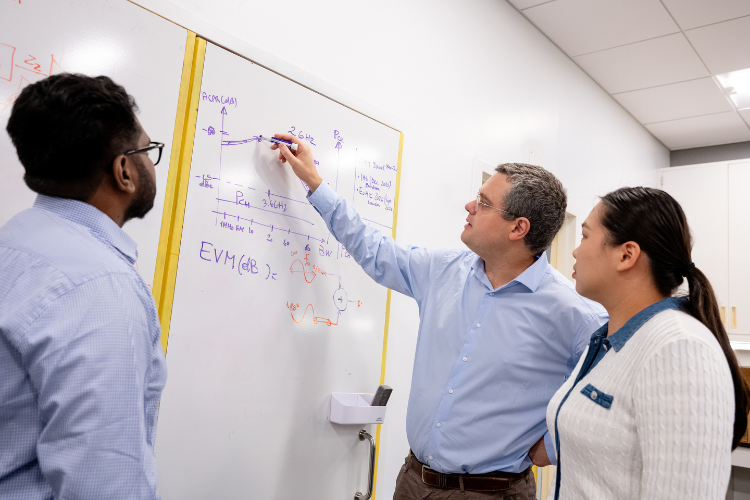
“It is incredible what the integration of digital, analog and RF electronics can achieve together—while historically they have been designed by separate groups, the need for performance now requires an integrated approach,” Dr. Cappello said. “This is exactly the goal of this project: to develop new techniques to improve the relationship between efficiency and linearity by using mixed-domain electronics, ensuring signals are transmitted accurately while using less energy. I’m incredibly thankful for NSF’s support of this endeavor and to receive this distinguished award.”
Telecommunications infrastructure accounts for an estimated 1-2% of global energy consumption, so improving transmitter efficiency can have a meaningful environmental impact, contributing to reduced greenhouse gas emissions worldwide.
The research backed by the CAREER Award also has the potential to enable smaller, lighter and more cost-effective transmitters with improved performance. These systems could operate at lower temperatures, increasing reliability while also offering greater range, bandwidth and overall functionality.
Dr. Cappello’s work includes collaborations with researchers at The Ohio State University and the University of Pennsylvania.
About Villanova University: Since 1842, Villanova University’s Augustinian Catholic intellectual tradition has been the cornerstone of an academic community in which students learn to think critically, act compassionately and succeed while serving others. There are more than 10,000 undergraduate, graduate and law students in the University's six colleges—the College of Liberal Arts and Sciences, the Villanova School of Business, the College of Engineering, the M. Louise Fitzpatrick College of Nursing, the College of Professional Studies and the Villanova University Charles Widger School of Law. Ranked among the nation’s top universities, Villanova supports its students’ intellectual growth and prepares them to become ethical leaders who create positive change everywhere life takes them. For more, visit www.villanova.edu.