Betting on a Circuit Split: Why the Supreme Court Should Hold That Kalshi’s Sports Event Contracts Are Wagers, Not Swaps
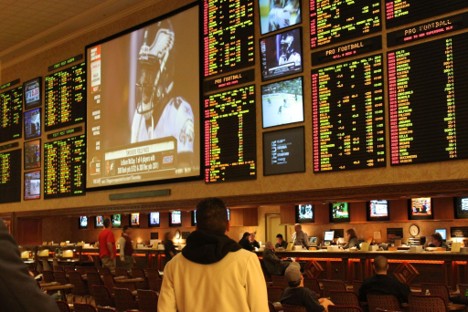
Photo Source: Baishampayan Ghose, Sports Betting at a Las Vegas Casino, Flickr (Nov. 18, 2010) (CC BY-SA 2.0).
By: Tanner Mundy* Posted: 10/22/2026
Kalshi advertises itself as “the first app for legal sports betting in all 50 states,” yet insists that what it sells are not bets at all.[1] Instead, Kalshi characterizes its sports event contracts as “swaps” under the Commodity Exchange Act (“CEA”), which would place them within the exclusive jurisdiction of the Commodity Futures Trading Commission (“CFTC”) and beyond the reach of state gambling laws.[2] Sports are central to Kalshi’s business, as more than 90% of its 2025 trades, representing 95% of its revenue, were sports-related.[3] Three federal courts of appeals have now reviewed preliminary injunction rulings on Kalshi’s theory, and they have split two to one against it.[4] New Jersey has asked the Supreme Court to resolve the conflict, and the Court should grant review and hold that these contracts are wagers, not swaps.[5] Murphy v. NCAA[6] left the choice to legalize sports betting to each state, and a ruling for Kalshi would let any company escape those choices by listing its bets on a CFTC-registered exchange.[7]
How the Circuits Split
In April 2026, a divided Third Circuit panel affirmed a preliminary injunction barring New Jersey from enforcing its gambling laws against Kalshi.[8] The majority reasoned that the outcome of a sports event “certainly can be associated with a potential financial, economic, or commercial consequence,” upholding the district court’s finding that such outcomes affect sponsors, advertisers, television networks, and franchises.[9] Judge Roth dissented, observing, as New Jersey had argued, that Kalshi’s interpretation would likely sweep in “virtually every kind of wager,” including casino games and charity raffles.[10] In August of 2026, the Ninth Circuit broke from the Third Circuit, affirming the dissolution of Kalshi’s injunction against Nevada as to its sports contracts and concluding that “Kalshi has a gambling problem.”[11] In September of 2026, the Sixth Circuit sided with the Ninth, holding that Kalshi failed to show that its contracts qualify as swaps and, alternatively, that the CEA would not preempt Ohio’s or Tennessee’s gambling laws even if they did.[12]
A Game Is Not a Swap
The CEA defines a swap to include a contract providing for payment “dependent on the occurrence, nonoccurrence, or the extent of the occurrence of an event or contingency associated with a potential financial, economic, or commercial consequence.”[13] The decisive phrase is “associated with,” which the Sixth Circuit interpreted to require an event “inherently associated” with a financial consequence, rather than one with merely downstream economic effects.[14] Kalshi’s alternative has no stopping point, as the Sixth Circuit noted that it would cover a contract on the color of the Super Bowl’s Gatorade shower, since the broadcast might boost sales of that flavor.[15] The Ninth Circuit put it bluntly: a Mets loss might, “in an uber-technical sense,” lead some fans to “guzzle more beer,” but calling one game “associated” with a financial consequence is “somewhat fanciful.”[16] The statutory context reinforces this reading, as the definition’s neighboring subparts refer almost exclusively to financial measures, indices, or instruments such as interest rates, currencies, and securities.[17] Those instruments allow parties to hedge existing risk, whereas Kalshi’s sports contracts, as the Ninth Circuit explained, “create risk, largely for ordinary consumers, where none previously existed.”[18] Kalshi itself once agreed, telling the D.C. Circuit in 2024 that “[t]he classic example” of a gaming contract “is a contract on the outcome of a sporting event.”[19] Finally, because the CEA generally prohibits entering into swaps except pursuant to a designated contract market, treating sports bets as swaps would mean that every wager at a licensed sportsbook, or even between friends, violates federal law.[20]
Did Dodd-Frank Quietly Undo Murphy?
In Murphy, the Supreme Court struck down the Professional and Amateur Sports Protection Act (“PASPA”), which had barred states from authorizing sports gambling, as a violation of the anticommandeering doctrine.[21] The Court observed that “Americans have never been of one mind about gambling” and explained that, unless Congress directly regulates sports gambling, “each State is free to act on its own.”[22] The Court also described federal gambling statutes as implementing “a coherent federal policy” that respects “the policy choices of the people of each State.”[23] When Congress passed the Dodd-Frank Act in 2010 in response to the 2008 financial crisis, PASPA still largely prohibited states from authorizing sports gambling, making it unlikely that Congress intended the CEA’s swap definition to federalize sports wagering.[24] The Ninth Circuit made the same point, reasoning that interpreting the definition to encompass sports betting would mean assuming Congress was “hiding an elephant in a mousehole.”[25] Yet under the Third Circuit’s approach, a CFTC-registered exchange may self-certify its sports contracts, begin offering them the next business day, and displace the choices that Murphy protected.[26] Congress has not regulated sports gambling directly, or indirectly through the CFTC, and the CFTC itself acknowledged in 2024 that it “is not a gaming regulator.”[27] Nor can the CFTC, which has sided with Kalshi and in June 2026 proposed converting its rule barring gaming contracts into a discretionary review, supply the missing authority, because courts, not the agency, decide what “swap” means.[28]
Consumers and Athletes Caught in the Middle
The stakes extend beyond federalism to the consumer protections that states enacted after Murphy.[29] New Jersey, Ohio, and Tennessee each require sports bettors to be at least twenty-one years old.[30] Kalshi, by contrast, generally allows users eighteen and older to open accounts, and a CNN analysis published in August 2026 estimated that users between eighteen and twenty-one had traded $3.9 billion in sports and parlay contracts on Kalshi so far that year.[31] Ohio’s regulator described Kalshi’s offering of sports wagering to people under twenty-one as “a flagrant disregard” of the state’s minimum gambling age, and Nevada and its co-amici warned the Sixth Circuit that Kalshi’s position “would effectively lower the gambling age in many States.”[32]
Sports integrity is also at stake, because New Jersey’s constitution prohibits wagering on college events held in New Jersey or involving New Jersey college teams, a restriction intended to protect student-athletes.[33] New Jersey’s cease-and-desist letter accused Kalshi of offering contracts on collegiate events in violation of that provision, and Kalshi has listed contracts on which teams will advance in the NCAA basketball tournaments.[34] Murphy itself acknowledged these concerns, noting opponents’ argument that sports gambling is “particularly addictive and especially attractive to young people” and observing that gamblers had, in the past, damaged the reputation of professional and amateur sports.[35]
The Court Should Take the Bet
Kalshi’s response to New Jersey’s petition is now due November 9, 2026.[36] Robinhood and Crypto.com’s derivatives affiliate have also petitioned for review of Ninth Circuit decisions issued the same day as Assad, so parties on both sides of the circuit split now seek the Court’s intervention.[37] Until the Court acts, the legality of sports prediction markets will continue to vary from state to state.[38] The Court should grant certiorari and adopt the Sixth and Ninth Circuits’ interpretation, because a definition written for Wall Street should not override the choice that Murphy gave to each state.[39]
*Staff Writer, Jeffrey S. Moorad Sports Law Journal, J.D. Candidate, May 2027, Villanova University Charles Widger School of Law.
[1] See KalshiEX, LLC v. Assad, No. 25-7516, slip op. at 10, 27 (9th Cir. Aug. 28, 2026) (noting Kalshi’s self-description as “the first app for legal sports betting in all 50 states” while Kalshi argues that sports bets and sports event contracts are different).
[2] See id. at 10, 23 (describing Kalshi’s argument that CFTC has exclusive regulatory authority over its sports event contracts, such that Nevada’s gaming regulations do not apply, and Kalshi’s reliance on CEA’s definition of “swap”); see also 7 U.S.C. § 2(a)(1)(A) (2024) (granting CFTC “exclusive jurisdiction” over transactions involving swaps traded or executed on designated contract market).
[3] See Assad, slip op. at 14 (reporting that over 90% of Kalshi’s trades in 2025, representing 95% of its revenue, were sports related).
[4] See KalshiEX LLC v. Schuler, Nos. 26-3196, 26-5235, slip op. at 3, 9 (6th Cir. Sep. 25, 2026) (rejecting Kalshi’s theory, noting that Third and Ninth Circuits had reached opposite results on substantially same question, while Fourth Circuit appeal remained pending); see also Michael McCann & Dan Bernstein, Kalshi Split Widens with 6th Circuit Ruling on Sports Event Contracts, Sportico (Sep. 26, 2026, at 10:00 ET), https://www.sportico.com/law/analysis/2026/kalshi-circuit-split-scotus-1234945840/ (reporting that Sixth Circuit’s ruling deepened conflict, with Sixth and Ninth Circuits allowing states to regulate sports prediction markets through their gambling laws and Third Circuit barring such enforcement).
[5] See Petition for Writ of Certiorari, Flaherty v. KalshiEX, LLC, No. 26-299, at i, 2 (presenting question whether Dodd-Frank Act preempted state regulation of sports bets offered on CFTC-registered markets and describing split between Third and Ninth Circuits); see also Assad, slip op. at 41 (concluding that Kalshi’s sports event contracts are likely not swaps under CEA).
[6] 584 U.S. 453 (2018).
[7] See id. at 486 (explaining that “[t]he legalization of sports gambling requires an important policy choice” and that, absent direct congressional regulation, “each State is free to act on its own”); see also Petition for Writ of Certiorari, Flaherty v. KalshiEX, LLC, No. 26-299, at 29–30 (arguing that, if Third Circuit were correct, Murphy would carry unstated exception allowing companies to evade state choices “by simply self-certifying sports bets with the CFTC”).
[8] See KalshiEX, LLC v. Flaherty, 172 F.4th 220, 224 (3d Cir. 2026) (affirming because Kalshi demonstrated reasonable chance of success on its argument that CEA preempts New Jersey law); see also Petition for Writ of Certiorari, Flaherty v. KalshiEX, LLC, No. 26-299, at 13 (noting that divided panel affirmed and that majority held New Jersey’s sports-wagering laws both field and conflict preempted as applied to sports bets).
[9] See Flaherty, 172 F.4th at 227–28 (holding that Kalshi’s contracts fit CEA’s swap definition because sports outcomes can be associated with economic consequences and holding that the district court did not clearly err in identifying numerous affected stakeholders); see also Petition for Writ of Certiorari, Flaherty v. KalshiEX, LLC, No. 26-299, at 17 (quoting majority’s conclusion that interpretive “analysis need not go further”).
[10] See Flaherty, 172 F.4th at 233 (Roth, J., dissenting) (accepting New Jersey’s argument that Kalshi’s proffered definition would likely encompass virtually every kind of wager that could exist, “including classic casino games and charity raffles”); see also Petition for Writ of Certiorari, Flaherty v. KalshiEX, LLC, No. 26-299, at 13–14 (noting that dissent did not formally decide whether Kalshi’s contracts are swaps and instead would have rejected preemption).
[11] See KalshiEX, LLC v. Assad, No. 25-7516, slip op. at 10, 27 (9th Cir. Aug. 28, 2026) (affirming order dissolving injunction as to sports event contracts, remanding as to Kalshi’s election contracts, and reasoning that Kalshi describes and markets its sports event contracts as “legal sports betting”); see also Robert Linnehan, Kalshi Files for Ninth Circuit En Banc Hearing While Robinhood Requests Cert Petition with SCOTUS, Sports Betting Dime (Sep. 10, 2026, at 11:59 ET), https://www.sportsbettingdime.com/news/industry/kalshi-files-for-ninth-circuit-en-banc-hearing-while-robinhood-requests-cert-petition-with-scotus/ (reporting that Kalshi has asked full Ninth Circuit to reconsider panel’s decision).
[12] See Schuler, slip op. at 3 (holding that Kalshi had not shown that its sports event contracts satisfy statutory definition of swap and, alternatively, that CEA neither expressly nor impliedly preempts Ohio’s or Tennessee’s gambling laws, and therefore affirming Southern District of Ohio’s denial of preliminary injunction and vacating Middle District of Tennessee’s grant of one).
[13] See 7 U.S.C. § 1a(47)(A)(ii) (2024) (defining one of six categories of swap); see also Assad, slip op. at 23 (noting that Kalshi relies on this subpart of definition).
[14] See Schuler, slip op. at 16, 20 (holding that qualifying event must be inherently associated with financial consequence and that Kalshi’s sports event contracts have, at most, downstream economic consequences, and contrasting change in interest rates, which has financial consequences, with who is named Super Bowl MVP, which does not).
[15] See id. at 21 (observing that Kalshi’s reading would encompass Gatorade-shower contract even though Kalshi’s counsel represented that Kalshi would not offer one).
[16] See Assad, slip op. at 48 (Lee, J., concurring) (agreeing that more natural reading of “event” would not include outcome of sporting event and concluding that outcome of typical sports game is not associated with potential financial, economic, or commercial consequence, as swap definition requires).
[17] See Schuler, slip op. at 22 (quoting KalshiEX, LLC v. Hendrick, 817 F. Supp. 3d 1014, 1027 (D. Nev. 2025)) (applying noscitur a sociis to surrounding swap definitions, which “refer almost exclusively to financial measures, indices, or instruments”); see also 7 U.S.C. § 1a(47)(A)(i), (iii) (listing interest or other rates, currencies, commodities, securities, and other financial or economic interests).
[18] See KalshiEX, LLC v. Assad, No. 25-7516, slip op. at 29 (9th Cir. Aug. 28, 2026) (agreeing with Nevada that, unlike traditional swaps, which allow parties to exchange cash flows on interest rates, currency rates, and security or commodity prices to hedge risk, Kalshi’s sports event contracts “do not help institutions or investors hedge against risk”).
[19] See id. at 37 (quoting Brief for Appellee at *41, KalshiEX LLC v. CFTC, No. 24-5205 (D.C. Cir. Nov. 15, 2024), 2024 WL 4802698) (noting that Kalshi had also told D.C. Circuit that “Congress did not want sports betting to be conducted on derivatives markets,” position that contrasts with Kalshi’s current one).
[20] See 7 U.S.C. § 2(e) (making it unlawful for any person other than eligible contract participant to enter into swap unless swap is entered into on, or subject to rules of, designated contract market); Schuler, slip op. at 25–26 (explaining that Kalshi’s reading would reach “every sports wager placed in a casino, on an online sports book, or between two friends at a bar”).
[21] See Murphy, 584 U.S. at 486 (quoting New York v. United States, 505 U.S. 144, 166 (1992)) (holding that PASPA unconstitutionally “regulate[s] state governments’ regulation” of their citizens); see also Schuler, slip op. at 7 (summarizing Murphy’s anticommandeering holding).
[22] See Murphy, 584 U.S. at 458, 486 (recounting nation’s shifting attitudes toward gambling and leaving legalization decision to states absent direct congressional regulation).
[23] See id. at 484 (explaining that federal gambling laws such as 18 U.S.C. §§ 1084 and 1955 apply only when underlying gambling is illegal under state law).
[24] See Schuler, slip op. at 6–7 (describing Dodd-Frank Act’s origins in 2008 financial crisis and noting that PASPA largely prohibited states from authorizing sports gambling when Act was enacted); see also Petition for Writ of Certiorari, Flaherty v. KalshiEX, LLC, No. 26-299, at 25 (arguing that because sports betting played no role in 2008 crisis, it is unlikely Act’s financial reforms “had anything to do with sports gambling”).
[25] See Assad, slip op. at 27 (quoting Whitman v. Am. Trucking Ass’ns, 531 U.S. 457, 468 (2001)) (finding it difficult to conclude that Congress upended decades of careful gambling regulation through broad definitions in Wall Street reform bill).
[26] See id. at 13 (explaining that designated contract market may self-certify new contract and begin offering it next business day); see also id. at 45 (noting that Third Circuit’s field-preemption holding depended on its determination that Kalshi’s contracts are swaps); Petition for Writ of Certiorari, Flaherty v. KalshiEX, LLC, No. 26-299, at 30 (arguing that Third Circuit’s rule would let companies evade state sports-gambling choices through self-certification).
[27] See Assad, slip op. at 38 (concluding that Dodd-Frank Act “cannot be read as a direct (or indirect) regulation of sports gambling”); see also Petition for Writ of Certiorari, Flaherty v. KalshiEX, LLC, No. 26-299, at 21 (noting that CFTC acknowledged in 2024 event-contracts rulemaking that it “is not a gaming regulator” and does not believe it has statutory mandate or specialized experience to oversee gambling).
[28] See Assad, slip op. at 20 (noting that even CFTC, as amicus, suggested that court can determine what constitutes swap under CEA); see also id. at 34–36 (rejecting reading of Special Rule advanced by “Kalshi, joined now by the CFTC,” holding that CFTC’s contrary view “is not entitled to deference,” and explaining that 17 C.F.R. § 40.11(a) bars Kalshi’s gaming-related contracts until amended); Prediction Markets; Public Interest Determinations, 91 Fed. Reg. 35,806 (proposed June 12, 2026) (to be codified at 17 C.F.R. pt. 40) (proposing to replace § 40.11’s self-executing prohibition with provision stating that Commission “may determine” that event contracts are contrary to public interest); Petition for Writ of Certiorari, Flaherty v. KalshiEX, LLC, No. 26-299, at 28 (quoting Loper Bright Enters. v. Raimondo, 603 U.S. 369, 411, 413 (2024)) (arguing that federal courts “decide all relevant questions of law” and cannot adopt interpretation with absurd consequences in hope that agency will later walk it back).
[29] See Petition for Writ of Certiorari, Flaherty v. KalshiEX, LLC, No. 26-299, at 2, 7 (describing New Jersey’s Sports Wagering Act, enacted after Murphy, and its limits aimed at insider trading, gambling by minors, and compulsive gambling); see also id. at 21 (explaining that state sports-wagering laws reflect “different sovereign choices for minimum ages; addressing compulsive gambling; and preventing insider trading”).
[30] See Petition for Writ of Certiorari, Flaherty v. KalshiEX, LLC, No. 26-299, at 7 (explaining that N.J. Stat. Ann. § 5:12A-11(e) requires persons placing sports wagers to be at least twenty-one); see also Schuler, slip op. at 7–8 (noting that Ohio requires sports bettors to be twenty-one and that Tennessee requires bettors to be twenty-one and physically located in Tennessee).
[31] See Signing Up as an Individual, Kalshi Help Ctr. (Mar. 10, 2026), https://help.kalshi.com/en/articles/13823778-signing-up-as-an-individual (listing among eligibility requirements for individual account that user “[b]e 18 years or older”); see also Marshall Cohen, Young Adults Under 21 Traded $5 Billion on Kalshi This Year Amid Prediction Market Frenzy, KEYT (Aug. 28, 2026, at 2:00 ET), https://keyt.com/news/money-and-business/cnn-business-consumer/2026/08/28/young-adults-under-21-traded-5-billion-on-kalshi-this-year-amid-prediction-market-frenzy/ (reporting CNN analysis estimating that users between eighteen and twenty-one had traded $5.4 billion on Kalshi so far in 2026, including roughly $3.9 billion on sports and parlays; noting Kalshi’s statement that this age group makes up 3.14% of its overall trading volume; and disclosing that CNN has partnership with Kalshi and uses its data to cover major events).
[32] See Schuler, slip op. at 9 (quoting Ohio Casino Control Commission’s cease-and-desist letter, which described Kalshi’s offering of sports gaming to individuals under twenty-one as “a flagrant disregard of Ohio’s statutory gambling age limit”); see also Petition for Writ of Certiorari, Flaherty v. KalshiEX, LLC, No. 26-299, at 24 (quoting Brief of Amici Curiae Nevada et al. at 22, Schuler, No. 26-3196 (6th Cir. June 11, 2026)) (citing brief as example of States emphasizing critical nature of their police power to regulate sports gaming).
[33] See N.J. Const. art. IV, § 7, ¶ 2(D) (prohibiting wagering on any college sport or athletic event that takes place in New Jersey or in which any New Jersey college team participates); see also Petition for Writ of Certiorari, Flaherty v. KalshiEX, LLC, No. 26-299, at 6 (explaining that this caveat was intended to protect student athletes from potentially harmful effects of sports wagering).
[34] See Petition for Writ of Certiorari, Flaherty v. KalshiEX, LLC, No. 26-299, at 12 (describing Division of Gaming Enforcement’s cease-and-desist letter, which informed Kalshi that it was offering bets on collegiate sporting events in New Jersey in violation of New Jersey Constitution); see also id. at 11 (noting that Kalshi allows users to bet on which teams will advance in certain rounds of NCAA March Madness); Schuler, slip op. at 8 (describing Kalshi contracts on “which teams will advance in the NCAA College Basketball Tournaments”).
[35] See Murphy, 584 U.S. at 460 (describing longstanding opposition to sports gambling, including observation that, in past, gamblers “corrupted and seriously damaged the reputation of professional and amateur sports”).
[36] See Docket, Flaherty v. KalshiEX, LLC, No. 26-299 (U.S.), https://www.supremecourt.gov/docket/docketfiles/html/public/26-299.html (reflecting September 22, 2026 order granting motion to extend time to file response to November 9, 2026, amicus brief filed by National Council of Legislators from Gaming States, and amicus brief submitted by International Association of Gaming Regulators and North American Gaming Regulators Association).
[37] See Docket, Robinhood Derivatives, LLC v. Dreitzer, No. 26-338 (U.S.), https://www.supremecourt.gov/docket/docketfiles/html/public/26-338.html (reflecting petition filed September 10, 2026, seeking review of Ninth Circuit’s August 28, 2026 decision in No. 25-7831); see also Docket, N. Am. Derivatives Exch., Inc. v. Nevada, No. 26-344 (U.S.), https://www.supremecourt.gov/docket/docketfiles/html/public/26-344.html (reflecting petition filed September 11, 2026, by North American Derivatives Exchange, Inc., doing business as Crypto.com | Derivatives North America, seeking review of Ninth Circuit’s August 28, 2026 decision in No. 25-7187).
[38] See McCann & Bernstein, supra note 4 (noting that Supreme Court is considering whether to review Third Circuit’s decision and that, until Court rules, sports prediction markets will be treated differently depending on state, with Sixth and Ninth Circuits permitting state enforcement and Third Circuit barring it).
[39] See Murphy, 584 U.S. at 486 (leaving legalization of sports gambling to each state absent direct congressional regulation); Assad, slip op. at 27 (declining to conclude that Congress upended decades of gambling regulation through “broad definitions of the words used in a Wall Street Reform Bill”); see also Schuler, slip op. at 30 (concluding that Kalshi’s sports event contracts do not constitute swaps).