Conference vs. Conference School: How the SEC is Using LSU Football’s Attempts to Add NFL Players as a Way to Gain Enforcement Power
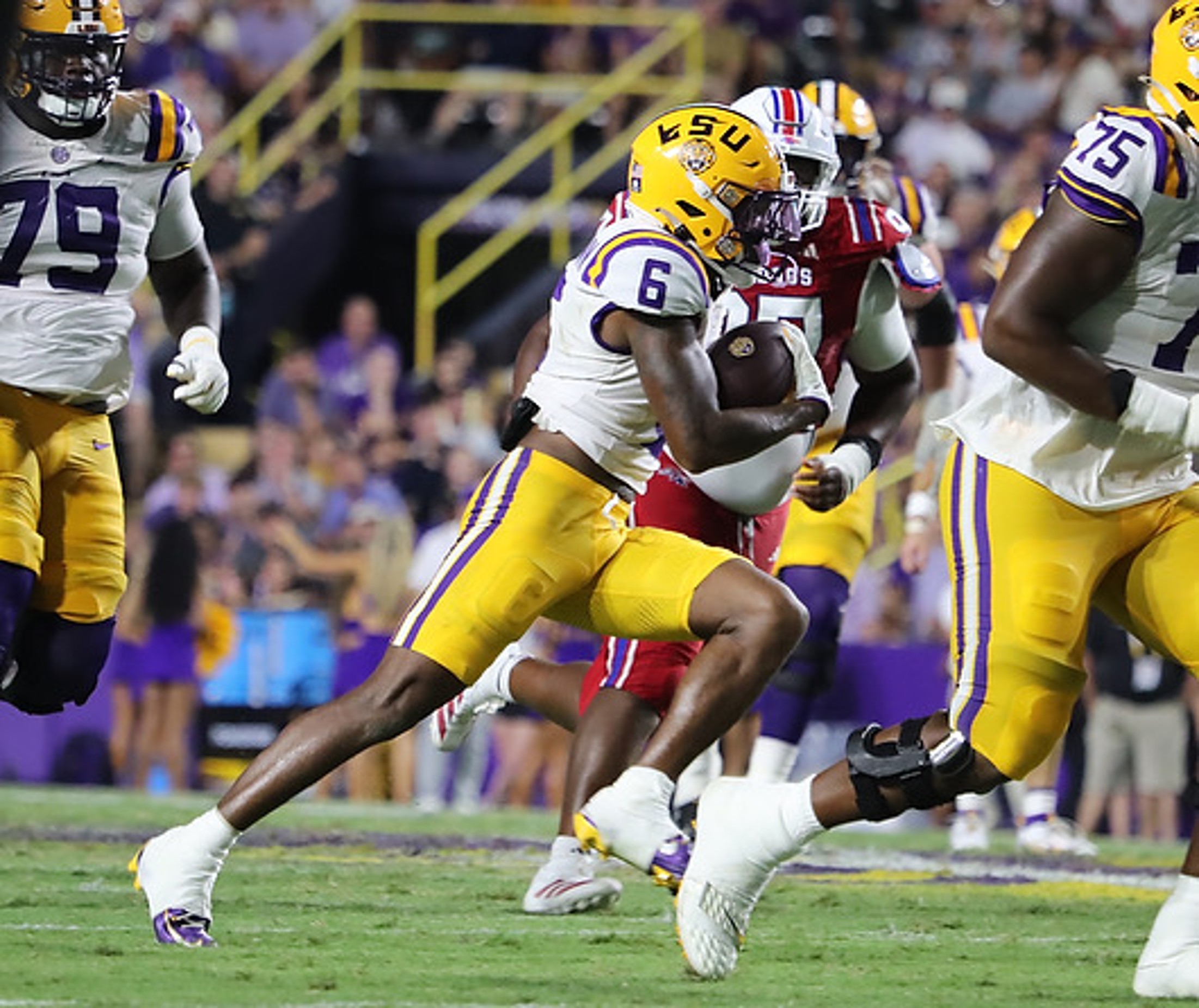
Photo Source: Tammy Anthony Baker, Louisiana Tech Bulldogs LSU Tigers Football, Flickr (Aug. 25, 2026) (CC BY 4.0).
By: Zachary Mayro* Posted: 09/30/2026
As Louisiana State University (“LSU”) football Head Coach Lane Kiffin left the field for halftime in their dominant win over Clemson University on September 5, he stopped the on-field reporter and told viewers to “imagine if we had pro players.”[1] This quippy remark was made in light of the Southeastern Conference’s (“SEC”) strong attempts to stop LSU from rostering two ex-NFL players, tight end Dae’Quan Wright and defensive lineman Zxavian Harris, both of whom signed contracts and participated in training camps with NFL clubs before attempting to return to college athletics.[2] Spanning no more than a few weeks, a battle between the SEC and one of its founding member schools resulted in multiple lawsuits, conference meetings, and threats to expel LSU from the SEC.[3] This blog post examines why SEC’s draconian efforts against LSU should be interpreted not only as an attempt to keep ex-NFL players out of college football, but more so a battle to grasp power to enforce its own rules, which have been diminished over the past few years by near constant court intervention.[4]
The Road to Baton Rouge
This latest controversy began on June 23, 2026, when the NCAA enacted what became known as the “5-for-5” rule.[5] Prior to the new rule, the NCAA gave student athletes five years to play four seasons, but allowed for eligibility extensions through redshirts, medical hardship waivers, and other exceptions.[6] As a consequence, student athletes began staying in college sports for much longer than five years.[7] The NCAA realized its system needed changing after many student athletes turned to the courts for extra eligibility approval.[8] As a way to curb athletes from taking advantage of eligibility rule loopholes and, ironically, to decrease litigation, the NCAA devised a new eligibility rule that granted student athletes five consecutive years to play five seasons of their sport.[9] However, in an effort to maintain roster stability, the NCAA’s new rule did not include the high school class of 2022, effectively giving that class only four years of eligibility.[10] As a result, hundreds of student athletes from the class of 2022 have been seeking a fifth year of eligibility through the court system.[11] This process has been successful in some jurisdictions, while less fruitful in others.[12]
Among the madness, Lane Kiffin escalated matters further: beyond seeking extra eligibility for the class of 2022, the LSU coach recruited two players who had been on NFL rosters and participated in the NFL preseason.[13] Wright and Harris’s return to the NCAA invoked two rule violations.[14] Both Wright and Harris were among the student-athletes not given a fifth year of eligibility since they were the class of 2022, so their return forced the 5-for-5 eligibility issue.[15] It also brought into contention the SEC’s long-standing rule of prohibiting players who participated in professional sports from returning to the collegiate level, which had not been an issue with the previous athletes seeking a fifth year.[16] In light of the NCAA’s new rules not granting a fifth year of eligibility to the high school class of 2022, and the SEC’s rules prohibiting professional players from being eligible, Wright and Harris, along with over forty other plaintiffs, sued the NCAA in Louisiana state court.[17] The Louisiana state court granted the Plaintiffs a preliminary injunction against the NCAA and SEC, prohibiting them from denying the players a fifth year of eligibility and effectively allowing Wright and Harris to play for LSU in the 2026 season.[18] While LSU received its desired result, the rest of the college football world condemned the result.[19]
After the Louisiana Judge’s decision to grant the players eligibility, and in anticipation of the Week 1 matchup between LSU and Clemson, Clemson’s general counsel sent a notice to LSU’s general counsel informing them that the contract between the schools contained language which prohibits participation of ineligible players.[20] When the news of LSU’s potential roster additions broke, the SEC issued a statement condemning NFL players returning to college sports.[21] Meanwhile, as SEC Commissioner Greg Sankey was testifying in Louisiana state court, the SEC initiated its own suit against LSU in Alabama federal court.[22] Additionally, the SEC scheduled a meeting among the conference schools to decide whether LSU should be expelled from the SEC.[23]
Amid backlash and leading up to the Clemson game, LSU did not add Harris or Wright to its roster.[24] However, the team did leave two roster spots open for the possibility of adding them in the future.[25] Eventually, in the face of the SEC's relentless threat of punishment, LSU finally backed down and declined to add the ex-NFL players on the 105-man roster.[26] After LSU’s roster decision, the preliminary hearing in the SEC’s federal case was postponed.[27] However, while LSU argued that the issue was now moot, the SEC decided to continue pursuing potential punishments against LSU.[28] On September 10, 2026, the SEC convened the other conference schools to discuss possible expulsion of LSU from the Conference, which requires an affirmative vote of at least two-thirds of the conference members.[29] While no punishments were imposed on LSU during the conference, the SEC stated that “discussions will continue” for an “appropriate resolution.”[30]
A Fight over Authority, Not Just Two Players
While the SEC and other conferences patiently await possible relief from Congress through the proposed Protect College Sports Act, they have had to find other ways to enforce their own rules.[31] The SEC’s response has been so forceful because years of successful antitrust and eligibility challenges have left the NCAA, and by extension its conferences, with a diminishing ability to enforce eligibility rules through the courts.[32] The SEC continuing to litigate even after LSU did not roster Harris and Wright, rendering the underlying dispute moot, suggests that the SEC’s real objective was establishing that the SEC retains authority over its rules, not a member institution acting unilaterally.[33] Clemson’s contractual notice points to a similar strategy: because conference and NCAA rules have proven vulnerable to injunctions, member institutions are increasingly looking to private agreements, such as game contracts, as an enforcement backstop that does not depend on eligibility rules surviving judicial scrutiny.[34] The SEC’s willingness to threaten a founding member with expulsion and its decision to keep litigating after LSU folded are extraordinary, as the SEC has never expelled a member institution from its conference.[35]
In the wake of courts disallowing conferences to enforce their own rules, the schools and conferences have come to realize that collective agreement and action to impose strict penalties is the only way to ensure compliance.[36] This battle between the SEC and LSU is only one chapter of a larger story of schools and conferences having to collectively band together and find ways to enforce their own rules.[37] Whether this threat keeps future NFL players from returning to college remains to be seen, but while college sports wait for the Congressional help it needs, the SEC will have to rely on extreme threats to enforce its most basic rules.
*Staff Writer, Jeffrey S. Moorad Sports Law Journal, J.D. Candidate, May 2027, Villanova University Charles Widger School of Law.
[1] See Sam Khan Jr., LSU’s Lane Kiffin with Big Halftime Lead vs. Clemson: ‘Imagine if We Had Pro Players’, N.Y. Times (Sep. 6, 2026), https://www.nytimes.com/athletic/7569379/2026/09/06/lane-kiffin-lsu-clemson-pro-players/ (reporting LSU Head Coach stated “imagine if we had pro players” when stopping to speak with ESPN’s Holly Rowe before going into locker room for halftime).
[2] See Agents: Dae'Quan Wright Waived by Browns, Set to Join LSU, ESPN (Aug. 23, 2026, at 17:32 ET), https://www.espn.com/college-football/story/_/id/49705433/agents-daequan-wright-waived-browns-set-join-lsu (reporting that Cleveland Browns waived tight end Dae’Quan Wright and had agreement to return to college and play for LSU during 2026 season); see also Dylan Sanders, LSU Tigers Add Former New Orleans Saints, Ole Miss DL Zxavian Harris, Yahoo! Sports (Aug. 24, 2026), https://sports.yahoo.com/articles/lsu-tigers-add-former-orleans-210716762.html (reporting defensive lineman Zxavian Harris, who was previously waived from New Orleans Saints, committed to LSU after Lane Kiffin recruited him).
[3] See Ben Portnoy, The SEC vs. LSU Battle Has Reached a Boiling Point: What’s the End Game?, Fox Sports (Sep. 9, 2026, at 10:07 ET), https://www.foxsports.com/stories/college-football/lane-kiffin-lsu-sec-expulsion-feud (recounting timeline of eligibility litigation, SEC rule changes, and Conference's expulsion threat against LSU over preceding weeks).
[4] See Michael McCann, Making Sense of NCAA Eligibility Legal Chaos, Sportico (Aug. 29, 2026, at 8:00 ET), https://www.sportico.com/law/analysis/2026/ncaa-eligibility-lawsuits-jordan-hudson-1234943224/ (demonstrating instances where NCAA and conferences have struggled to enforce its own rules with athletes turning to courts to grant more eligibility).
[5] See Andrea Adelson, NCAA Division I Cabinet OK's 5-year, Age-Based Eligibility, ESPN (June 23, 2026, at 15:25 ET), https://www.espn.com/college-sports/story/_/id/49156177/ncaa-division-cabinet-ok-5-year-age-based-eligibility (reporting NCAA Division I Cabinet unanimously approved new eligibility rule).
[6] See Amy Bryant, What Is the NCAA’s New 5-in-5 Eligibility Rule?, Student-Athlete Advis. (June 27, 2026), https://www.thestudentathleteadvisors.com/blog/fv8fgdg1g57e0aqlh6sure4ipwic4b (describing prior NCAA eligibility system); see also 2024-25 NCAA Division I Manual, at 54-61, NCAA (2024) (allowing athletes to preserve season by redshirting or, for football, playing in less than five games; restoring season lost to early-season injuries or illnesses through medical hardship waiver; and extending eligibility for military or religious service, pregnancy, and other circumstances beyond athletes control).
[7] See Michael McCann, NCAA Warns of College Athletes Playing 18 Seasons in Pavia Case, Sportico (Feb. 11, 2026, at 13:01 ET), https://www.sportico.com/law/analysis/2026/diego-pavia-18-seasons-ncaa-litigation-1234884328/ (noting named plaintiff in litigation had already played six seasons of college football, and NCAA warned ruling for athletes could open door to student-athletes competing for as many as eighteen seasons).
[8] See Adelson, supra note 5 (stating NCAA’s new model was enacted in response to student athletes challenging NCAA’s eligibility denials through lawsuits).
[9] See id. (stating new rule, where athletes are given five years of eligibility over five seasons as soon as their eligibility begins, was imposed in response to recent litany of legal challenges from athletes seeking eligibility).
[10] See Eligibility 101: NCAA Division I and Division II Age-Based Eligibility Rules, NCAA (last accessed Sep. 12, 2026), https://www.ncaa.org/eligibility-center/division-i-and-division-ii-age-based-eligibility-rules/ (displaying table explaining that “student-athletes who used their final season of competition (under previous rules) during 2025-26” have “[n]o additional eligibility”); see also Suit Alleges New NCAA Rule Unfair to High School Class of 2022, ESPN (June 14, 2026, at 18:34 ET), https://www.espn.com/college-sports/story/_/id/49169049/suit-alleges-new-ncaa-rule-unfair-high-school-class-2022 (stating NCAA did not include Class of 2022 in effort to avoid “destabiliz[ing] rosters just ahead of the coming season” and “disrupting settled expectations of countless student-athletes regarding their expected roster spots and playing time next year”).
[11] See Jon Rothstein (@jonrothstein), X (Aug. 28, 2026, at 18:14 ET), https://x.com/JonRothstein/status/2093462154653380879 (showing statement from NCAA to its members containing status updates from cases spanning nine jurisdictions and containing 322 former student athletes as plaintiffs).
[12] Compare Judge Grants Injunction for Class of ‘22 Athletes Seeking 5th NCAA Season, ESPN (Jul. 31, 2026, at 18:26 ET), https://www.espn.com/college-football/story/_/id/49501415/judge-grants-injunction-class-22-athletes-seeking-play-5th-ncaa-season (explaining how district court ruling in Denver granted athletes from high school class of 2022 eligibility in spite of the new NCAA rule), with Dan Murphy, Court Halts Order, Denies Extra Year of Eligibility, ESPN (Aug. 21, 2026, at 11:52 ET), https://www.espn.com/college-football/story/_/id/49682102/court-halts-order-denies-extra-year-eligibility (describing recent win for NCAA after Tenth Circuit Court of Appeals granted NCAA stay, effectively reversing previous judge’s decision to grant high school class of 2022 students eligibility).
[13] See Agents: Dae'Quan Wright Waived by Browns, Set to Join LSU, supra note 2 (describing how Kiffin reached out to Wright while Wright was under contract and still part of Cleveland Browns).
[14] See infra notes 15–16 (detailing how Wright and Harris return violate NCAA’s 2026 eligibility rule and SEC’s rule prohibiting athletes who participated in professional sports).
[15] See Agents: Dae'Quan Wright Waived by Browns, Set to Join LSU, supra note 2 (mentioning Wright graduated from high school in 2022 and ran out of college eligibility); see also David Cobb, LSU Excludes Ex-NFL Players Dae'Quan Wright and Zxavian Harris From Roster Amid Ongoing Legal Battle With SEC, CBS Sports (Sep. 5, 2026, at 00:17 ET), https://www.cbssports.com/college-football/news/lsu-ex-nfl-players-legal-battle-sec/ (stating Harris exhausted his eligibility under new eligibility rules).
[16] See Craig Meyer, SEC Says it Will Stand by Rule Banning Pro Players From Competing, Yahoo! Sports (Sep. 1, 2026), https://sports.yahoo.com/articles/sec-says-stand-rule-banning-233721133.html (stating SEC was preparing to enforce its rule banning professional athletes from returning to college).
[17] See Michael McCann, Ruling for LSU’s Ex-NFL Players Sets Up State-Federal Court Clash, Sportico (Sep. 4, 2026, at 09:54 ET), https://www.sportico.com/law/analysis/2026/ex-nfl-players-can-join-lsu-sec-lawsuit-1234944020/ (stating Wright and Harris are two of more than forty other plaintiffs seeking fifth year of college eligibility in Louisiana state case Pyburn v. NCAA).
[18] See id. (stating Louisiana Judge William Jorden issued preliminary injunction against NCAA and SEC, blocking them from enforcing eligibility rules against plaintiffs).
[19] See Cobb, supra note 14 (reporting LSU’s moves drew backlash from multiple state attorneys general, and quoting Clemson coach Dabo Swinney calling potential roster additions “embarrassing”).
[20] See Shane Shoemaker, LSU Put on Notice by Clemson With Contract Breach Warning: Report, Yahoo! Sports (Sep. 4, 2026), https://sports.yahoo.com/articles/lsu-put-notice-clemson-contract-222655079.html (reporting Clemson’s notice to LSU reminding school that its contract prohibits ineligible players, and ongoing legal battle for eligibility does not erase LSU’s contractual obligations).
[21] See Scott Polacek, SEC Issues Statement Opposing NFL Players Returning to CFB amid Latest Commits to Lane Kiffin, LSU, Bleacher Report (Aug. 24, 2026), https://bleacherreport.com/articles/25483367-sec-issues-statement-opposing-nfl-players-returning-cfb-amid-latest-commits-lane-kiffin-lsu (reporting SEC released statement on August 24, 2026, which stated that “[i]ndividuals who choose to leave college athletics, sign professional playing contracts, and compete professionally should not then be permitted to return to college competition”).
[22] See Matt Baker, Chris Vannini & Justin Williams, Louisiana Judge Opens Door For LSU To Roster Ex-NFL Players; SEC Sues School, Kiffin To Stop It, N.Y. Times (Sep. 3, 2026), https://www.nytimes.com/athletic/7562896/2026/09/03/sec-lsu-lane-kiffin-lawsuit-suing/ (mentioning during hearing for Wright and Harris’ case, SEC separately filed lawsuit in federal court against LSU); see also Mark Schlabach, SEC Files Suit vs. LSU Over School's Intent to Play Pro Athletes, ESPN (Sep. 3, 2026, at 13:58 ET), https://www.espn.com/college-football/story/_/id/49816309/sec-files-suit-vs-lsu-school-intent-play-pro-athletes (reporting news of SEC’s federal lawsuit against LSU broke as SEC commissioner Greg Sankey was testifying).
[23] See Pete Thamel, Mark Schlabach & Dan Murphy, SEC Schedules Vote About Whether To Expel LSU, Amends Lawsuit, ESPN (Sep. 8, 2026, at 11:34 ET), https://www.espn.com/college-football/story/_/id/49869481/sec-files-amendment-authority-expel-lsu-conference (detailing SEC’s amended complaint against LSU that scheduled plans to convene member schools’ presidents and chancellors to hold vote on whether to expel LSU from SEC).
[24] See Austin Nivison, Lane Kiffin Says 'Uncertainties' Prevented LSU From Rostering Ex-NFL Players in Week 1 vs. Clemson, CBS Sports (Sep. 5, 2026, at 13:38 ET), https://www.cbssports.com/college-football/news/lane-kiffin-explains-ex-nfl-players-not-on-roster-lsu-clemson/ (reporting LSU did not add Harris or Wright to roster prior to facing Clemson after facing potential severe penalties).
[25] See id. (reporting LSU kept two roster spots open to preserve possibility of later adding Wright and Harris).
[26] See Max Olson, Sources: LSU Completes Roster Without Adding Ex-NFL Players, ESPN (Sep. 8, 2026, at 22:36 ET), https://www.espn.com/college-football/story/_/id/49875000/lsu-completes-roster-adding-nfl-players (reporting LSU had added two players to complete its 105-man roster, which did not include Wright and Harris, meaning ex-NFL players could no longer be added later in season).
[27] See Seth Emerson & Matt Baker, Is LSU vs. SEC Feud Cooling? Lawsuit Hearing Postponed, President Says Roster Issue ‘Moot’, N.Y. Times (Sep. 9, 2026), https://www.nytimes.com/athletic/7579197/2026/09/09/lsu-sec-hearing-lawsuit-lane-kiffin/ (reporting LSU and SEC’s battle was de-escalating after LSU did not add Wright and Harris to finalized roster).
[28] See id. (reporting LSU president Wade Rousse sent SEC letter pointing out issue underlying controversy between sides was not moot as players could no longer be added to roster, and stating LSU would not interfere with scheduled meeting of SEC presidents and chancellors where possible expulsion would be discussed).
[29] See Alex Scarborough, No Sanctions For LSU After SEC Meeting on Expulsion, ESPN (Sep. 10, 2026, at 18:50 ET), https://www.espn.com/college-football/story/_/id/49897284/no-sanctions-lsu-sec-meeting-expulsion (reporting SEC held video conference among SEC presidents and chancellors to determine if it would “terminate” LSU, which requires at least two-thirds affirmative vote from presidents).
[30] See id. (stating meeting ended without imposing any punishments, but parties will continue working to find appropriate resolution).
[31] See Brian A. Cromer & Daniel C. Boswell, Protect College Sports Act: A Landmark Bill Awaits the Return of the U.S. Senate, Stites & Harbison PLLC (Sep. 11, 2026), https://www.stites.com/resources/client-alerts/protect-college-sports-act-a-landmark-bill-awaits-the-return-of-the-u-s-senate/ (explaining Act would grant NCAA, its conferences, and member schools targeted federal antitrust protection to enforce eligibility, transfer, and compensation rules, and noting SEC endorsed bill in August 2026); see also G. Hunter Bates, Ed Pagano, Jessica Taub Rosenberg, Randall Boe & Virgil A. Miller, Senate To Consider Sweeping College Sports Legislation: A Vote in the Senate Next Week Could Set the Stage for the Passage of the Protect College Sports Act, Akin Gump (Sep. 8, 2026), https://www.akingump.com/en/insights/alerts/senate-set-to-act-on-the-protect-college-sports-act-of-2026 (noting Senate cloture vote on bill is scheduled between September 15 and 23, 2026).
[32] See McCann, supra note 4 (noting various successful challenges against NCAA and power conferences from athletes seeking eligibility).
[33] For further discussion of SEC's continued litigation after LSU declined to roster Wright and Harris, see supra notes 25–27 and accompanying text.
[34] For further discussion of Clemson's contractual notice to LSU, see supra note 19 and accompanying text.
[35] See Emerson & Baker, supra note 26 (mentioning since its inception, SEC has never expelled member school).
[36] See Sean Leahy, Each Power Four Conference Adopts Policy to Ban Pro Football Players from Joining Their Respective Conferences, Yahoo! Sports (Aug. 27, 2026), https://sports.yahoo.com/college-football/article/big-ten-sec-big-12-approve-ban-on-pro-players-returning-to-college-to-play-acc-considering-move-151028832.html (reporting Big Ten, SEC, Big 12, ACC, and Mountain West each adopted nearly identical bans on rostering former professional athletes within days of one another).
[37] See Amanda Christovich, Big Ten, SEC Schools Call for Texas Tech Boycott After Sorsby Ruling, Front Off. Sports (June 9, 2026), https://frontofficesports.com/article/big-ten-sec-schools-call-for-texas-tech-boycott-after-sorsby-ruling/ (demonstrating schools from Big Ten and SEC had to band together and threaten to boycott Texas Tech to stop them from rostering football quarterback Brendan Sorsby after Texas state court allowed Sorsby to play despite ban for sports gambling).