Subpoenas Without Borders: 28 U.S.C. § 1782 and the Swiss Case Against FIFA’s President
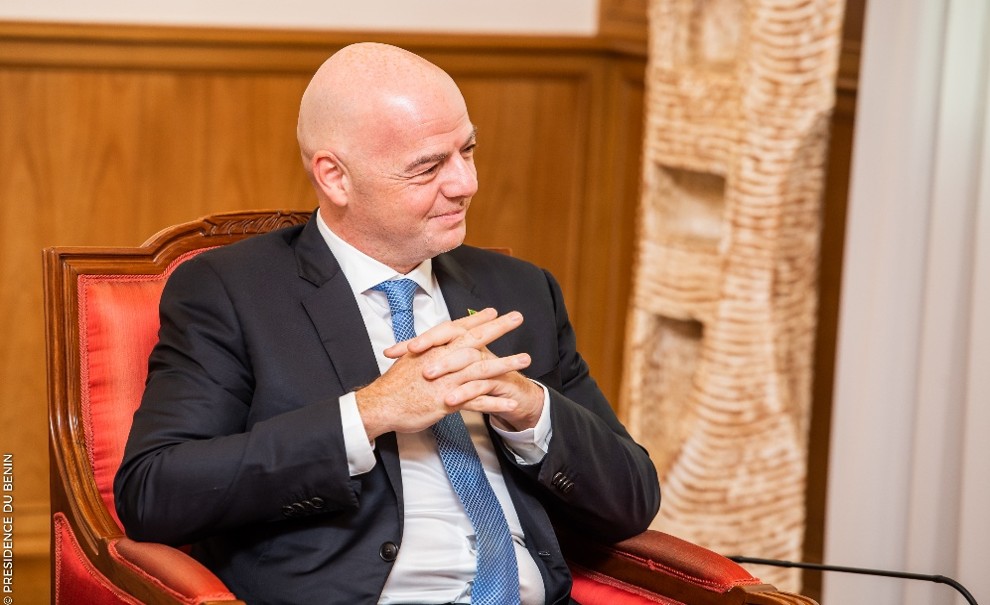
Photo Source: presidencebenin, Audience de la délégation de la FIFA-55, Flickr (Jan. 10, 2019) (CC BY-NC-ND 2.0).
By: Sophie N. Guichardan* Posted: 09/25/2026
Although North America’s 2026 World Cup Summer has hit an end, Switzerland’s legal fight against FIFA President Gianni Infantino is just beginning.[1] The governing body for European soccer, the Union of European Football Associations (“UEFA”), is preparing a criminal complaint in Switzerland against Infantino on the grounds that the FIFA President quietly pushed a discounted sale of the organization’s commercial rights without proper authorization.[2] To build the case, UEFA has turned to American courts to obtain evidence held in the United States, including discovery aimed at investor Joshua Kushner and his venture capital firm, Thrive Capital.[3]
UEFA’s leg of choice to obtain the evidence is 28 U.S.C. § 1782, a single federal statute that allows a United States court to order a person in its district to hand over testimony or documents in a foreign proceeding.[4] Like other ordinary tools of discovery, Section 1782 has quietly taken shape in the law as a legitimate instrument of international sports governance by enabling foreign prosecutors to reach evidence held in the United States, which they would otherwise be unable to.[5] Although Section 1782 is a procedural tool rather than a source of liability, it can still shape a foreign case by facilitating evidence discovery.[6]
How a $4.2 Billion Deal Led to the Swiss Complaint
The legal dispute between Infantino and UEFA stems from a financial plan that would have moved FIFA’s commercial rights into a new subsidiary, FIFA Forward Enterprise.[7] This plan covered FIFA’s media and ticketing rights, as well as sponsorship and licensing rights.[8] Under the FIFA Forward Enterprise arrangement, a roughly twenty percent stake in FIFA would have gone directly to Thrive Eternal, the permanent-capital vehicle Kushner created under Thrive Capital, as the lead investor for just $4.2 billion dollars, a price UEFA argues fell far short of assets valued closer to $20 billion.[9]
To European officials, the criminal conduct lies in how the deal was struck.[10] Infantino negotiated these financial plans in secret without the FIFA Council’s involvement or a competitive sale.[11] As a result, the football confederations mounted a staunch opposition against the deal and the plan collapsed.[12] From there, UEFA sought to use Article 158 of the Swiss Criminal Code, which makes it a crime for someone entrusted with managing another’s property to breach that duty and cause financial loss, against Infantino.[13] FIFA, for its part, has dismissed this effort as a “smear campaign.”[14]
Section 1782’s Legislative History and Extended Reach
Congress broadened Section 1782 in 1964, replacing its earlier reference to a foreign court with “foreign or international tribunal” and extending the statute’s assistance to any interested person.[15] The statute now permits an interested person to ask a federal district court to order someone who resides or is found in that district to give testimony or produce documents for use before a foreign tribunal.[16] Practically, Section 1782 turns a federal courthouse into a place where a party to a case abroad can obtain evidence that the foreign court has no power to collect on its own.[17] That reach is also why the language “found in the district” is important in the statute because UEFA filed applications in three separate districts at once.[18] Each filing followed a different one of UEFA’s targets: Kushner and Thrive Capital in the Southern District of New York, FIFA’s Miami office in the Southern District of Florida, and Infantino’s adviser, Greg Maffei, in the District of Colorado.[19] Each of these applications asks a local court to reach evidence that Swiss prosecutors would otherwise have no power to obtain themselves.[20]
The statute’s reach also begins early in a criminal investigation timeline.[21] Section 1782 encompasses criminal investigations conducted before any formal accusation is made and in Intel Corporation v. Advanced Micro Devices, Inc.[22], the Supreme Court confirmed a foreign proceeding need only be within reasonable contemplation.[23] Although UEFA’s Swiss complaint has not yet been filed, the decision in Intel accounts for the gap between when a criminal investigation begins and when formal charges are brought.[24] Still, a firmer boundary comes from ZF Automotive US, Inc. v. Luxshare, Ltd.[25], where the Court limited Section 1782 to governmental adjudicative bodies and excluded private arbitration.[26] Here, the Swiss criminal court fits comfortably within the category of governmental adjudicative bodies.[27]
Applying the Intel Factors
Clearing statutory hurdles is only the first step; a district court must then decide whether to grant discovery to the foreign nation by weighing the four discretionary factors laid out in Intel.[28] The factor that carries the most weight asks whether the target takes part in the foreign proceeding at all, since a tribunal can compel its own participants but has no power over an outsider.[29] Kushner and Thrive Capital both fall outside that line, since neither is an expected defendant in the expected litigation in Switzerland and no Swiss prosecutor has the inherent power to compel a New York investor to hand over records.[30] This is exactly what Section 1782 was intended to address, and it creates the opportunity for UEFA’s argument to grant the subpoena.[31]
None of the remaining three factors would change that conclusion.[32] Kushner, if he wants, can call the request overbroad and claim disclosure would expose commercially sensitive information.[33] He can also question the timing of the subpoena, which comes just in time as the NBA reviews his agreement to buy the Los Angeles Lakers.[34] However, even so, Kusher’s objections would be more likely to narrow the scope of the subpoena rather than challenge its issuance outright, so long as UEFA keeps its demands tied to the specific Swiss criminal claims.[35] In light of all four factors, the court is likely to grant this request.[36]
America’s Duties as Cup Host and Facilitator of International Legislation
In the end, the significance of this fight is not solely between Switzerland and the United States; global events, such as the World Cup, often produce disputes that must be settled across international borders.[37] Here, Section 1782 works to help the United States facilitate foreign dispute resolution faster while still ultimately leaving the underlying case for Switzerland’s laws to decide.[38] Unlike law in the U.S., Article 158 of the Swiss Criminal Code treats fiduciary mismanagement that causes loss as a crime in its own right with no need to prove a bribe.[39] United States law offers no clean equivalent because in Skilling v. United States[40], the Supreme Court narrowed honest-services fraud to schemes built on bribery or kickbacks.[41] The limit matters here because a theory built on self-dealing rather than bribery has no natural home in American fraud.[42] The United States has pursued FIFA before, but it only was able to do so by charging for racketeering and wire fraud built on broadcasting and marketing rights.[43]
Even that approach has not been entirely secure.[44] In 2023, a federal judge in Brooklyn acquitted two defendants after concluding that their honest-services fraud did not meet the standard for foreign commercial bribery.[45] The Second Circuit revisited the case in 2025, holding the statute did meet the standard for foreign commercial bribery and ordering the jury’s verdict reinstated—though the Supreme Court has since granted certiorari, vacated that judgment, and remanded the case to the Second Circuit, leaving the theory’s reach over foreign commercial bribery unsettled once again.[46] UEFA’s Swiss criminal charge, by contrast, rests on mismanagement of the organization itself.[47] The Swiss law goes straight at the self-dealing of Infantino regardless of proof of a bribe, and despite our own standards for commercial bribery, an American court may turn out to be the one that allows Swiss prosecutors to pursue him.[48]
*Staff Writer, Jeffrey S. Moorad Sports Law Journal, J.D. Candidate, May 2028, Villanova University Charles Widger School of Law.
[1] See Gabriele Marcotti, Champions League Draw Becomes UEFA’s Latest Stand Against FIFA President Infantino, ESPN (Aug. 28, 2026, at 04:14 ET), https://www.espn.com/soccer/story/_/id/49744909 (reporting on widening conflict between UEFA and FIFA over Infantino’s commercial plans).
[2] See Michael McCann, Kushner Can Challenge UEFA Demands in Infantino Case, Sportico (Aug. 28, 2026, at 18:02 ET), https://www.sportico.com/law/analysis/2026/joshua-kushner-uefa-subpoena-infantino-criminal-case-1234943144/ (analyzing UEFA’s contemplated Swiss criminal case against Infantino over planned FIFA Forward Enterprise deal).
[3] See id. (analyzing why Kushner and Thrive, as nonparties beyond Switzerland’s reach, are prime targets for § 1782 discovery).
[4] See 28 U.S.C. § 1782(a) (2018) (authorizing district court to order person found in its district to give evidence for use in foreign proceeding).
[5] See Annie Peterson, FIFA Accuses European Body UEFA of ‘Smear Campaign’ in Filing Related to World Cup Sell-Off Plan, Local 10 (Sep. 3, 2026, 6:09 ET), https://www.local10.com/news/florida/2026/09/03/fifa-accuses-european-body-uefa-of-smear-campaign-in-filing-related-to-world-cup-sell-off-plan/ (reporting that FIFA moved to intervene and dismissed UEFA’s § 1782 applications as press releases dressed up as legal pleadings); see also Intel Corp. v. Adv. Micro Devices, Inc., 542 U.S. 241, 247 (2004) (describing how assistance statute provides for use in foreign proceedings).
[6] See Intel Corp., 542 U.S. at 247 (characterizing § 1782 as vehicle for gathering evidence to aid foreign proceedings).
[7] See Sara Germano, UEFA Pursues Possible Criminal Probe Over FIFA’s Kushner Deal, Sportico (Aug. 27, 2026, at 12:17 ET), https://www.sportico.com/leagues/soccer/2026/uefa-possible-criminal-probe-over-fifas-kushner-deal-1234943083/ (describing proposed FIFA Forward Enterprise subsidiary).
[8] See id. (reporting that new entity would consolidate FIFA’s principal commercial revenue streams under single corporation).
[9] See Pardeep Cattry, UEFA Takes Legal Action Against FIFA, Joshua Kushner Over Scrapped World Cup Stake Sale, CBS Sports (Aug. 27, 2026, at 15:57 ET), https://www.cbssports.com/soccer/news/uefa-takes-legal-action-against-fifa-joshua-kushner-over-world-cup-investment/ (reporting that deal would have given Thrive roughly twenty-percent FIFA stake as lead investor for $4.2 billion); see also Germano, supra note 7 (noting UEFA’s objection that $4.2 billion price fell short of assets estimated $20 billion value).
[10] See McCann, supra note 2 (analyzing UEFA theory that deal itself constituted criminal mismanagement).
[11] See Germano, supra note 7 (reporting that plan bypassed both competitive sale and FIFA Council, governance failures UEFA now casts as criminal).
[12] See Marcotti, supra note 1 (reporting the confederations’ opposition to sell-off and UEFA’s escalating stance against Infantino); see also Cattry, supra note 9 (describing how FIFA abandoned plan within days of its July announcement amid condemnation from soccer officials).
[13] See Schweizerisches Strafgesetzbuch [StGB] [Criminal Code] Dec. 21, 1937, SR 311.0, art. 158 (Switz.).
[14] See Peterson, supra note 5 (reporting FIFA contention campaign is pressure tactic and UEFA coerced European federations into opposing deal).
[15] See Act of Oct. 3, 1964, Pub. L. No. 88-619, 78 Stat. 995, 997 (1964) (revising § 1782 to allow assistance in "foreign or international tribunal" proceedings, and to permit applications by any interested person); see also Intel Corp. v. Adv. Micro Devices, Inc., 542 U.S. 241, 247–49 (2004) (recounting 1964 revision broadening statute).
[16] See 28 U.S.C. § 1782(a) (2018) (permitting any interested person to ask district where person resides or is found to order testimony or production of documents for use before foreign tribunal); see also Intel Corp., 542 U.S. at 246–47 (setting out statutory requirements for discovery in aid of foreign proceeding).
[17] See 28 U.S.C. § 1782(a) (giving federal courts power to compel evidence located in United States for use in foreign proceeding); see also Intel Corp., 542 U.S. at 247 (describing how statute lets litigants abroad gather evidence held in U.S.).
[18] See Cattry, supra note 9 (noting UEFA filed simultaneously in all three districts to gather evidence for its Swiss complaint).
[19] See id. (reporting that UEFA filed each § 1782 application in district where its target resides or is found, as statute requires).
[20] See 28 U.S.C. § 1782(a) (tying each application to district where target is found).
[21] See id. (permitting discovery in aid of investigation not yet formally charged).
[22] 542 U.S. 241 (2004).
[23] See 28 U.S.C. § 1782(a) (noting that § 1782 covers proceedings before formal accusation is made); see also Intel Corp., 542 U.S. at 258–59 (holding that foreign proceeding need only be within reasonable contemplation).
[24] See Intel Corp., 542 U.S. at 259 (rejecting any requirement that proceeding be pending or imminent); see also Marcotti, supra note 1 (reporting UEFA has not yet filed its complaint).
[25] 596 U.S. 619 (2022).
[26] See id. at 637–38 (limiting § 1782 to actions against governmental or intergovernmental adjudicative bodies).
[27] See id. at 632–38 (excluding private arbitration while leaving governmental tribunals within statute’s scope).
[28] See Intel Corp., 542 U.S. at 264–65 (describing discretionary factors that guide § 1782 requests, including: (1) whether person from whom discovery is sought is participant in foreign proceeding; (2) nature of foreign tribunal, character of proceedings abroad, and receptivity of foreign court to United States judicial assistance; (3) whether request conceals attempt to circumvent foreign proof-gathering restrictions; and (4) whether request is unduly intrusive or burdensome).
[29] See id. at 264 (explaining that nonparticipant’s evidence may be unobtainable absent § 1782 aid).
[30] See McCann, supra note 2 (noting Kushner and Thrive are not parties to anticipated Swiss proceeding).
[31] See Intel Corp. v. Adv. Micro Devices, Inc., 542 U.S. 241, 264 (2004) (treating nonparticipant status as reason favoring assistance).
[32] See id. at 264–65 (identifying remaining factors as nature and receptivity of foreign tribunal to United States judicial assistance, whether request conceals attempt to circumvent foreign proof-gathering restrictions, and whether it is unduly intrusive or burdensome).
[33] See McCann, supra note 2 (discussing possible objections available to Kushner).
[34] See McCann, supra note 2 (noting timing of sale concerns); see also Peterson, supra note 5 (reporting FIFA’s framing of dispute).
[35] See Intel Corp., 542 U.S. at 265 (favoring tailored discovery over outright denial).
[36] See id. at 264–65 (explaining that district court may decline § 1782 aid even when statutory requirements are met, weighing four factors together to guide that discretion).
[37] See Marcotti, supra note 1 (reporting global scale of UEFA-FIFA conflict).
[38] See 28 U.S.C. § 1782(a) (2018) (enabling American courts to assist foreign proceedings).
[39] See Schweizerisches Strafgesetzbuch [StGB] [Criminal Code] Dec. 21, 1937, SR 311.0, art. 158 (Switz.).
[40] 561 U.S. 358 (2010).
[41] See id. at 408–09 (confining honest-services fraud to bribery and kickback schemes); see also Cong. Rsch. Serv., R45479, Bribery, Kickbacks, and Self-Dealing: An Overview of Honest Services Fraud and Issues for Congress (2020), https://www.congress.gov/crs-product/R45479 (providing background on honest-services fraud and debate over extending § 1346 beyond bribery and kickbacks to self-dealing).
[42] See Skilling, 561 U.S. at 408–11 (limiting honest-services fraud to bribe-and-kickback schemes, excluding undisclosed self-dealing and conflict-of-interest schemes).
[43] See Press Release, U.S. Dep’t of Justice, Nine FIFA Officials and Five Corporate Executives Indicted for Racketeering Conspiracy and Corruption (May 27, 2015), https://www.justice.gov/usao-edny/pr/nine-fifa-officials-and-five-corporate-executives-indicted-racketeering-conspiracy-and (announcing forty-seven count indictment charging fourteen defendants with racketeering, wire fraud, and money laundering conspiracies amounting to over $150 million in bribes and kickbacks for media and marketing rights to international soccer tournaments).
[44] For further discussion of litigation over honest-services fraud, see infra notes 45–46 and accompanying text.
[45] See United States v. Full Play Grp., S.A., 690 F. Supp. 3d 5, 25 (E.D.N.Y. 2023) (acquitting defendants on ground that honest-services fraud did not reach foreign commercial bribery).
[46] See United States v. Lopez, 143 F.4th 99 114, 116 (2d Cir. 2025) (holding that honest-services wire fraud reaches foreign commercial bribery and remanding with instructions to reinstate jury’s verdict), cert. granted, judgment vacated sub nom. Lopez v. United States, 146 S. Ct. 1494 (2026) (remanding for further consideration in light of pending motion to dismiss indictment).
[47] See UEFA Pursues Possible Criminal Probe, supra note 7 (describing UEFA’s mismanagement theory); see also Schweizerisches Strafgesetzbuch [StGB] [Criminal Code] Dec. 21, 1937, SR 311.0, art. 158 (Switz.) (defining criminal mismanagement as manager’s breach of duty to safeguard another’s property that causes principal financial loss, with heightened penalty where manager acts for unlawful gain).
[48] See StGB art. 158 (Switz.) (showing loss-causing disloyalty even absent any corrupt payment); see also 28 U.S.C. § 1782(a) (2018) (empowering federal district court to order person found in its district to produce evidence for use in foreign proceeding).