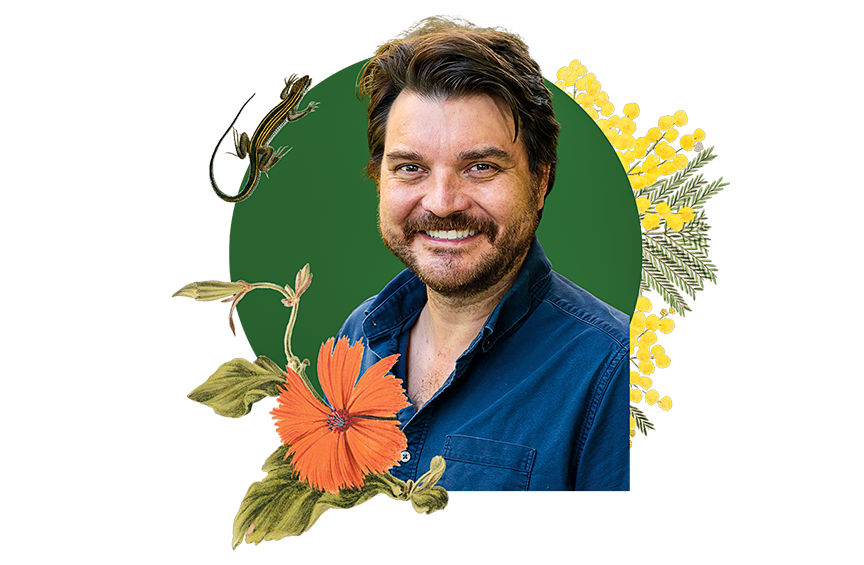
Where in the world is Dr. Bauer?
Click here to discover where Dr. Bauer's work has taken him.

Villanova’s world-renowned lizard expert has built a scientific family tree
—one discovery, and one student, at a time

Villanova’s world-renowned lizard expert has built a scientific family tree—one discovery, and one student, at a time
A small pile of academic herpetology journals sits neatly stacked on the desk of Aaron Bauer, PhD, the Gerald M. Lemole Endowed Chair in Integrative Biology at Villanova University. When his seemingly impossible schedule quiets for a moment, and before they are cataloged and retired into his vast herpetological library, the professor will read each one keenly. It is something he has done since the early days of his career.
“Many years ago, I would look through those, and while reading I would say, ‘If I'm doing my job, somebody is citing me for something in every issue,’” Dr. Bauer says. “As I've gotten older, I look to see that one of my former students or postdocs is an author.”
A renowned herpetologist who has mentored generations of other renowned herpetologists, there’s a good chance he sees both.
“The culture of mentorship that Dr. Bauer has created is Villanova at its finest–deeply invested in students and rooted in a genuine passion for developing others,” says Amanda Grannas, PhD, vice provost for Research, chief research officer and professor of Chemistry. “His commitment demonstrates the lasting impact a faculty member can have on an entire field.”
Ian Brennan, PhD, ’14 MS, a senior scientist and curator at Australia’s Queensland Museum Kurilpa, was just one of the many students who benefited from Dr. Bauer’s guidance. “He sits at this rare intersection of a Venn diagram,” says Brennan. “He's an exceptional researcher, a wonderful person and a fantastic mentor.”
Dr. Bauer is part of the large community of teacher-scholars at Villanova, where the Augustinian Catholic academic community values both roles for faculty–as top-tier researchers and dedicated educators–with their students’ engagement and experience at the center. “He reflects the very best of the teacher-scholar model, showing how transformative it can be when faculty pair world-class expertise with true dedication to student growth,” says Christine Palus, PhD, senior vice provost for Academics.
DID YOU KNOW?
Dr. Bauer has described 320 new species of reptiles, more than any other living scientist and fifth-most of all time.
As the world’s foremost expert in geckos, Dr. Bauer is widely known and celebrated in the scientific community for his academic achievements.
“He’s a present-day Charles Darwin,” says Elizabeth Patton ’26 MS, before correcting herself. “Actually, he’s probably more productive than Darwin.”
“Dr. Bauer’s understanding of the natural world comes from a sense of wonder that has been kind of lost in the modern era,” adds Phil Skipwith, PhD, ’11 MS, an assistant professor of Biology at the University of Kentucky who studied under the professor.
Dr. Bauer’s first species description—which is the formal scientific documentation of a new species—happened to be the largest gecko ever to exist, and the specimen he studied was the only one ever found. He has since described 319 more new species of reptiles, more than any other living scientist and fifth-most of all time. An impressive 940 publications, including 54 published in a single year, bear his name.
There is even a species of gecko—Hemidactylus aaronbaueri, or Aaron Bauer’s house gecko—named in homage to his achievements.
But, as a 2022 Philadelphia Inquirer profile of him notes, “Sheer number of species is not the point.” Largely through his contributions in taxonomy—the classification of species—Dr. Bauer has built a robust record of lizard biodiversity. Humankind, therefore, possesses a far better understanding of reptiles because of him. The animals he has studied—particularly endangered species—have been the true beneficiaries of his life’s work.
“If you don’t have a name on something, you can’t protect it,” he says in that same Inquirer profile. “You can’t communicate about it with other scientists.”
Yet, Dr. Bauer’s influence on the history, present and future of his field exists far beyond his Google Scholar page and his 16,000 pages of authored work. It is reflected in the global community of herpetologists whose careers he has helped shape, a legacy that traces its roots back to Villanova University.

Talk to any student who has passed through his lab over the decades, and you will assuredly hear of the “Aaron Bauer Pipeline.”
“It’s a very real thing,” Patton says.
Since 2000, a little more than a decade after he began teaching at Villanova, 54 master’s students have come through his research lab, and Dr. Bauer estimates 80% of them have gone on to obtain PhDs and remain in herpetology. Of those who didn’t, several work in other branches of zoology.
One of his former students recently described his 100th different species of Indian gecko. Another has become what Dr. Bauer calls “the world expert” in a large group of snakes with knife-like teeth. Other Bauer Lab alumni have gone to careers studying skinks, Australian and South American frogs, Asian snakes, reptile specimens encased in amber and a “vast majority” of the 40 families of lizards, including, of course, geckos. Many who haven’t remained in herpetology pursued similar work in other zoological branches, researching weaver birds, insects and marsupials. They work in museums, higher education institutions, nonprofits and numerous other sectors.
“We are populating the world with herpetologists,” Dr. Bauer, sporting one of his signature Hawaiian shirts, says with a laugh.
In its simplest form, the pipeline is this: His master’s students leave Villanova and most obtain their PhDs, largely remaining in herpetology—a crowded field—and academia. Many of them teach undergraduates who go on to join Dr. Bauer’s lab for their master’s work. Some of those master’s graduates pursue their PhDs under the guidance of previous pupils of Dr. Bauer’s. Currently, two of his former students are advising PhD candidates who also came from his program.
“It’s really cool to see a generation of Villanova master’s students going on to their careers and now mentoring the next generation,” Dr. Bauer says. “They know what our students are going to be like, because they have been through the program themselves.”
All the while, the entire cohort of Villanova herpetologists support one another in research endeavors with collaborations often facilitated and nurtured by Dr. Bauer himself. His mentorship begins on arrival and never ends.
“I came to his lab with the interest, but didn’t know the community or how to begin,” Patton says. Dr. Bauer listened to her ideas, helped her cultivate relationships in the field and guided her toward a thesis project that aligned with her interests. “It’s having a person on the inside, and not just anywhere on the inside, but the pillar.”
“They have a network to tap into,” Dr. Bauer says. “Sometimes, we have four or five people on a paper who didn't overlap with each other at all in my lab, but they have been in touch with one another because they came out of Villanova and have similar research interests. It’s really rewarding to know there's a community carrying on with this work.”
That community, and no doubt the professor and researcher at the center of it, has attracted students to Villanova from across the planet: China, the United Kingdom, Angola, Turkey, Kenya and South Africa, to name a few.
“We attract students from all over the world,” Dr. Bauer says. “But then we send them back out all over the world to continue their contributions to the field.”
- Phil Skipwith, PhD, ’11 MS
You might have to pry from Dr. Bauer the details of his career achievements, but ask him about the successes of his students, and he will talk for hours. Effusing praise for their ambition and skill and speaking proudly of their post-Villanova adventures come as easily to him as discovering a new gecko.
He will also be the first to tell you that a professor just down the hall in the Mendel Science Center is a major reason his master’s students have left Villanova with the tool kit they have.
“Todd Jackman is absolutely integral to everything we do,” Dr. Bauer says. “When he came here, the program really started to take off.”
Todd Jackman, PhD, professor of Biology and fellow herpetologist, joined Dr. Bauer at Villanova in the late 1990s. Both professors earned their PhDs from the University of California, Berkeley, but never met—they missed one another by a year. When the two researchers finally joined forces on the East Coast, it elevated the appeal of Villanova’s program. They have become what one former student calls “inextricably linked.”
“There’s a real synergy here,” Dr. Jackman says. “Word started to get out that if you were interested in herpetology and wanted an excellent master’s program, you applied to Villanova.”
Though their labs and research interests differ, the two are perfectly complementary, forming what Dr. Jackman calls a “unique blend” of academic offerings to students at all levels. Dr. Bauer mainly concentrates on morphology and taxonomy–using physical characteristics to classify species and understand evolutionary relationships. He has carved a niche advising master’s students. Dr. Jackman’s forte is studying reptiles at a molecular level, using DNA and genetics as a lens to understand their classification and evolution. He often has undergraduate researchers working on projects. Each professor has his own separate research lab, but they do a large amount of collaborative work both with their own research and with students.
Former master’s student Ed Stanley, PhD, ’09 MS, now an associate curator with the Florida Museum of Natural History, worked concurrently with each professor during his time in the graduate program. The molecular work on his thesis—investigating the DNA-based evolutionary relationships of a group of African lizards—was done under the guidance of his adviser, Dr. Jackman. At the same time, Dr. Bauer was finding Dr. Stanley opportunities for intensive fieldwork and helping him engage with the historical and biological meaning of his work.
Dr. Stanley, who came to Villanova from Scotland unsure of his career goals, is now considered the world’s foremost expert in the use of micro-computed tomography (micro-CT) scanning to study the evolution of snakes, lizards and amphibians–yet his Villanova connections endure. He continues to collaborate with both Dr. Bauer and Dr. Jackman on numerous projects, and his current PhD candidate recently completed master’s-level work with Dr. Bauer.
“All of us are connected, and that tether keeps growing longer,” Dr. Stanley says. “You might be out the door at Villanova, but that door of opportunities never closes.”
- Ed Stanley, PhD, ’09 MS
Famed journalist Margaret Fuller once said, “If you have knowledge, let others light their candles in it.” Dr. Bauer has been lighting others’ candles for nearly four decades, in ways that resonate deeply.
Last year, Dr. Bauer reconnected with a student named Jerry Johnston, PhD, ’90 CLAS, who took his undergraduate herpetology class in 1989, Dr. Bauer’s second year at Villanova. Dr. Johnston, now a professor of Biology at Santa Fe College in Florida, leads the Santa Fe River Turtle Project and in 2011 was named Florida Professor of the Year. What he told Dr. Bauer the day they caught up moved him to tears.
“I never knew this, but he switched his major after taking my class,” Dr. Bauer says. “It was my class that set him on this career path.”
That is why, despite his prolific scientific achievements, those who have been under his tutelage balk at describing Dr. Bauer’s legacy solely by his scholarship. Certainly, no herpetologist would argue its impact, but it just doesn’t quite paint the whole picture.
“It feels a little silly to look at his achievements and say his students are his legacy, but it’s true,” Dr. Stanley says. “It’s all of the above: the discoveries, the publications—his whole body of work. That includes the continued work of his students. It’s a real tribute to his teaching and mentorship.”
“Hopefully, people will continue to cite the things I publish, but eventually they will become old news,” Dr. Bauer says. “I feel that the work means nothing if you're the only one who has the results. For me, a day researching and a day teaching are both days to write home about. To be able to do the research, publish the work and then see a student’s excitement when it makes a connection for them is incredibly meaningful.
“I get to see these students for the first time when they are just starting to have these incredible ideas but still have a lot to learn. By the time they leave here, they are leading their field.”
He gestures at the journals and picks one up from his desk, quickly leafing through a few pages to prove his point. He doesn’t have to go very far before a familiar name pops out. His face fills with pride.
“I can't imagine a job I would have ever preferred more than this one.” ■
DID YOU KNOW?
Dr. Bauer and Dr. Jackman are not the only faculty in Villanova’s Department of Biology who study reptiles. Alyssa Stark, PhD, researches the adhesive properties of gecko toes, and Stephanie Campos, PhD, studies how the chemical signaling in lizards impacts their social behavior.
A Library to Marvel At
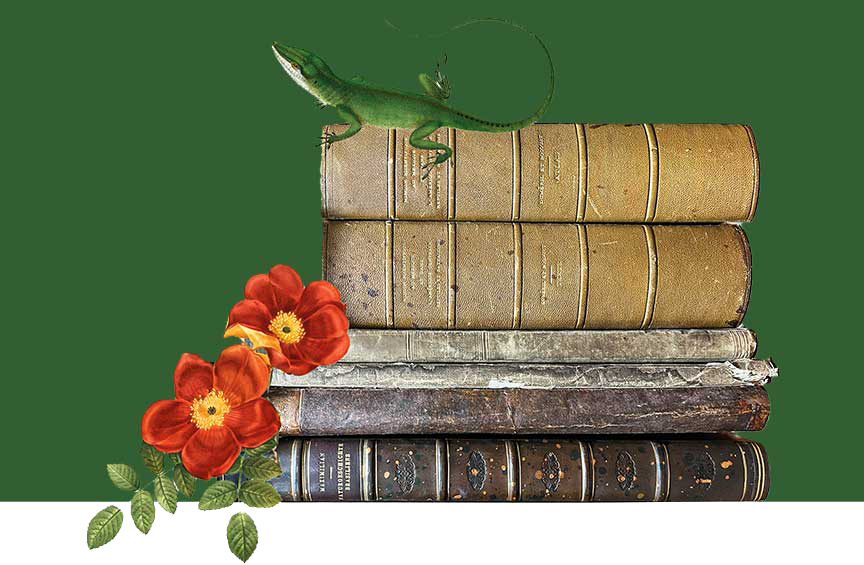
In the 2012 movie The Amazing Spider-Man, the superhero’s nemesis—an evil reptile researcher aptly named The Lizard—is depicted in a scene in front of his large scientific library. The library in that scene was modeled after Dr. Bauer’s personal collection, which includes the largest assembly of herpetological texts in the world.
"Dr. Bauer’s library, which he calls his hobby, fills more than just a few rooms in his home and features upward of 20,000 books, 700 journal runs and 170,000 reprints in various languages, spanning several centuries and countless subjects. His oldest text is De Serpentibus, the first printed book dedicated solely to snakes, written in Latin by Nicolai Leoniceni in 1518.
This unrivaled collection, and Dr. Bauer’s vast comprehension and retention of the material, give his students ready access to an invaluable trove of scholarly resources. He uses some of them for curated readings in his coursework and discussions, and often draws from them to answer specific questions from students. His library has become a destination for researchers around the world, and he estimates he receives more than 300 requests a year for digital scans of his collected works.
“I feel good about making it a resource for other people to further their opportunity for education,” he says. “I don’t have everything in herpetology, but I’m darn close.”
NEXT IN FEATURES
The first Augustinian pope brings Villanova's core values of truth, unity and love into focus