Where in the world is Dr. Bauer?
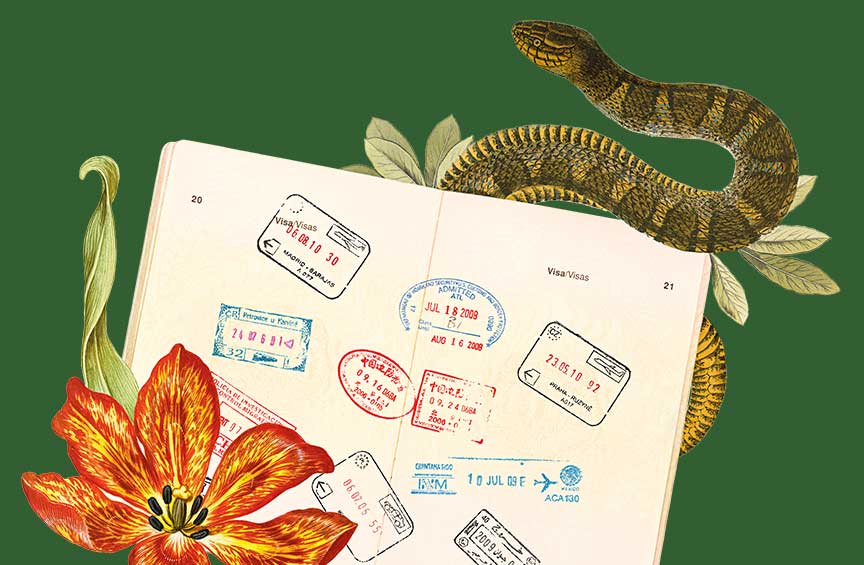
Dr. Bauer has traveled across the globe for field research, museum work and other research endeavors with local colleagues to countries and territories such as:
Argentina
Australia
Austria
Belgium
Botswana
Brazil
Canada
Chile
China
Croatia
The Czech Republic
Denmark
Eswatini
Fiji
France
French Polynesia
Germany
Hungary
Israel
Italy
Japan
Kazakhstan
Lesotho
Luxembourg
Malawi
Malaysia
Mexico
Morocco
Netherlands
New Caledonia
New Zealand
Norway
Poland
Portugal
Réunion
Russia
Serbia
Seychelles
Singapore
South Africa
Spain
Sri Lanka
Sweden
Switzerland
Thailand
Turkey
Malawi
Malaysia
Mexico
Morocco
Netherlands
New Caledonia
New Zealand
Norway
Poland
Portugal
Réunion
Russia
Serbia
Seychelles
Singapore
South Africa
Spain
Sri Lanka
Sweden
Switzerland
Thailand
Turkey
Malawi
Malaysia
Mexico
Morocco
Netherlands
New Caledonia
New Zealand
Norway
Poland
Portugal
Réunion
Russia
Serbia
Seychelles
Singapore
South Africa
Spain
Sri Lanka
Sweden
Switzerland
Thailand
Turkey
Malawi
Malaysia
Mexico
Morocco
Netherlands
New Caledonia
New Zealand
Norway
Poland
Portugal
Réunion
Russia
Serbia
Seychelles
Singapore
South Africa
Spain
Sri Lanka
Sweden
Switzerland
Thailand
Turkey
Angola: “After 40 years of civil war, my colleagues and I were able to enter Angola as it began to open for scientists. We have described 36 new species of lizards and snakes, and much of our work on lizard malaria is being conducted here.”
India: “Herpetology in India has undergone a renaissance in the last 25 years, and I have been able to participate in it by publishing my own work and teaching in an intensive herpetology school for undergraduates, many of whom have since become close colleagues.”
Namibia: “This is my favorite place to work, and I have had more than 50 trips here, including one as a Fulbright African Area Specialist. I think my work sorting out the evolutionary relationships of most of the major lizard groups here has been my most important contribution.”
Argentina
Australia
Austria
Belgium
Botswana
Brazil
Canada
Chile
China
Croatia
The Czech Republic
Denmark
Eswatini
Fiji
France
French Polynesia
Germany
Hungary
Israel
Italy
Japan
Kazakhstan
Lesotho
Luxembourg
Malawi
Malaysia
Mexico
Morocco
Netherlands
New Caledonia
New Zealand
Norway
Poland
Portugal
Réunion
Russia
Serbia
Seychelles
Singapore
South Africa
Spain
Sri Lanka
Sweden
Switzerland
Thailand
Turkey
Angola: “After 40 years of civil war, my colleagues and I were able to enter Angola as it began to open for scientists. We have described 36 new species of lizards and snakes, and much of our work on lizard malaria is being conducted here.”
India: “Herpetology in India has undergone a renaissance in the last 25 years, and I have been able to participate in it by publishing my own work and teaching in an intensive herpetology school for undergraduates, many of whom have since become close colleagues.”
Namibia: “This is my favorite place to work, and I have had more than 50 trips here, including one as a Fulbright African Area Specialist. I think my work sorting out the evolutionary relationships of most of the major lizard groups here has been my most important contribution.”
RETURN TO THE MAIN STORY
Villanova’s world-renowned lizard expert has built a scientific family tree–one discovery, and one student, at a time