Decoding the Catacomb Frescoes
Villanova researchers use advanced imaging to uncover new insights into two ancient Roman frescoes
By James Hill
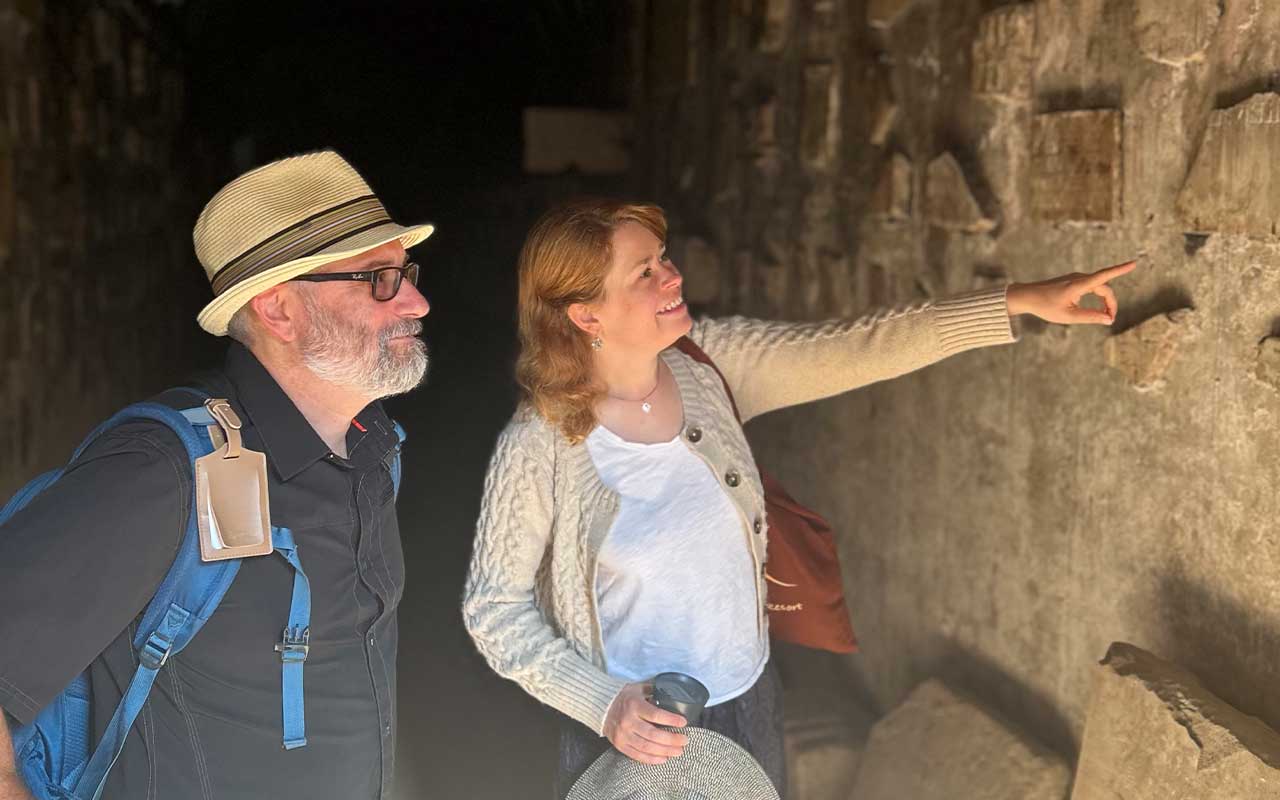
Buried beneath the streets of Rome, the Catacombs of Priscilla are among the most significant remnants of Christianity’s early years, when believers practiced their faith underground for fear of persecution—and at times at risk of martyrdom.
This past summer, Elizabeth Schrader Polczer, PhD, assistant professor of New Testament in the Department of Theology and Religious Studies, and Anthony Lagalante, PhD, professor of Chemistry, gained rare access to the ancient site. With grant support from Villanova and permission from the Vatican, the researchers were able to collect data on two frescoes within the catacombs’ third-century Greek Chapel: the Raising of Lazarus, which depicts a scene from the Gospel of John in which Jesus miraculously revives a man from death, and the Fractio Panis (Breaking of Bread), which portrays a group of people gathered at a table celebrating a commemorative meal.
Among the world’s earliest surviving examples of Christian artwork, these paintings have long sparked discussion within academia, with questions surrounding the individuals, interactions and dynamics presented. Of particular interest to Dr. Schrader Polczer, who studies women’s roles in the Gospel narratives, is whether a second female figure was added to the Raising of Lazarus, potentially diminishing the disciple Mary’s centrality to the scene.
“The oldest artwork surrounding the Lazarus story is inconsistent, showing him with one sister (Mary) in some instances and two sisters (Mary and Martha) in others,” she says. “With this particular fresco, a lithograph from 1896 appears to indicate there’s one sister, but since 1970, the literature has indicated there are two.”
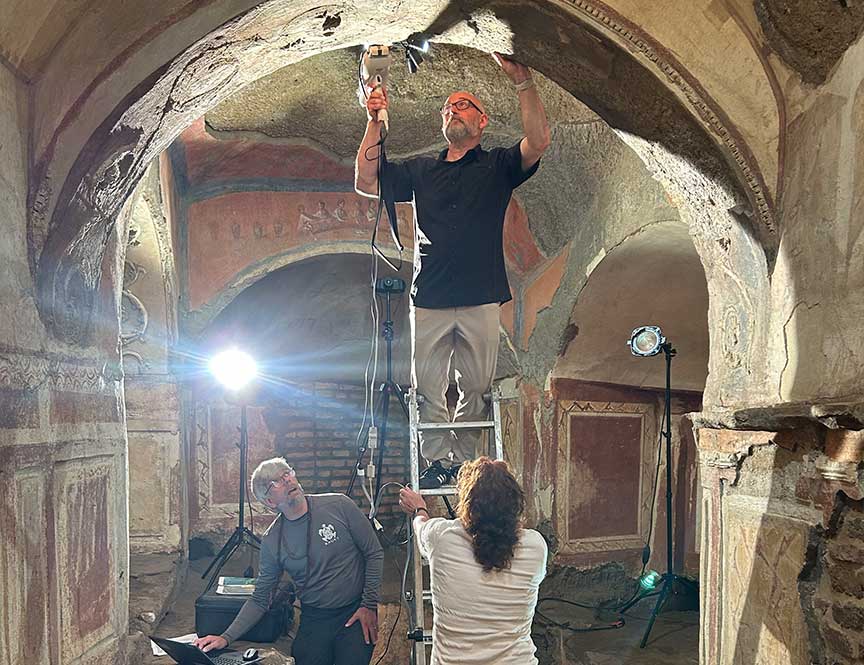
Through hyperspectral imaging and pigment analysis, Dr. Schrader Polczer and Dr. Lagalante aim to discern whether and how the Raising of Lazarus and the Fractio Panis were modified over time. The practices effectively enable the researchers to examine the retouched frescoes layer by layer, working toward their artists’ original intent, without damaging the pieces themselves.
“Historically, an expert on a particular painter or painting style would look at brushstrokes, application methods and such,” says Dr. Lagalante, who used his own portable X-ray fluorescence (pXRF) spectrometer to investigate. “Now, a scientist can step in and provide a complementary set of data, imaging beyond what our eyes can see and determining the chemical elements that comprise the pigments to reveal if they are appropriate for the time period of the artwork.”
The result is not just a step toward solving a centuries-old mystery but a means toward better understanding a community that, in a period of great uncertainty, committed their beliefs to the walls of their chapel for the sake of posterity.
“It strengthens my faith,” says Dr. Schrader Polczer. “I find it so meaningful to be connected to these early Christians; to be in the place that they were and to see how beautifully they depicted these narratives in their own time—these stories that still matter today.”
DID YOU KNOW?
Dr. Lagalante is no stranger to pigment analysis. He was part of an interdisciplinary team of conservators, art historians and scientists that worked from 2013 to 2015 to conserve the 17th-century painting Triumph of David, which is currently housed in Falvey Library’s Dugan Polk Reading Room. Over time, the team revealed the artist’s original brilliant colors, which had been hidden beneath several layers of grime, discolored varnish and overpaint.
NEXT IN NOVA-WORTHY
A Champion for Villanova and the Region
Lifetime achievement award from Philadelphia nonprofit honors vision and leadership of Villanova’s President