The Irish Connection
A medieval chalice is a symbol of Villanova’s lasting relationship with Ireland
By Yasmine Iqbal
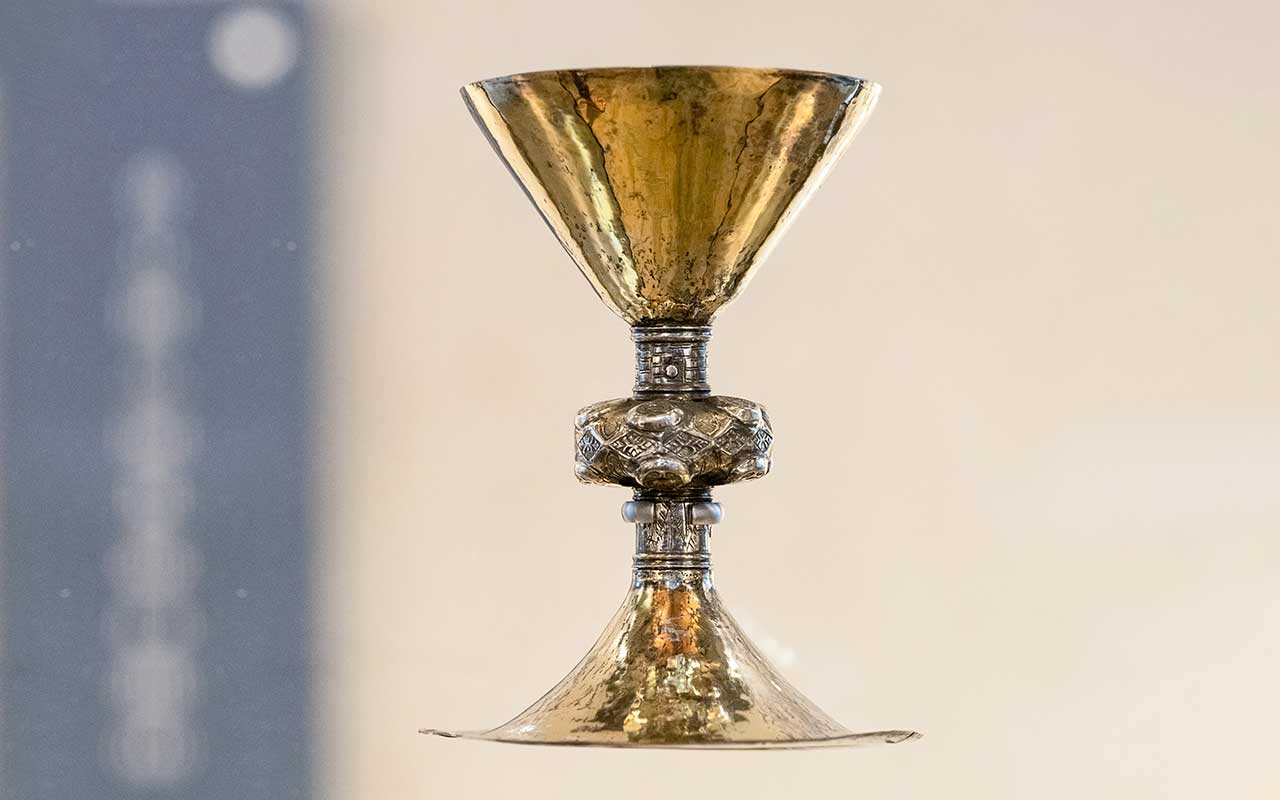
Around 1480 in southern Ireland, a medieval metalworker crafted a silver-gilt chalice. It was small, about seven inches in height, and simple, decorated only with evocative motifs, including a cross, on a knop–an ornamental knob–in the middle of its stem. For some time, it was used for its original purpose as a sacred vessel for Eucharistic wine.
During Oliver Cromwell’s conquest of Ireland (1649–53), English soldiers plundered many Irish monasteries and melted down liturgical objects in an effort to suppress Catholicism. But somehow, this chalice survived.
“Experts have indicated that a chalice of this size would often end up in a priest’s pocket, and essentially always be on the move,” says Martin Dunphy, an Irish entrepreneur and–together with his wife, Teri Dunphy–founder of the Poleberry Foundation. In 2021, the chalice was acquired by the foundation at an auction and named the Ó Learghusa Chalice, after Martin’s mother, whose family has roots in Galway, in the west of Ireland.
Martin had immediately recognized the chalice’s significance. “When I saw it for the first time, I was struck by how small and plain it is–but it was a tiny little piece that had a bit of magic. I felt that it had been on a journey and hidden away for decades. And it needed to be out in the world again.”
He reached out to several institutions to inquire if they’d be interested in exhibiting the chalice, but the person who called back first was Joseph Lennon, PhD, the Emily C. Riley Director of the Center for Irish Studies at Villanova.
“This is a remarkable material artifact, but it’s also a spiritual one,” Dr. Lennon says. He notes that its survival speaks to the endurance of the Irish people during a particularly brutal period in Irish history.
Over the past several years, scientists and historians have analyzed the chalice’s composition and background to illuminate its path over time. It was exhibited for the first time at Villanova in 2022 in “Thirst for the Divine,” an exhibition at the Villanova Art Gallery. The chalice was also used in a Mass celebrated by the Rev. Peter M. Donohue, OSA, PhD, ’75 CLAS, Villanova’s President, in St. Thomas of Villanova Church.
Since then, the chalice has been displayed in various museums in the US and Europe, including the Irish American Heritage Museum in Albany, NY, and the Princess Grace Irish Library in Monaco. It has also been used to celebrate Masses in Washington, DC, New York City, Monaco and Ireland, at Waterford’s Cathedral of the Most Holy Trinity, the country’s oldest Catholic cathedral.
Last September, the chalice returned to Villanova on long-term loan. It’s housed in a custom-made glass and metal display case in the St. Augustine Center’s Fedigan Room, where it seems to float in midair.
“Villanova is proud to share the chalice and tell its story,” Dr. Lennon says. He adds that it is a liturgical object that continues to be used–a true “chalice of the people.”
NEXT IN NOVA-WORTHY
Ireland’s prime minister visits Villanova to celebrate shared heritage, academic exchange and enduring Irish-American ties