OFFICE OF THE OMBUDS
“What happened here? What have I done? What have they done? What can I do? How can I do it? How should I do it?”

Questions like these naturally occur during a career. When such concerns arise, the Faculty Ombuds is here to help. A trusted confidant, the Ombuds will listen without judgment and strategize ways to answer those questions so you can move forward.
The Faculty Ombuds is a valuable resource for all faculty, providing impartial, confidential and informal assistance to help resolve conflicts or issues that may arise in the academic or workplace environment. Following the standards of practice of the International Ombudsperson Association, the Ombuds advocates for the principles of fairness and equity, rather than individuals, groups or entities. The Provost and Faculty Leaders collaborated to create the Faculty Ombuds position.
How to Use the Ombuds
- Conflicts that may arise when working with an advisor, supervisor, someone you manage, a colleague, a team or a group
- Dealing with a conflict that is keeping you from doing your job well
- Interpersonal or intragroup conflicts, misunderstandings, disputes or miscommunications
- Raising concerns about misconduct: academic, financial or research
- Policy issues
- Fear of coming forward or of acting to stop unacceptable behavior
- Retaliation or fear of retaliation
- Grades, academic credit or intellectual property disputes
- Harassment, discrimination, abuse of power, bullying or unfair treatment
- Ethical dilemmas
- Cultural misunderstandings
- Perceived or potential conflicts of interest
- Annoying or frustrating behaviors
- Incivility or rudeness
- Working conditions
- Unfair treatment
- Suggestions for improvement at Villanova
The Office of the Ombuds provides faculty with an opportunity to resolve concerns in a confidential, informal, neutral and independent manner. Open and honest communication between the Ombuds and faculty is essential, so it is helpful to understand the following
The Ombuds is:
- Objective
- Unbiased
- A confidential employee
The Ombuds is not:
- A representative
- An advocate
- A decision-maker
Faculty concerns sometimes revolve around claims of wrongdoing either by, or against, the faculty member initiating the Process. Participation in the Ombuds Process is aimed at resolving such issues and does not constitute an admission of wrongdoing by any party.
Any information that faculty disclose during the Process will be kept confidential by the Ombuds. Any documentation that faculty prepare during this Process and share with the Ombuds will also be considered confidential by the Ombuds. The Ombuds does not maintain any records. Any short-term working notes kept by the Ombuds during the Process will be destroyed at its conclusion, as will any other documents created or used by the Ombuds.
With permission from faculty initiating this Process, the Ombuds may reveal faculty's identity to another party to the concern to resolve it. In general, no other parties will be invited to participate in the Process without faculty consent.
To protect the assurances of confidentiality provided by the Ombuds, any participants in the Process agree not to: record any portion of the Process, subpoena the Ombuds or otherwise seek to compel the production of information or documentation created and/or shared with the Ombuds during the Process, or use statements or offers made during the Process as evidence.
The Faculty Ombuds is a confidential resource and does not report to, accept notice of a claim against, or represent the University in any way. There are limited exceptions to this, such as information provided indicating the abuse or neglect of children, the risk of serious harm, and a court order. The Ombuds also provides anonymized, aggregated concerns to Faculty Congress and Administration leadership.
- Provide impartial and confidential consultation
- Help clarify issues
- Analyze and develop options
- Work together to gather information
- Understand an issue from all perspectives
- Identify University policies
- Facilitate meetings to enhance communication between parties
- Encourage the use of mediation and other informal means of resolution, when appropriate
- Report on any matters discussed, except in limited circumstances such as where there is imminent risk of serious harm
- Participate in any formal investigations or proceedings
- Provide legal advice
- Receive claims against the University
*The Ombuds is not a mandatory reporter for purposes of Title IX*
- Conflicts that may arise when working with an advisor, supervisor, someone you manage, a colleague, a team or a group
- Dealing with a conflict that is keeping you from doing your job well
- Interpersonal or intragroup conflicts, misunderstandings, disputes or miscommunications
- Raising concerns about misconduct: academic, financial or research
- Policy issues
- Fear of coming forward or of acting to stop unacceptable behavior
- Retaliation or fear of retaliation
- Grades, academic credit or intellectual property disputes
- Harassment, discrimination, abuse of power, bullying or unfair treatment
- Ethical dilemmas
- Cultural misunderstandings
- Perceived or potential conflicts of interest
- Annoying or frustrating behaviors
- Incivility or rudeness
- Working conditions
- Unfair treatment
- Suggestions for improvement at Villanova
Villanova's Ombuds

Meg Willoughby is the inaugural ombuds for Villanova University and founded its Ombuds Office in 2019, creating an organizational landmark of proactive conflict prevention and early resolution. She is a confidential consultant to Villanova faculty, providing independent, impartial and informal assistance to problem-solve workplace concerns, while collaborating with University stakeholders to manage anonymized, emerging and systemic issues. The Ombuds Office has become an important component of the University’s commitment to fair process and practice.
Meg has assisted other organizations and their ombuds to do the same through her leadership within the Ombuds Committee of the American Bar Association’s Dispute Resolution Section. She has contributed to the enactment of two policies, which have advanced the ombuds profession: Resolutions 503 (2026) and 500 (2024).
Before shifting to the ombuds role, Meg was a practicing attorney who utilized alternative dispute methods to achieve optimal resolutions in high-stakes environments. She served as Senior Attorney and Subject Matter Expert in the U.S. Department of Education, Office for Civil Rights, an objective investigator of complaints against schools alleging discrimination and retaliation. Before that, she was a litigation associate handling civil rights and commercial matters at Stradley, Ronon, Stevens & Young LLP.
She is a passionate board member of the First Tee of Greater Philadelphia, a nonprofit that provides students with access to golf and whose mission is to develop them into better golfers and people. Meg provides pro bono legal services to Philadelphia’s indigent residents, inspired by her husband’s leadership in that field. They have three beloved teenage daughters and a Bernedoodle in Fairmount, Pennsylvania.
Willoughby received a JD from Rutgers University, Camden School of Law; a Master of Public Affairs and Politics from Rutgers University, Bloustein School of Planning and Public Policy; and a BS in Marketing from Boston College, Carroll School of Management.
Using the Ombuds Services
Contact: The Ombuds Office can be reached by email or by phone (x9-3273) to schedule a consultation.
Meeting: The Ombuds will conduct meetings in whatever modality faculty prefer, including in person or by Zoom or by phone.
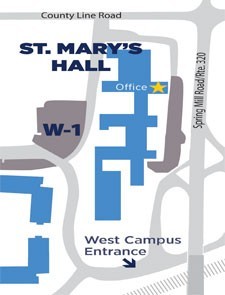
Directions: To best support the confidential nature of this work, the Ombuds Office is located on West Campus in St. Mary’s Hall, at the intersection of N. Spring Mill (RT 320) and County Line Roads. Using the main Hall entrance near the University Shop, the Office is the second on the left (2L).