
2026 Ward Lecture Explores the Engineering Behind Advanced Therapeutics
New cell and gene therapies offer possibilities for patients with cancer and inherited diseases, including some who previously had few treatment options. Turning those discoveries into treatments that can reach more patients requires solving difficult engineering problems: how to manufacture living medicines consistently, protect fragile biological materials and reduce the time and resources required to deliver each dose.
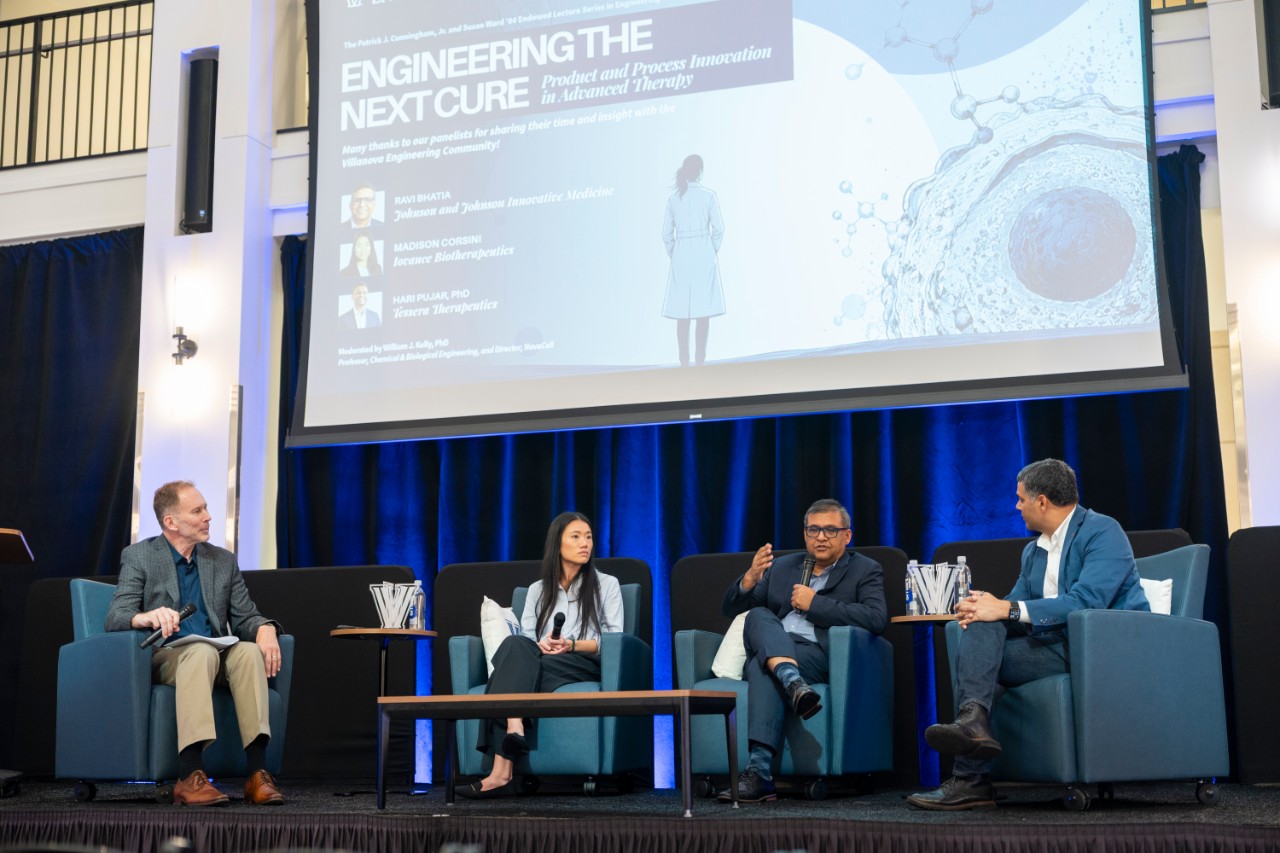
Those challenges were the focus of Villanova Engineering’s annual Patrick J. Cunningham, Jr. and Susan Ward ’80 Endowed Lecture. Held Oct. 2, 2026, in the Jones Family Learning Commons in Drosdick Hall, “Engineering the Next Cure: Product and Process Innovation in Advanced Therapies” brought together three industry experts to discuss the work behind these treatments and the opportunities for engineers to improve their effectiveness, affordability and accessibility.
Moderated by William J. Kelly, PhD, professor of Chemical and Biological Engineering and director of NovaCell, the panel featured Hari Pujar, PhD, chief operating officer at Tessera Therapeutics, co-founder and board director of Mirai Bio, and board director at Ring Therapeutics; Ravinder “Ravi” Bhatia, senior scientific director at Johnson & Johnson Innovative Medicine; and Madison Corsini, manager of process engineering at Iovance Biotherapeutics.
The group discussed the shift in medicine from drugs that act on proteins to treatments that deliver genetic instructions or use living cells to fight disease. As these therapies continue to evolve, so do the processes, technologies and engineering approaches needed to develop and produce them.
Engineers across disciplines play an important role in this work, from optimizing biological processes to developing automated equipment, robotics and the specialized facilities needed to support advanced therapies, the experts noted. These innovations are also helping address some of the challenges associated with producing these therapies, including their high cost.
“Cell and gene therapies can cost anywhere from roughly $100,000 to $1 million to produce today. But technologies are already being developed that could bring those costs down,” said Dr. Pujar.
Research and engineering are not the only forces driving innovation in advanced therapeutics. Artificial intelligence is also playing an increasingly important role, Bhatia said, helping researchers and engineers develop new approaches to both the product and the process to make it.
“I think the power of AI is definitely going to make a difference,” he said. “In cell therapy manufacturing, we generate a lot of data, from patient history and previous treatments to our own manufacturing data. I’m excited about the future of using AI to predict how a patient’s cells will perform during manufacturing and then using that information to adapt the manufacturing process to make sure the patient gets the drug product.”
About the Patrick J. Cunningham Jr. and Susan Ward ’80 Endowed Lecture Series in Engineering:
In 2009, Villanova Engineering alumna Susan Ward ’80 ChE and her husband, Patrick Cunningham, established an endowed engineering lecture series to offer students exposure to experts from various engineering fields and educational opportunities outside the classroom. The inaugural event was held in 2010, and the lecture has since become an annual event at Villanova.
Elizabeth Slocum
Director of Communication and Marketing
elizabeth.slocum@villanova.edu
Alyson Hersker
Director of Events and Experience
alyson.hersker@villanova.edu