
FORGING STRONGER FOUNDATIONS
Hands-on learning and industry collaboration prepare Civil Engineering students to lead in structural design
By Lauren Barnes
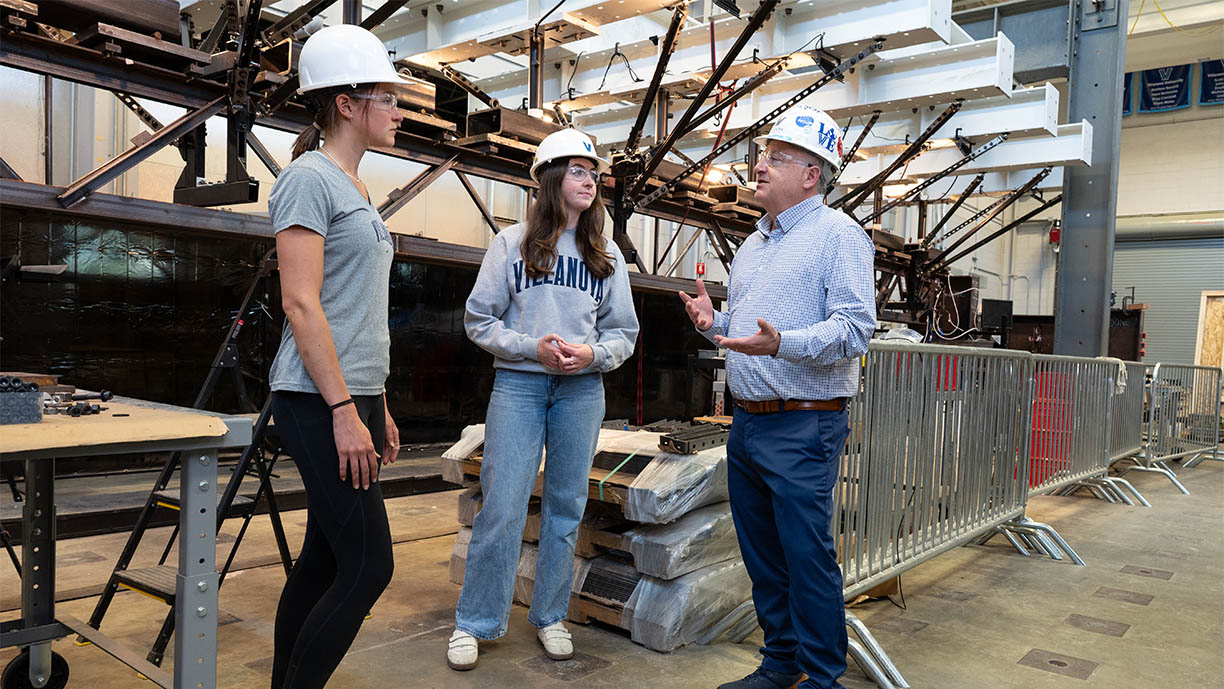
Thanks to a $2 million industry grant, students in Civil Engineering—from undergraduates to PhD candidates—are gaining confidence in professional settings as they work alongside industry engineers, contribute to research, present findings and learn to trust their expertise.
Awarded in 2024, the five-year grant from New Millennium, a Steel Dynamics company, supports a research program focused on advancing the design, behavior and performance of structural steel components used in commercial buildings, with an emphasis on improving efficiency, safety and constructability in modern structural systems. While the research aims to validate and optimize design assumptions used by New Millennium, it also expands hands-on research for students at every level.
Experimental testing is conducted in Villanova’s Richard K. Faris Structural Engineering Teaching and Research Laboratory. Through their involvement, students develop strong laboratory and analytical skills while gaining experience coordinating undergraduate assistants, managing equipment scheduling, and refining professional communication and project management skills.
“The hands-on, interactive nature of this experience has been incredibly valuable,” says Allyson Cottier ’25 CE, ’26 MSCE, who has worked on the project for the past two years. “I’ve built testing setups, troubleshot instrumentation and worked directly with industry professionals, gaining a deeper understanding than coursework alone can provide.”
Teams of approximately 10 students meet monthly with six employees from New Millennium to present research findings, review experimental results and discuss progress. These regular interactions provide students with meaningful exposure to industry professionals and real-world engineering challenges, strengthening the connection between academic research and professional practice.
The research itself is highly collaborative. “Students participate in all aspects of the research. They assist in designing all components of the experimental testing program, from the support structure to the data acquisition plan and the synthesis of the data,” says Civil and Environmental Engineering Professor David Dinehart, PhD, a co-principal investigator on the project alongside fellow CEE professors Shawn P. Gross, PhD, and Joseph Robert Yost, PhD, PE.
The involvement ensures that students not only contribute to but also graduate with the technical expertise and knowledge needed to lead in structural engineering.
In addition to technical growth, the program fosters mentorship and a strong sense of community among participants. This approach creates a dynamic learning environment where knowledge is actively shared and applied. Ultimately, the initiative exemplifies how academia and industry can work together to prepare the next generation of engineers.
“Working alongside New Millennium has emphasized the importance of adaptability in problem-solving,” Cottier says. “Not everything in my research has gone according to plan, so I’ve had to reassess, adjust and move forward in real time while coordinating with an industry leader. This experience has strengthened my ability to navigate complexities and make thoughtful decisions with the end goal in mind.”
Next: Faculty Q&A
Leading and Learning in Engineering
Dr. Eric Musselman shares his enthusiasm for his new role as associate dean for Undergraduate Affairs