
SOLVING WHAT’S NEXT
Two signature lectures examine the evolving demands on engineers—from sustaining the digital backbone of AI to confronting complex environmental systems
By Lauren Barnes
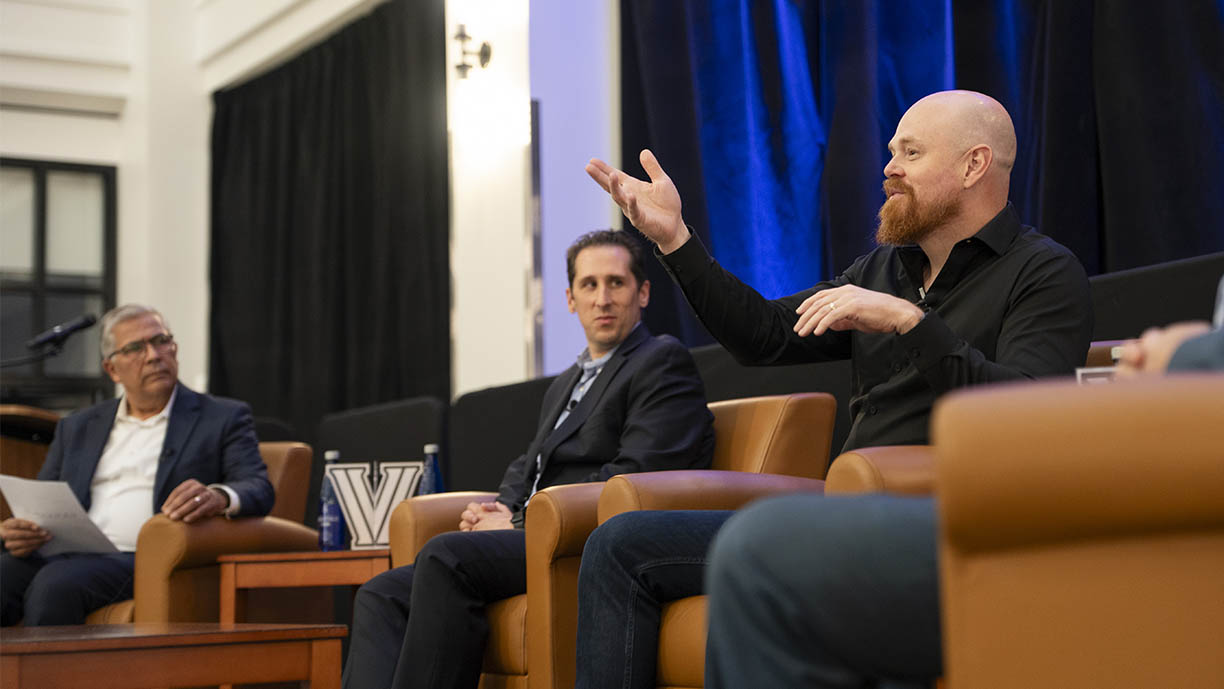
Villanova Engineering brought global challenges and emerging technologies into focus this year through two signature lectures that highlighted the evolving role of engineers in a complex world.
During the annual Patrick J. Cunningham, Jr. and Susan Ward ’80 Endowed Lecture, “The Data Center Revolution,” industry panelists explored how data centers are reshaping the infrastructure of the digital age.
Moderated by Alfonso Ortega, PhD, the James R. Birle Professor of Energy Technology at Villanova, the discussion featured David Quirk, president and CEO of DBL Associates; Sean James, senior director of data center research at Microsoft; and Dustin Demetriou, PhD, senior engineer in IBM’s Systems Advanced Thermal Energy Efficiency Lab.
Panelists noted that while data centers have existed for decades, the rise of artificial intelligence has thrust them back into the spotlight. James explained how graphics processing units (GPUs), originally designed for video games, are now essential for powering AI and machine learning due to their ability to perform many calculations simultaneously.
The speakers also emphasized the scale of challenges facing the industry, particularly as demand for computing power grows. At the same time, they highlighted opportunities for students to help share more efficient and sustainable solutions.
“I don’t think that AI is going to go away,” said Dr. Demetriou. “As AI continues to grow, data centers will play an increasingly critical role in supporting it. … There’s a lot that can be done from a sustainable and
responsible perspective.”
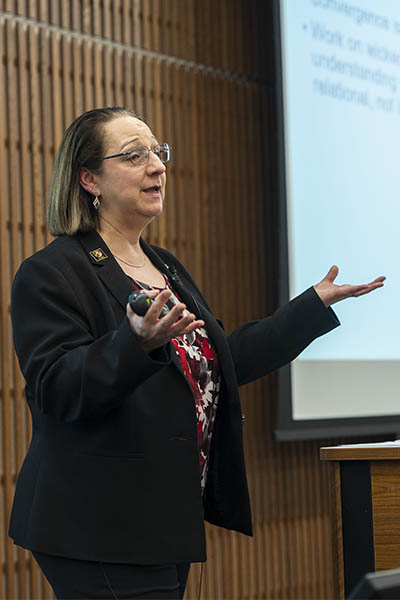
The annual Claire L. and Gerard F. Jones ’72 Distinguished Lecture, meanwhile, addressed the “wicked” challenges of water systems and the urgent need to modernize aging infrastructure. In her talk, “Convergence Research for Solving Wicked Water Problems,” Jeanne M. van Briesen, PhD, PE, dean of the College of Engineering and Information Technology at the University of Maryland, Baltimore County, drew on decades of research in river biochemistry, drinking water safety and energy impacts.
She defined “wicked” problems as complex, interconnected challenges that resist simple solutions. “You can’t study water problems without understanding climate change—there are many interdependencies, and the causes are often multiple,” she said, noting that attempted fixes can sometimes create new issues.
Dr. van Briesen emphasized that addressing these challenges requires more than traditional technical approaches. She highlighted convergence research, which brings together diverse fields to collaborate on real-world problems and develop new solutions. “It’s really about mindset and how you approach these problems,” she said. “Wicked problems don’t get solved; they get stewarded.”
Next: Features
Villanova Engineers harness AI to transform research into solutions that shape the future