
OUR AUGUSTINIAN HERITAGE
This history was adapted from The Augustinian Province of St. Thomas of Villanova by Michael DiGregorio, OSA, and the website of the Augustinians of the Midwest. Census numbers are from the Augustinian Curia database—Rome, Italy.
The term Augustinians applies to two separate and unrelated types of Catholic religious orders. Mendicant Orders are those whose members take individual or corporate vows of poverty and depend on charitable contributions to sustain their work. These Augustinians balance a religious life of contemplation with apostolic ministry, live in community with each other and follow the Rule of St. Augustine. The largest and most familiar, originally known as the Hermits of St. Augustine or Austin friars, is now known simply as the Order of St. Augustine (OSA). Two other Mendicant branches of the Order, seeking to return to their monastic roots, also exist. The Discalced Augustinians, to which Martin Luther belonged, became independent in 1592. The Augustinian Recollects followed in 1612.
Beyond the Mendicants, various congregations of clerics, known as Canons Regular, also follow the Rule of St. Augustine. They lead a semi-monastic life, while remaining committed to pastoral care, appropriate to their primary vocation as priests. They generally form one large community, usually serve parishes in the vicinity, and are organized as autonomous religious congregations, normally distinct by region. There also exist religious groups who refer to Augustine or call themselves Augustinian but who have no canonical status with either the Order of St. Augustine or the Catholic Church.
The Order of St. Augustine is composed of priests and brothers, whether professed or novices; contemplative nuns; and members of various Augustinian Secular Fraternities. In addition, the Augustinian family also includes other groups: religious institutes, both male and female, such as the Augustinians of the Assumption, the Sisters of St. Rita, as well as other groups of lay faithful affiliated to the Order. Augustinians differ from traditional monastic orders in that they do not take vows of stability, meaning that they do not live in a single house (monastery or friary) but move as need requires. Friars are engaged in apostolic activity, such as pastoral care, mission work, education, prison ministries, etc. Further, as an international order, they are divided into various provinces throughout the world, with each Province being led by a Prior Provincial and all are under the supervision of a Prior General in Rome. Lastly, they have a special commitment to corporate poverty. Augustinians wear a religious habit, consisting of three pieces: a tunic, a cincture (belt) and a capuche (shoulder cape) with hood. All are usually black in color.
The Augustinian friars came into being as part of the mendicant movement of the 13th century, a new form of religious life which sought to bring the religious ideals of the monastic life into an urban setting, allowing the religious to serve the needs of the People of God in an apostolic capacity. At this time there were a number of eremitical groups living in such diverse places as Italy, England, Switzerland and Germany.
In 1244, Pope Innocent IV issued the Bull Incumbit Nobis. This brief pastoral letter served as the Magna Carta initiating the foundation of the Order as it is known today. This papal bull exhorted these hermits to adopt ‘the Rule and way of life of Blessed Augustine,’ to profess this Augustinian manner of life in a way that they themselves would decide with regard to specific charism and apostolate, and to elect a Prior General.
These Tuscan hermits came together for a general chapter in March 1244, as decreed by the Bull Praesentium Vobis, a chapter presided over by Cardinal Annibaldi. At this chapter, the Order formally adopted the Rule of St. Augustine, to follow the Roman office with the Cistercian Psalter and to hold triennial elections of the Prior General. This event is commonly called the Little Union. On March 31 of the same year, Pope Innocent IV issued the Papal Bull Pia Desideria, formally approving the foundation of the Order. In 1256, Pope Innocent’s successor Pope Alexander IV called together various other hermit groups from around the world and ultimately joined them to this existing Augustinian Order. This historical union has subsequently been referred to as the Grand Union of 1256.
This early time in the Order’s history was characterized by a great devotion to learning, study, prayer, service of the poor, and the defense of the Pope and the Church—a particular charism of the Order rooted in its status as the only Order in the history of the Church to be founded directly by the Pope.
The formal beginnings of what is now the Province of St. Thomas of Villanova date to the year 1796. The founding friars were the Irish Augustinians, Matthew Carr, OSA and John Rosseter, OSA. The first foundation was the Church of St. Augustine in Philadelphia begun in 1796 and completed in 1801. The first American vocation was Michael Hurley, OSA.
In May of 1844, anti-Catholic rioters burned the Church of St. Augustine to the ground. Not only the church, but also the friary and several adjoining buildings were destroyed, including the community’s valuable theological library of some 3,000 volumes. But, out of this tragedy was born the second Augustinian foundation, Villanova College.
In 1841, friars purchased a 200-acre farm 10 miles outside the city, and established what was soon to become the center of Augustinian life in the province for many years. The college was begun in 1842. Instrumental in the work of establishing the new community and school were the friars, Patrick Moriarty, OSA and John O’Dwyer, OSA, who was Villanova College’s first president. In 1848, St. Augustine’s Church was rebuilt and additional foundations were established in Massachusetts. Subsequently, care of additional parishes in Pennsylvania and New York also was given to the friars. On August 25, 1874, the province was juridically established under the patronage of St. Thomas of Villanova, and the first provincial chapter was held in December of the same year. By this time, the province was 44 friars strong, serving more than 14 churches in four states.
Charles Mary Driscoll, OSA, was elected Prior Provincial in 1894 and, in 1920, became the first American- born Augustinian to become a member of the General Curia. John Fedigan, OSA, was provincial in 1899 when the American province sent its first friars to Cuba following the Spanish-American War. The Rev. William Jones, OSA, later to become bishop of San Juan, Puerto Rico, began the Colegio San Agustin in Cuba. The mission to Cuba lasted until 1961 when all but one of the friars were expelled and the Order’s properties confiscated by the new regime.
Expansion of Augustinian life in the United States was especially notable through the 1950s. A church and school dedicated to St. Rita had been started at the turn of the century in Chicago and other foundations added subsequently in the Midwestern states. This activity formed the basis for what would eventually grow into the Province of Our Mother of Good Counsel in 1941. Similarly, missions begun in California in the 1920s and added to in the following decades, flowered into the separate California Province of St. Augustine in 1969.
Under the leadership of Joseph Dougherty, OSA, the Province of St. Thomas of Villanova undertook the opening of a mission in Nagasaki, Japan in 1952. In the 1960s, the Villanova province joined with the Midwest province in undertaking mission work in Chulucanas, Peru. The special general chapter of 1968, called to draw up new Constitutions in accordance with the directives of the Second Vatican council, was held at Villanova. At the same time, a notable decline in the number of applicants to religious life was beginning to be felt in the province as elsewhere. Seminaries, high schools and parishes were either closed or returned to dioceses. On a more positive note, the later part of the century was a period of growing interest in Augustinian lay groups, such as the Augustinian Seculars.
In 1994, the ordinary provincial chapter of the Villanova province was the largest in the history of the Order, and the first to be held as a chapter of the whole. Every succeeding ordinary chapter since has followed this same pattern. Under the leadership of provincial John Deegan, OSA, the province adopted a plan to review the ministries of the province, in light of established criteria. Decisions were made to withdraw from a number of parishes in order to fortify other foundations or to begin new ministries. As a result, the province experienced both the sorrow of separation from some longstanding missions and the joy of venturing into new areas—most notably, responsibility for a foundation in South Africa.
Today, the Order of St. Augustine claims approximately 2,600 friars working in 46 countries. The largest numbers are found in Spain (500+), United States (300+), Mexico (240+), Italy (200+) and Peru (130+).
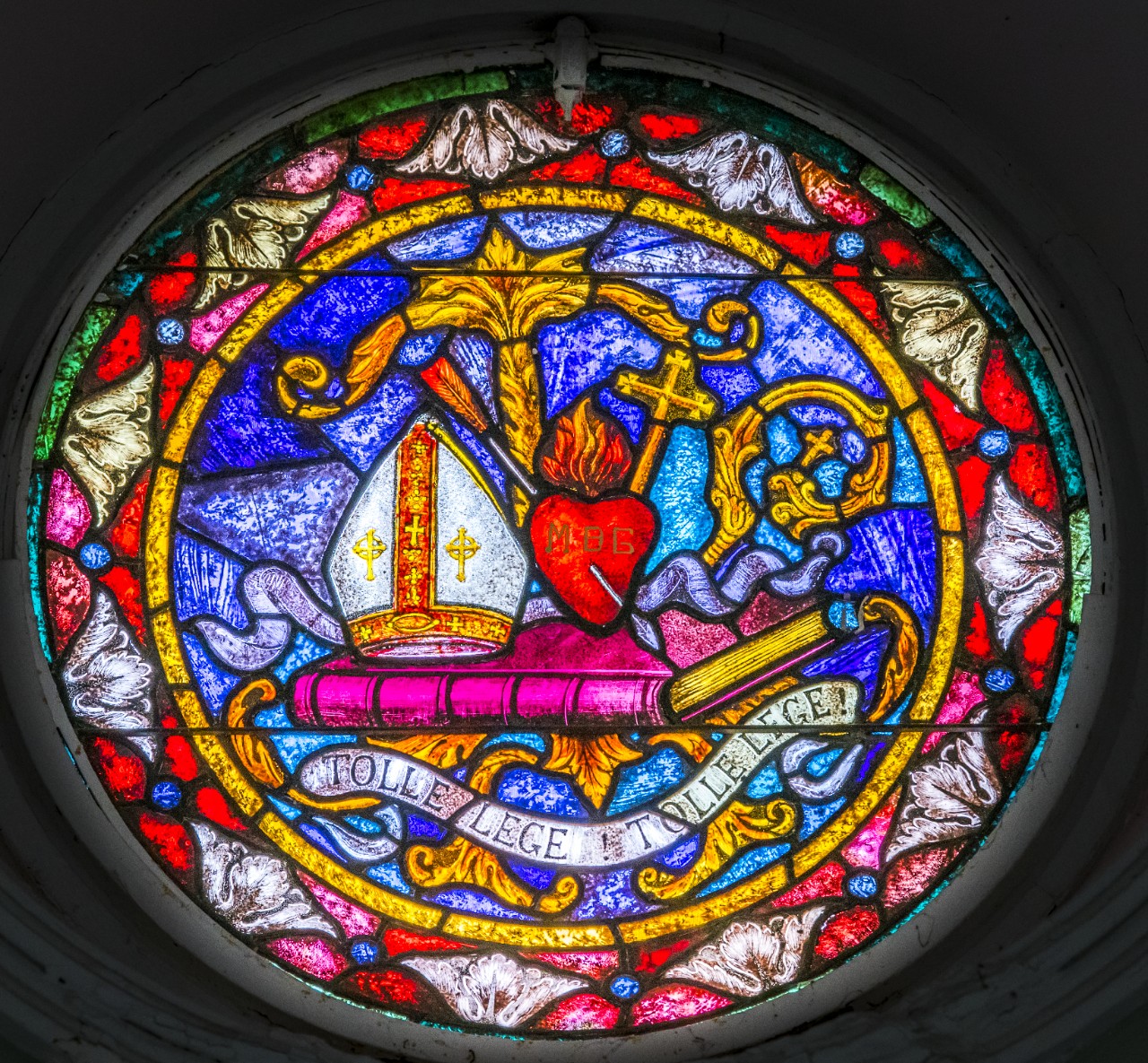
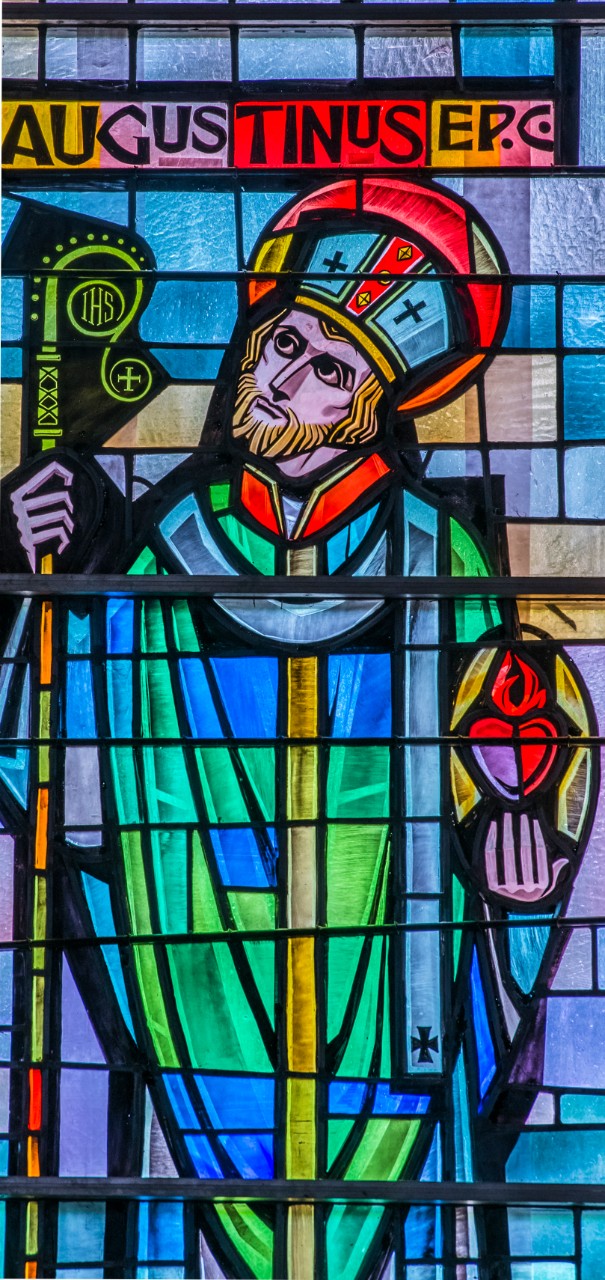
The heart on fire is found in the Augustinian seal with other imagery of Augustinian spirituality.
The book symbolizes the Word of God, source of light and truth, and the quest for wisdom.
The arrow piercing the heart represents the Spirit of God calling us to continued growth and reminding us of the source of our restlessness.
The seal may also contain Augustine’s mitre or crozier, which remind us that he was a leader in the church and in his communities. The scroll with the words, “Tolle Lege,” bring to mind his conversion, and remind us to turn to the Bible.
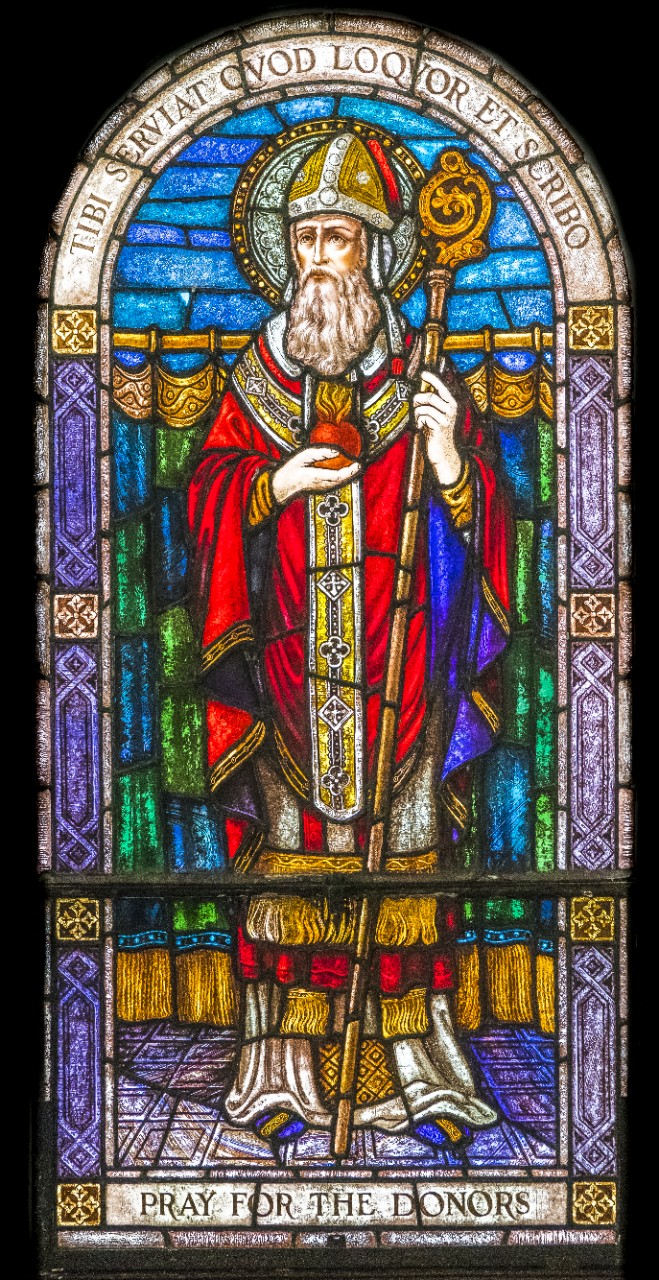
The symbol of the heart on fire represents Augustine’s caritas. Caritas includes both love of God and of neighbor.
Augustine is often represented holding a flaming heart to indicate his commitment to caritas. The Augustinian heart is passionately alive, with the desire to know God and experience divine love in our lives.
Augustine writes in the Confessions that our heart is restless until they rest in God (Conf. 1.1.1). As we journey on this pilgrimage together, look for images of the restless heart as we seek to follow Augustine’s example in setting our own hearts on fire with love.

The NCAA college basketball season tips off on an international stage, as Villanova and Notre Dame meet in an unprecedented college basketball showdown on November 1, 2026, at the Palazzo dello Sport in Rome. The men’s matchup will air live on FOX at 3:30 PM CST (9:30 AM ET), followed by the women’s game on FS1 at 6:00 PM CST (12:00 PM ET).
Inspired by the recent election of Pope Leo XIV, the first American-born Pope and a Villanova graduate, student-athletes from some of the United States’ top Catholic universities will travel to Rome and Vatican City for a one-of-a-kind international experience to begin their college hoops season.