PEOPLE TO KNOW
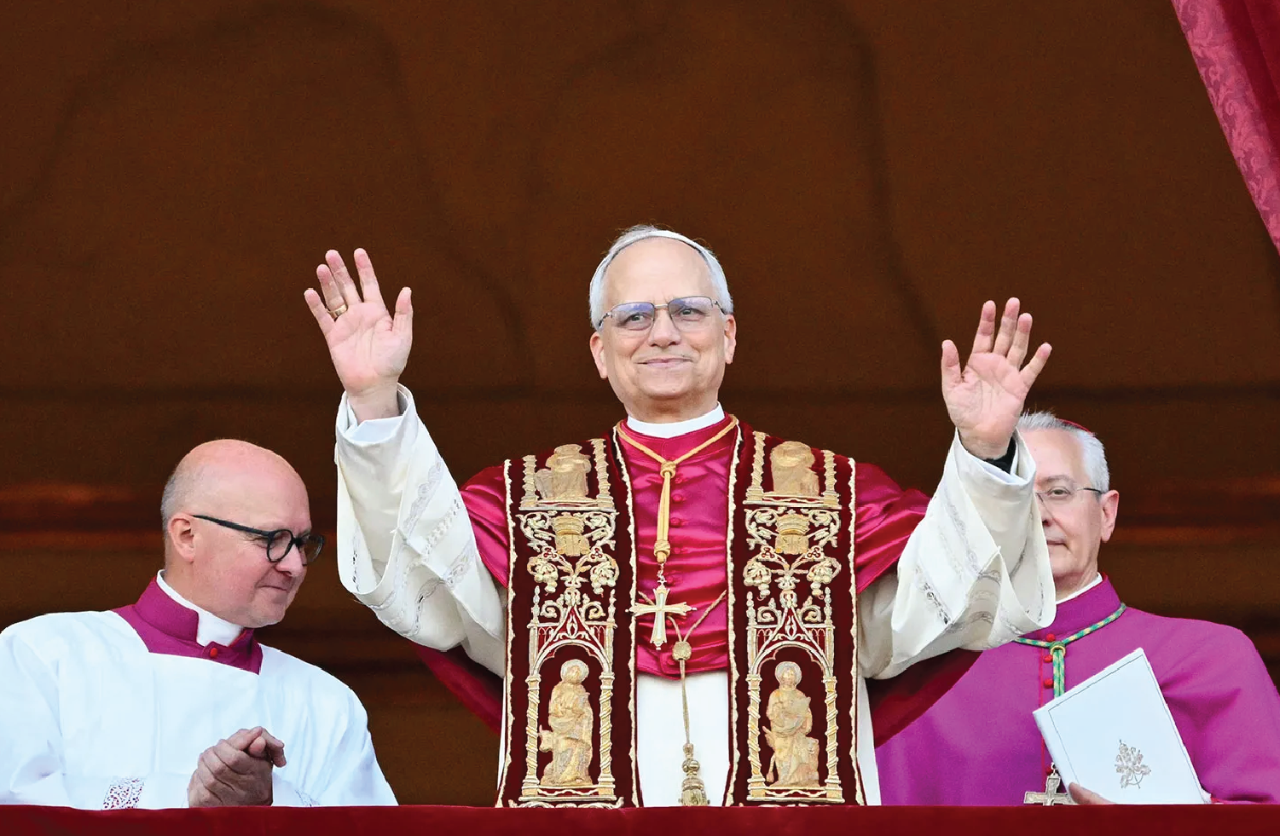
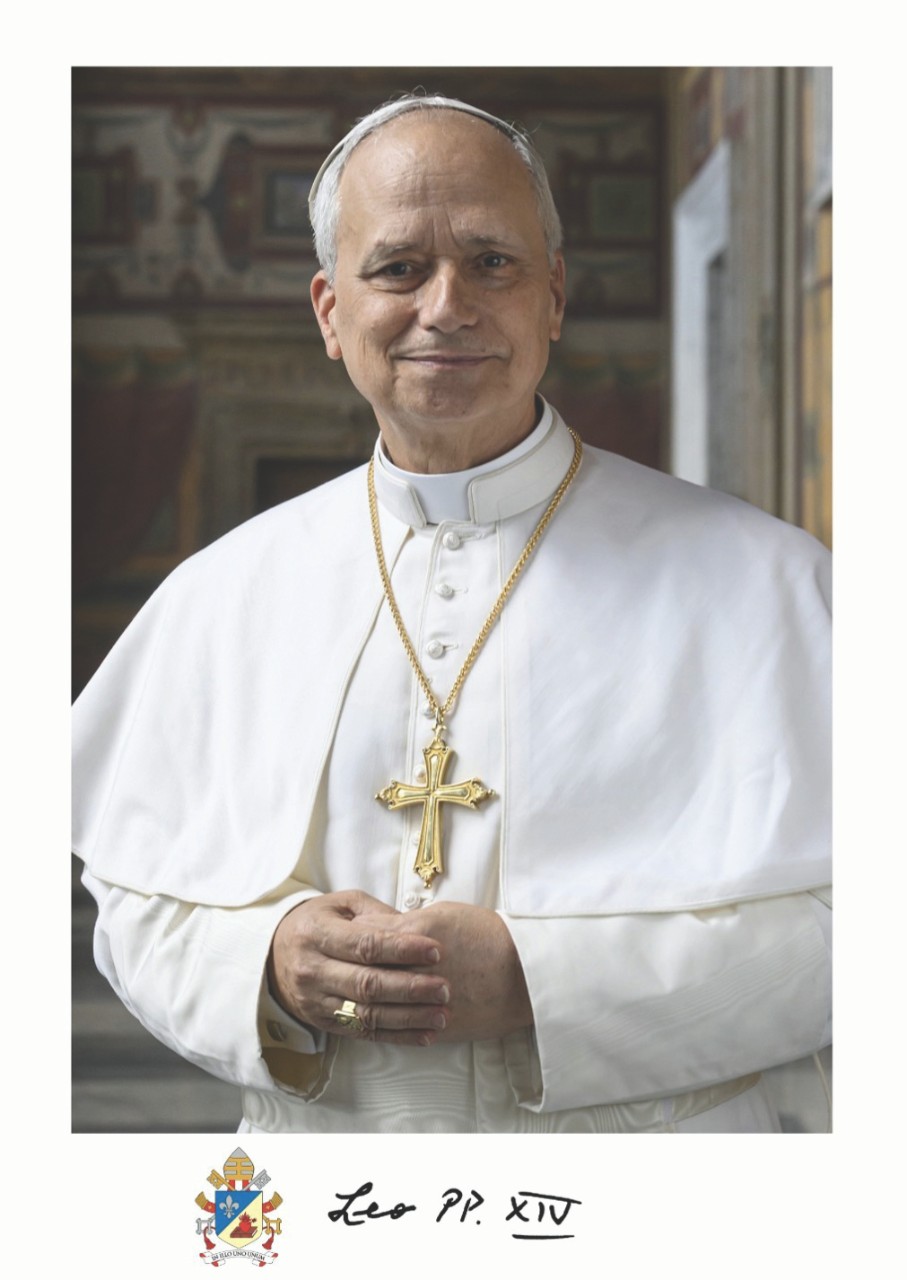
POPE LEO XIV
A native of Chicago, Pope Leo was born Robert Francis Prevost on September 14, 1955, to Louis Marius Prevost and Mildred Martínez. He attended the Minor Seminary of the Augustinians in Holland, Mich., and in 1977 earned a degree in mathematics from Villanova University.
That same year, he entered the novitiate of the Order of St. Augustine in St. Louis, in the Province of Our Mother of Good Counsel headquartered in Chicago. He professed his first vows in 1978 and made his solemn vows in 1981. He completed a master of divinity degree at Catholic Theological Union in Chicago and was ordained a priest in 1982 at the Augustinian College of St. Monica in Rome. He remained there to complete a licentiate and doctorate in canon law at the Pontifical University of St. Thomas Aquinas.
Following his return to the Americas, he began over a decade of ministry in Peru. He was first assigned to Chulucanas, and later transferred to Trujillo, where he directed Augustinian formation for candidates from three regional vicariates. He served as prior, professor, formation director, judicial vicar of the archdiocese, and pastor in two parishes—one of which he helped establish in a poor neighborhood of Trujillo.
In 1999, he was elected prior provincial of the Midwest Augustinian Province of Our Mother of Good Counsel, and in 2001, prior general of the worldwide Augustinian Order—a role to which he was re-elected in 2007, reflecting the tremendous trust his brothers had in his ability to lead them.
After completing his second term as prior general, he returned to Chicago in 2013, serving in leadership and formation. In 2014, Pope Francis named him apostolic administrator of the Diocese of Chiclayo, Peru, and Prevost was ordained a bishop at the Cathedral of St. Mary in Chiclayo that December on the Feast of Our Lady of Guadalupe. He served as bishop of Chiclayo from 2015 to 2023, while also leading and advising within the Peruvian Episcopal Conference. In 2019, he was appointed to the Congregation for the Clergy, and a year later to the Congregation for Bishops. In January 2023, then–Bishop Robert Prevost, OSA, returned to Rome and was named prefect of the Dicastery for Bishops and president of the Pontifical Commission for Latin America. He was created cardinal on September 30, 2023, receiving the Deaconry of Santa Monica (a fitting choice for an Augustinian), and in February 2024 was elevated to the Order of Bishops and assigned the Suburbicarian Church of Albano.
Shortly afterward on May 8, 2025, he was elected pope. “I announce to you a great joy; we have a pope!,” said Cardinal Protodeacon Dominique Mamberti, in Latin. “The most eminent and most reverend lord, Lord Robert Francis Cardinal of the Holy Roman Church Prevost, who has taken the name Leo XIV.”
“To see him emerge on that balcony, it was like seeing a family member—our brother!” remembers Prior Provincial Fr. Robert P. Hagan, OSA, “We were speechless: so proud and yet so humbled at the same time. Pope Leo is an unassuming man. He is incredibly gifted and spent his whole life in the service of God’s people. He has devoted his ministry to serving the poor, building bridges, and bringing people together. He consistently keeps in mind those living on the margins. I am excited to watch him continue this important work as our Holy Father.”
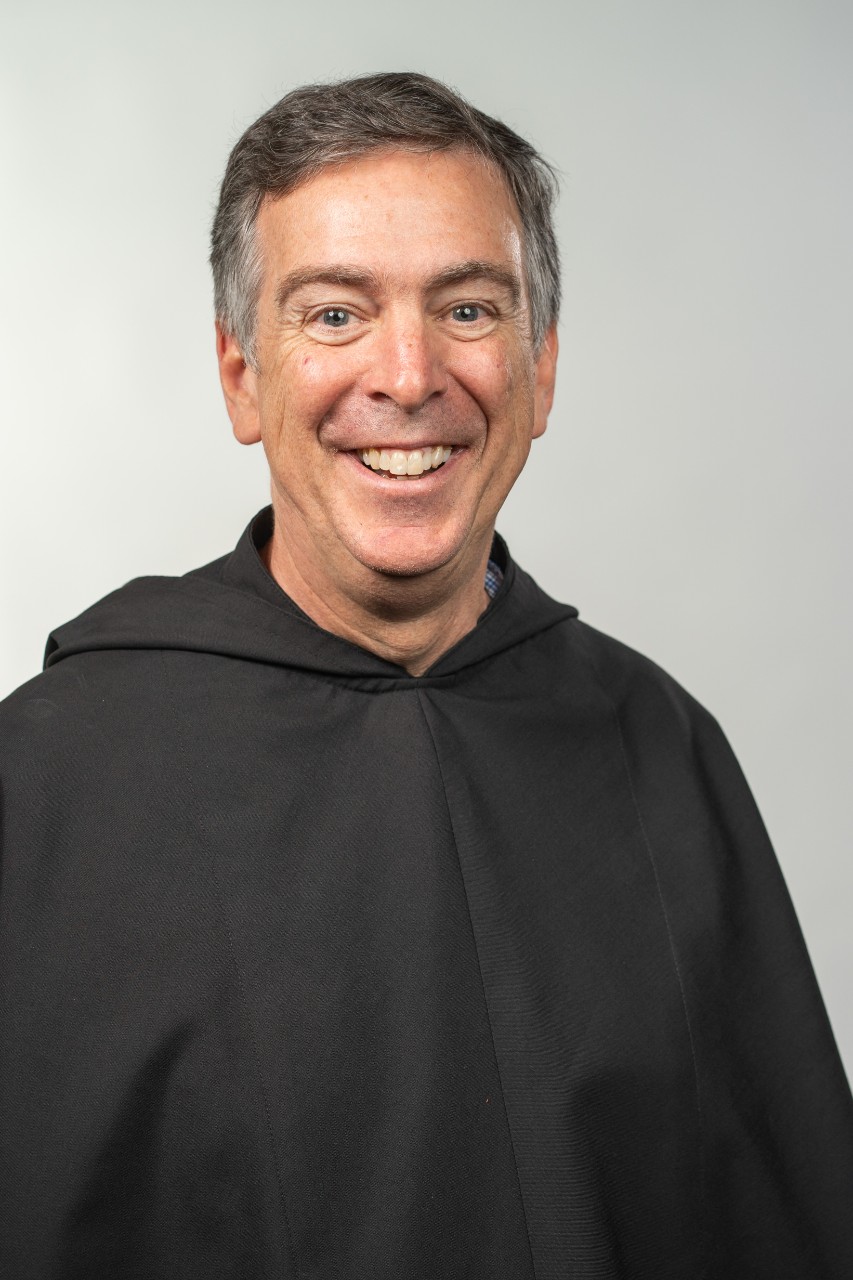
FATHER JOSEPH FARRELL, OSA
The Rev. Joseph L. Farrell, OSA, STL, STD, ’85 VSB, ’19 MS was elected Prior General of the Order of St. Augustine at the Order’s 188th General Chapter on Sept. 9, 2025. Father Farrell is the second Prior General elected from the Augustinian Province of St. Thomas of Villanova and 98th Prior General of the Order since the position was first assigned in 1256, shortly after its founding.
Prior to his election, Father Farrell served two consecutive six-year terms as the Vicar General of the worldwide Order, and as assistant general for North America beginning in 2013.
A Drexel Hill, Pa., native and graduate of Monsignor Bonner High School, Father Farrell completed his undergraduate studies at Villanova School of Business in 1985, earning a Bachelor of Science in Business Administration before joining the pre-novitiate program at the St. Augustine Friary in Villanova. Following the novitiate, he earned a Master of Arts in Theology from the Washington Theological Union.
Ordained in 1991 at Our Mother of Good Counsel Church in Bryn Mawr, Pa., Father Farrell was first assigned to the St. Augustine Parish in Lawrence, Mass., before returning to Pennsylvania to serve as chaplain at Monsignor Bonner and as a member of their St. Ambrose Friary Community. From 1996 to 2003, he was assigned as campus minister of Merrimack College, an Augustinian institution in Massachusetts, before pursuing studies at the Pontifical Gregorian University in Rome, where he earned both his Licentiate in Sacred Theology and Doctorate in Sacred Theology.
Upon his return to the United States, Father Farrell was assigned to the St. Thomas of Villanova Monastery and held the position of director of Programming and Outreach in Villanova University’s Office for Mission Effectiveness, while also serving as an adjunct professor of Theology. During this time, he worked with undergraduate and graduate students to introduce them to St. Augustine and his teachings both inside and outside of the classroom.
From 2008 to 2010, Father Farrell was assigned as prior to Blessed Stephen Bellesini Friary, the house of formation for pre-novitiates to the Order in Ardmore, Pa. At the Provincial Chapter of 2010, he was elected a counselor of the Province.
In 2019, just prior to his re-election as Vicar General, he completed his Master of Church Management at Villanova.
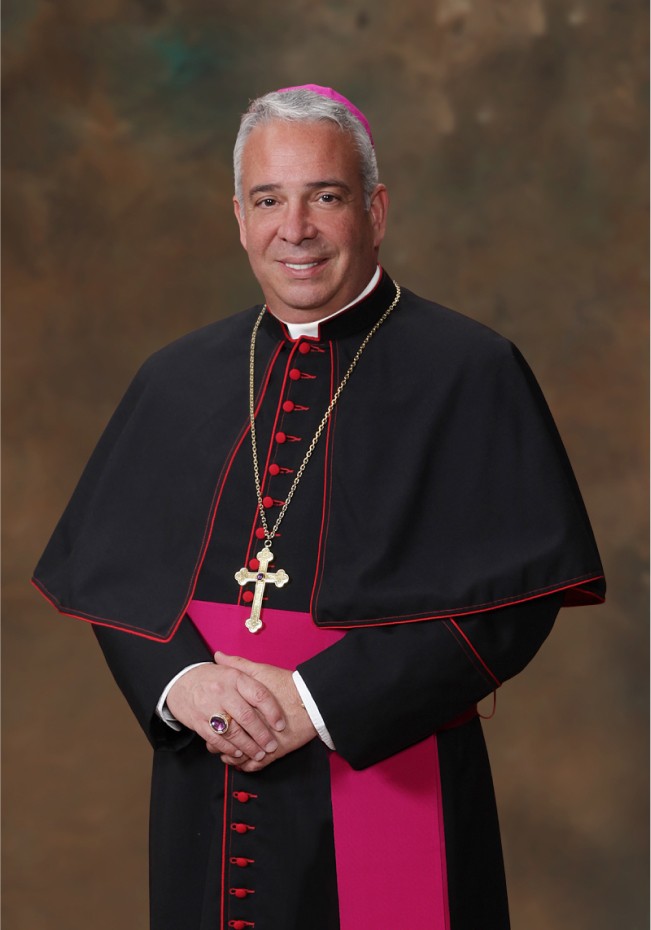
ARCHBISHOP NELSON J. PÉREZ
Nelson J. Pérez was born in Miami, Florida, on June 16, 1961, to David and Emma Pérez. He was raised in West New York, New Jersey, and earned a Bachelor of Arts Degree in Psychology from Montclair State University in 1983.
He then entered Saint Charles Borromeo Seminary in Philadelphia, where he earned Master of Divinity and Master of Arts in Theology degrees in 1988 and 1989.
Father Pérez was ordained a priest for the Archdiocese of Philadelphia at the Cathedral Basilica of Saints Peter and Paul on May 20, 1989. His first priestly assignment was as Parochial Vicar of Saint Ambrose Parish, Philadelphia (1989-1993). He also served as Acting Director of the Office for Hispanic Catholics (1990-1993); founding Director of the Catholic Institute for Evangelization (1993-2002); Pastor of Saint William Parish, Philadelphia (2002-2009); and Pastor of Saint Agnes Parish, West Chester (2009-2012).
In 1998, he was named Chaplain to His Holiness, Pope John Paul II, with the title of Monsignor. In 2009, he was named a Prelate of Honor by Pope Benedict XVI.
His work in education included teaching courses in psychology and religious studies at La Salle University, Philadelphia (1994-2008) and Developmental Psychology at Saint Charles Borromeo Seminary (Fall, 2011).
Pope Benedict XVI appointed Monsignor Pérez, Auxiliary Bishop of the Diocese of Rockville Centre in New York on June 8, 2012. He was ordained a Bishop on July 25, 2012, in Saint Agnes Cathedral, Rockville Centre. As Auxiliary Bishop he served as Episcopal Vicar for the Eastern Vicariate, overseeing 66 parishes and as the Episcopal Vicar for Hispanic Ministry, overseeing 54 parishes with pastoral ministry to Hispanics along with Formation Programs and Ecclesial Movements. In addition, he served as a member of the Diocese of Rockville Centre’s Priest Personnel Board; Presbyteral Council; Corporate Member of Catholic Health Services; Vice Chair of Catholic Charities Board of Directors and member of its Executive and Governance Committees; member of the Diocesan Pastoral Council; Chair of the Diocesan V Encuentro Planning Committee; and a board member of the Diocese’s Catholic Faith Network.
On July 11, 2017, Pope Francis appointed Bishop Pérez the 11th Bishop of the Diocese of Cleveland and he was installed at the Cathedral of Saint John the Evangelist on September 5, 2017.
On January 23, 2020, Pope Francis appointed him the 14th Bishop and 10th Archbishop of the Archdiocese of Philadelphia. A kind, joyous, and hard-working person, Archbishop Pérez enriches those ministries and people entrusted to his care. Rooted in Pope Francis’ Apostolic Exhortation, “The Joy of the Gospel,” Archbishop Pérez’s pastoral vision can be summarized as: “Church on Mission: Proactive, Involved, Supportive, Fruitful, and Joyful.”
In 2025, Archbishop Pérez instituted the Trust and Hope initiative in the Archdiocese of Philadelphia, a strategic and concerted effort to renew the Catholic Church of Philadelphia by investing in growth. This initiative emerged from 100 listening sessions involving nearly 15,000 participants. The initiative is focused on growing missionary capacity throughout the Church of Philadelphia by equipping its parishes, schools, and charitable ministries with the tools and resources necessary to grow organically. As a result, they will maximize their ability to fulfill the Great Commission of sharing the love of Jesus and spreading the Word of God to those not engaged in the life of the Church.
This missionary initiative has resulted in the establishment of five Missionary Hubs connected to parishes as well as a Digital Missionary Hub designed to engage a new generation of digital natives. It is envisioned that approximately 50 Missionary Hubs will be established over the next decade. Part of this initiative also involves a public outreach campaign, “Catholic.Every.Day,” that connects all in the Philadelphia metropolitan area to the message of the Gospel and demonstrates the Catholic Church as the greatest force for good in the region.
As a part of the United States Conference of Catholic Bishops, Archbishop Pérez has served as a member of the Administrative Committee; Chair of the Bishops’ Standing Committee on Cultural Diversity; Chair of the Bishops’ Sub-Committee for Hispanic Affairs; lead Bishop for the V Encuentro process for the USCCB; a member of the Bishops’ Sub-Committee for the Catholic Campaign for Human Development; and a member of the Religious Liberty Committee. In November 2022, Archbishop Pérez was appointed to the Board of Catholic Relief Services serving as Chair for a three-year term.
He currently serves on the following boards: Board of Trustees of the Basilica of the National Shrine of the Immaculate Conception in Washington, D.C.; the Papal Foundation; National Eucharistic Congress; the Black and Indian Mission; the National Catholic Bio-Ethics Center; and the Catholic University of America. Archbishop Pérez also serves as the Episcopal Advisor for the National Federation for Catholic Youth Ministry (NFCYM).
In December 2020, Pope Francis appointed Archbishop Pérez to the Pontifical Commission for Latin America. Pope Leo XIV reappointed him to this commission in 2026.
In May 2024, he received an Honorary Doctorate in Sacred Letters from Villanova University, Villanova.
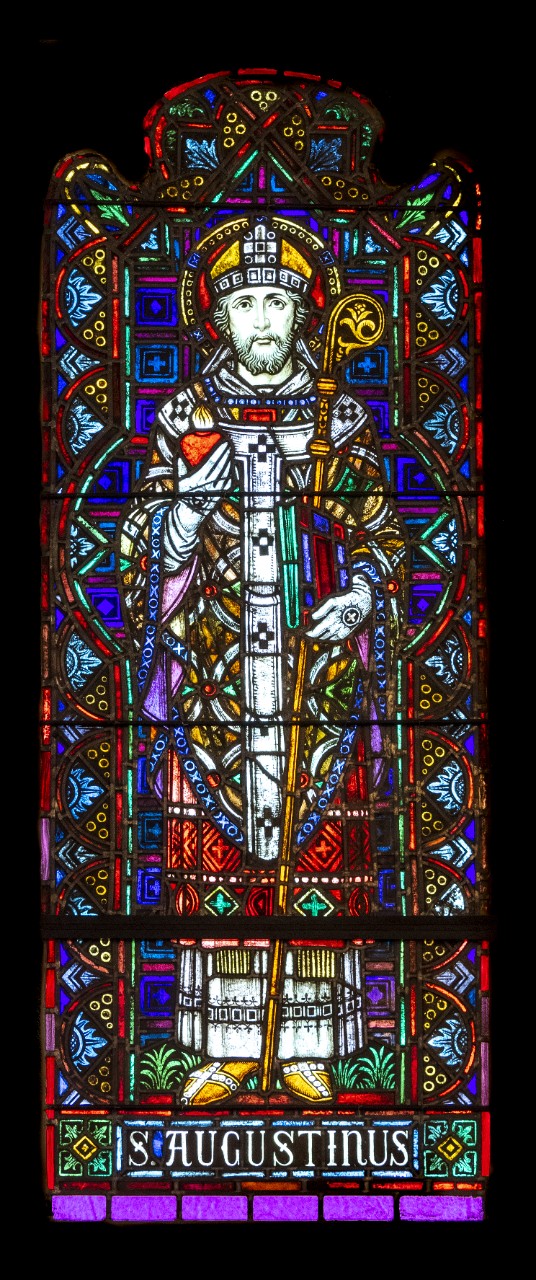
ST. AUGUSTINE
Augustine (Aurelius Augustinus 354–430 AD) was born a Roman citizen in Thagaste (modern-day Souk Ahras, Algeria) to his mother Monica, an Amazigh Christian, and father Patricius, a Roman pagan. He had a brother named Navigius and a sister whose name was never recorded.
We do not know definitively what Augustine looked like. Race in the ancient world was not a sociological category in the same way that it is for us today. It is likely that given his Amazigh roots he had a darker complexion, and contemporary Augustine scholarship is focusing more on his African origin and identity (and why it has often been overlooked). Augustine had a noticeable North African accent, for which he was ridiculed when he traveled to mainland Italy.
Augustine suffered from illness (asthma, stomach issues, and fevers) throughout his life. As a boy, he almost died due to a stomach ailment, but his mother declined to have him baptized once his health began to improve. At the time, Monica thought it would be better to delay baptism due to her concern that Augustine’s adolescent sins would be more grievous if committed after baptism.
Augustine grew up in what we today might consider a middle-class household. His father had a small estate and worked as a government bureaucrat; this position afforded him some respect but not much income (though his household did have slaves). While both of Augustine’s parents thought it was important that he receive a quality education, they struggled with providing the necessary funds. They were able to send him to a neighboring town, Madaura, to study grammar and literature as a boy. But when he was 16, his parents could not afford the fees for higher studies, so he had to stay home for a year while they saved. With the help of a wealthy benefactor, Romanianus, the next year Augustine attended what we might think of as ‘college’ in Carthage.
As a student, Augustine showed a lot of promise. He was very skilled in Latin rhetoric and particularly admired the writings of Cicero. But he got frustrated with the rote-memorization style of his education and the corporal punishment inflicted by his teachers. In particular, he hated being forced to learn Greek. While he was a student in Carthage, Augustine read Cicero’s dialogue Hortensius (now lost), which he claimed ignited his interest in philosophy.
In his later teenage years, Augustine entered into a long-term relationship with a woman whose name and backstory we do not know. When he was about seventeen, the same year that Augustine’s father died, she gave birth to their son, Adeodatus, whose name means ‘Gift from God.’ Augustine would later end his relationship with this woman to become engaged with a younger, more affluent girl. Augustine did get engaged, but he was never married.
Augustine taught rhetoric at a school in Carthage throughout his twenties. During this time he also became a ‘hearer’ (similar to a student auditor) of Manichaeism, a dualistic religion with Christian, Gnostic, and pagan elements. After growing frustrated with his students’ unruly behavior in Carthage, he took a teaching position in Rome (where he grew even more frustrated with his students because they would cheat him of his fees). While in Rome, he turned away from Manichaeism and started embracing Skepticism. He also met Symmachus, then the Prefect of Rome, who helped him to secure a prestigious teaching position in Milan. Thus, by the age of 30, Augustine had achieved great career success and found himself in a prominent center of Roman (and Christian) intellectual life.
In Milan, Augustine started reading the works of the Neo-Platonists, especially Plotinus, as well as the writings of St. Paul, both of which dramatically shifted his thinking. He also encountered Ambrose, the Bishop of Milan, who inspired Augustine to become a catechumen (meaning a Christian under instruction before baptism). Ambrose was particularly complimentary of Augustine’s mother, Monica, who traveled to Milan to be with her son and arrange a marriage for him (it is at this time that Augustine ended his relationship with the mother of his son).
In the summer of 386, Augustine, 31 years old, and his friend Alypius met a fellow North African man named Ponticianus who told them the story of how two Roman officials were inspired to become Christians after learning about the conversion of St. Antony of Egypt. Augustine felt overcome with shame and frustration that he could not follow their example; his main obstacle was his concern he could not lead a chaste life. But that summer he experienced a conversion.
Augustine described that as he wept beneath a fig tree he heard a child’s voice say, ‘Tolle lege’ (‘pick up and read’), and picked up a nearby text of the letters of St. Paul. He happened upon Romans 13:13-14: ‘Not in dissipation and drunkenness, nor in debauchery and lewdness, nor in arguing and jealousy; but put on the Lord Jesus Christ, and make no provision for the flesh or the gratification of your desires.’ Augustine interpreted this as a message from God, and he resolved to become a baptized Christian. Shortly thereafter, his friend Alypius did the same. Augustine reported his conversion experience to his mother, who was overjoyed.
Not long after his conversion, Augustine quit his teaching position. He spent the next six months in Cassiciacum in a small country villa owned by his friend Verecundus. With his mother, son, brother, and small group of friends, Augustine spent the time resting, discussing philosophy, writing dialogues, and preparing for baptism. Augustine and his son Adeodatus were baptized by Ambrose in Milan on the Easter Vigil in April 387. The next year, he returned to Africa. During the journey, his mother Monica died and was buried in Ostia, Italy. Shortly afterward, his son Adeodatus and his close friend Nebridius also died.
Augustine sold his patrimony and gave the money to the poor. He kept his family’s house in Thagaste and converted it into a monastic site for himself and his friends. In 391, Augustine, 36 years old, visited the port city of Hippo (modern-day Annaba, Algeria) to try to set up another monastery there. At mass, Valerius, the Bishop of Hippo, pressed for Augustine’s immediate ordination to the priesthood (on account of his learned reputation and skill with Latin). Augustine was not able to refuse. In 396, Bishop Valerius died, and Augustine succeeded him as Bishop of Hippo.
As bishop, Augustine likely delivered over 4,000 sermons, though only about 800 are known to us. In 397, he began to write (Augustine actually would have dictated the work to a scribe) the Confessions, which he completed in 400 or 401. While serving as bishop, Augustine wrote some of his most important treatises, including On Christian Doctrine, On the Trinity, and The City of God. He was also involved in responding to challenges posed to the Church by the Donatist, Pelagian, and Arian controversies.
Toward the end of his life, Augustine began to experience health problems and eventually died due to illness in 430 at the age of 75. Because Augustine took effort to catalogue and circulate his writings, his works were able to be read within his own lifetime and copied and transmitted for centuries after his death. He has had a profound influence on western thought; most subsequent thinkers have been shaped directly or indirectly by his ideas.
Augustine was canonized as a saint in 1303 by Pope Boniface VIII. His feast day is August 28, the day of his death. He is considered the patron saint of brewers, printers, theologians, and sore eyes.
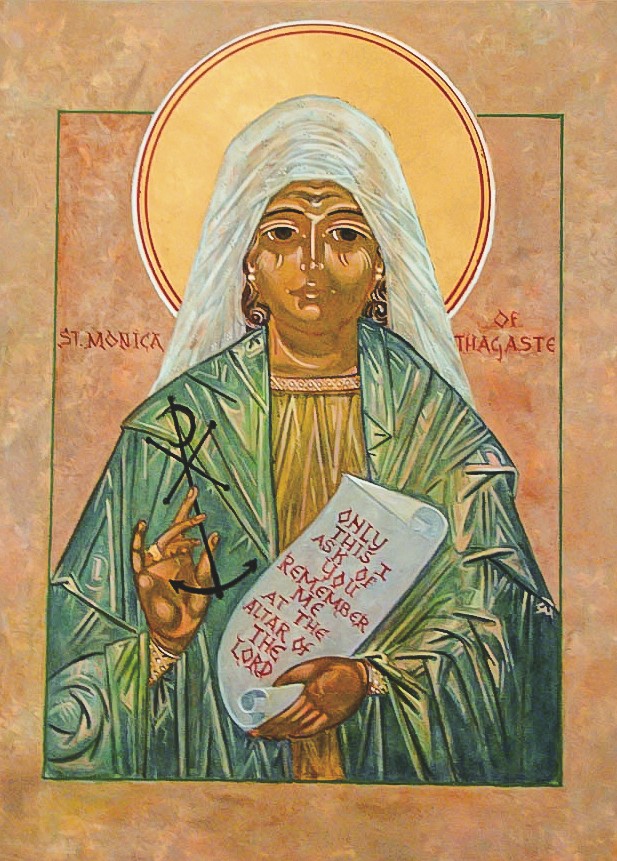
ST. MONICA (331–387)
Monica, born in Thagaste, North Africa, around the year 331, was the daughter of devout parents who educated her in the faith. She married Patricius, a pagan Roman official and had three children, including Augustine.
Monica’s whole life, as well as her sanctification, was inextricably bound up with Augustine’s, and her faith, hope and love were heroically tested and proved pure in the crucible of suffering. After being deceived by Augustine of his future plans, she followed him to Milan, where in 386, due in great part to St. Ambrose’s preaching and her prayer, Augustine finally converted and was baptized in the spring of 387.
Like all God’s saints, Monica is a woman ‘for all seasons.’ Her advice and her powerful example as a wife are a model for domestic peace and stability. Her long years of caring and crying, coupled with continual prayer, speak of her perseverance and trust in God’s providence, and in her heroic efforts for her son’s conversion, she herself became a saint.
Monica did not live long after Augustine’s baptism and was buried in Ostia, Italy. Her importance was not recognized until the 13th century, when the story of St. Monica began to spread and a feast in her honor was established. In 1430, Pope Martin V ordered her relics to be brought to Rome. Later, Archbishop of Rouen, Cardinal d’Estouteville built the Basilica di Sant’Agostino in honor of St. Augustine. It was he who had the relics of St. Monica deposited in a chapel to the left of the Basilica’s high altar.
Her feast is celebrated on August 27. She is patron of wives and abuse victims. St. Monica Hall at Villanova University is named in her honor.
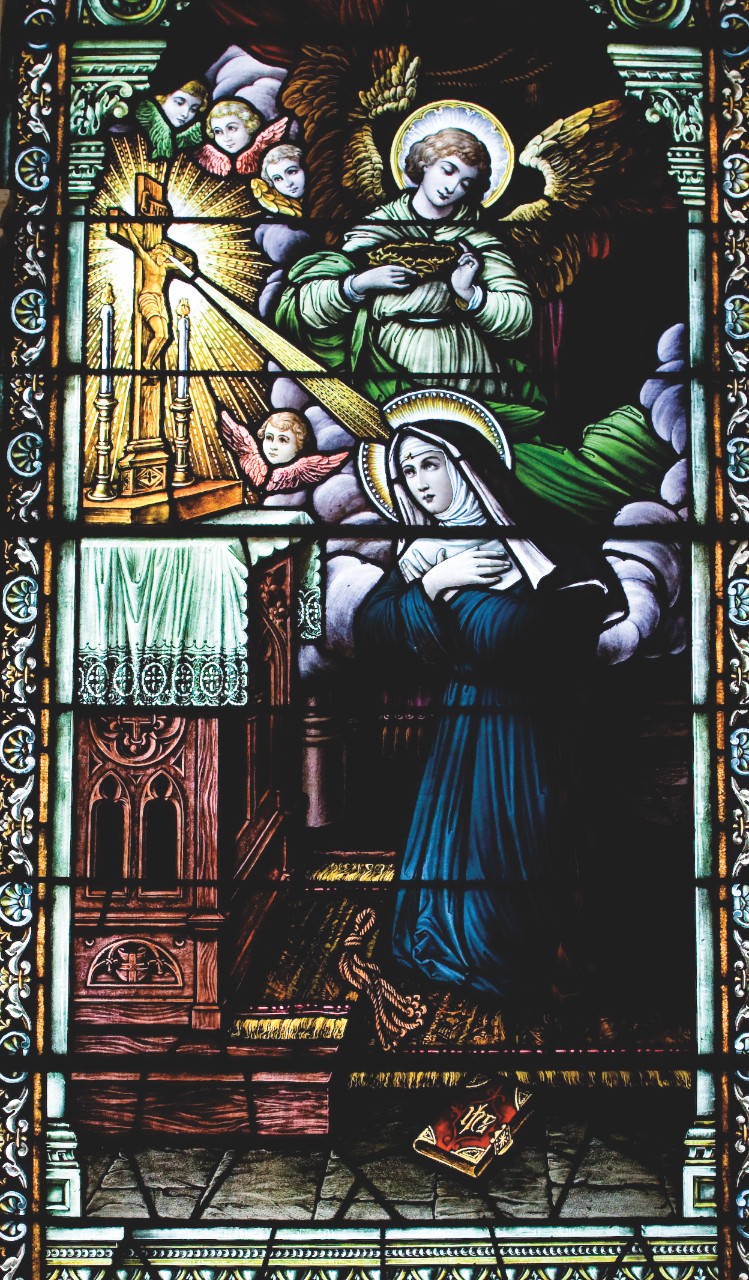
ST. RITA OF CASCIA
(1386–1457)
Margherita Lotti was born in the village of Roccaporena, near Cascia, in Umbria. An only child, her parents arranged her marriage to Paolo Mancini, despite her wish to enter the Augustinian Convent. Rita bore twins, but when the boys were young teens, Paolo was murdered. Rita’s sons were expected to avenge their father and defend family honor, but Rita, influenced by the peacemaking example of her parents, forgave her husband’s killers.
To convince her sons to do likewise, she reminded them of how Christ forgave those who killed him. Shortly thereafter, both sons died from illness. Following these tragedies, Rita placed her trust in God, relying on her deep faith to find her way. Rita felt called again to religious life. However, the convent denied her, due to the circumstances of Paolo’s death, and because she had already lived 18 years as a wife and mother. Through the intercession of her patron saints, she entered the convent and lived for 40 years, devoted to the Passion of Jesus. In response to her prayer to be joined to Christ’s suffering, she received stigmata in the form of a chronic head wound as if caused by a crown of thorns. While on her death bed, Rita prayed for a sign that her husband and sons were safe in heaven and asked for a rose. Despite the January snows, a single rose was found growing and brought to her.
She died on May 22, 1457, was beatified in 1627 and was canonized on May 24, 1900 by Pope Leo XIII. Her feast day is May 22. Villanova University’s St. Rita Hall is named for her. The Augustinians have managed the National Shrine of Saint Rita of Cascia in South Philadelphia since it opened in 1915. Rita is the patroness of the impossible.
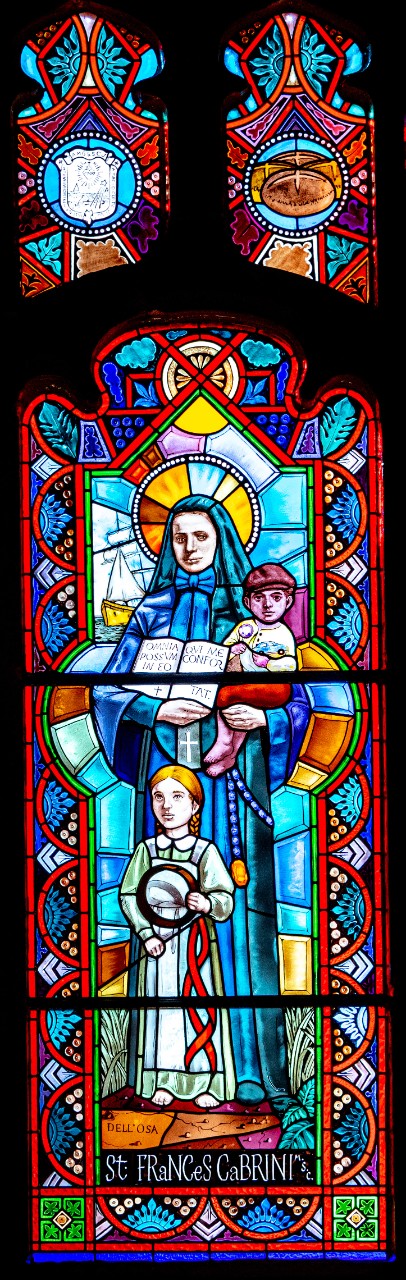
ST. FRANCES CABRINI
(1850–1917)
The youngest of thirteen children, Frances Cabrini was born on July 15, 1850 in a small village called Sant’Angelo Lodigiano near the city of Milan, Italy. She grew up enthralled by the stories of missionaries and made up her mind to join a religious order. Because of her frail health, she was not permitted to join the Daughters of the Sacred Heart who had been her teachers and under whose guidance she obtained her teaching certificate.
However, in 1880, with seven young women, Frances founded the Institute of the Missionary Sisters of the Sacred Heart of Jesus. She was as resourceful as she was prayerful, finding people who would donate what she needed in money, time, labor and support. She and her sisters wanted to be missionaries in China; she visited Rome to obtain an audience with Pope Leo XIII. The Pope told Frances to go “not to the East, but to the West,” to New York rather than to China as she had expected. She was to help the thousands of Italian immigrants already in the United States.
In 1889, New York seemed to be filled with chaos and poverty, and into this new world stepped Mother Frances Cabrini and her sister companions. Cabrini organized catechism and education classes for the Italian immigrants and provided for the needs of the many orphans. She established schools and orphanages despite tremendous odds.
Soon, requests for her to open schools came to Frances Cabrini from all over the world. She traveled to Europe, Central and South America and throughout the United States. She made 23 tran -Atlantic crossings and established 67 institutions: schools, hospitals and orphanages.
Her activity was relentless until her death. On December 22, 1917, in Chicago, she died. In 1946, she was canonized a saint by Pope Pius XII in recognition of her holiness and service to mankind and was named Patroness of Immigrants in 1950.
Today the Missionary Sisters and their lay collaborators work as teachers, nurses, social workers, administrators and members of institutional boards of trustees. They can be found on six continents and 15 countries throughout the world– wherever there is need.
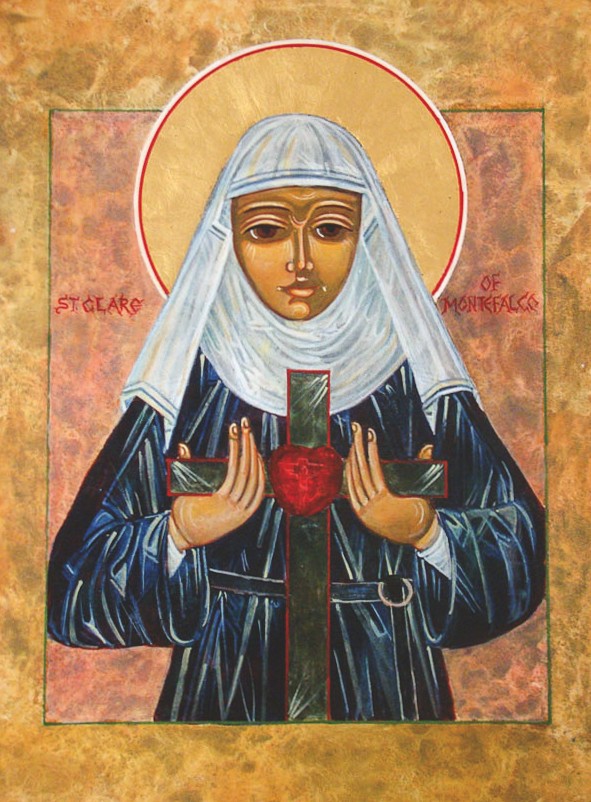
ST. CLARE OF MONTEFALCO
(1268–1308)
An Augustinian contemplative nun and mystic, Clare was born in Montefalco, in the province of Umbria, Italy, around the year 1268. There she spent her whole life. When she was 6 years old, she went to live with her sister, Giovanna, who, with some companions, had formed a religious community.
In 1290, the community moved to a new house and set up a regular convent. Clare moved with the sisters and made her profession of vows under The Rule of St. Augustine. On November 22, 1291, Giovanna died and Clare succeeded her as Abbess. She led the congregation until her own death on August 17, 1308.
Both in her personal life and in her office as Abbess, she was a model of the community life inspired by Augustine’s Rule. Clare constantly counseled her sisters on the need for self-denial; she dedicated personal effort in the pursuit of holiness. She was deeply devoted to the Passion of Christ and her heart was filled with the love of the cross, so much so that she is most often referred to as St. Clare of the Cross. During her last days, she revealed that in her heart she carried the impression of the cross of Christ. After her death, her heart was examined and the symbols of the Passion of Christ were found there.
Her heart is venerated in the Augustinian Church at Montefalco and is visited by many pilgrims. St. Clare Hall on the campus of Villanova is named in her honor.

The NCAA college basketball season tips off on an international stage, as Villanova and Notre Dame meet in an unprecedented college basketball showdown on November 1, 2026, at the Palazzo dello Sport in Rome. The men’s matchup will air live on FOX at 3:30 PM CST (9:30 AM ET), followed by the women’s game on FS1 at 6:00 PM CST (12:00 PM ET).
Inspired by the recent election of Pope Leo XIV, the first American-born Pope and a Villanova graduate, student-athletes from some of the United States’ top Catholic universities will travel to Rome and Vatican City for a one-of-a-kind international experience to begin their college hoops season.