
PLACES TO VISIT
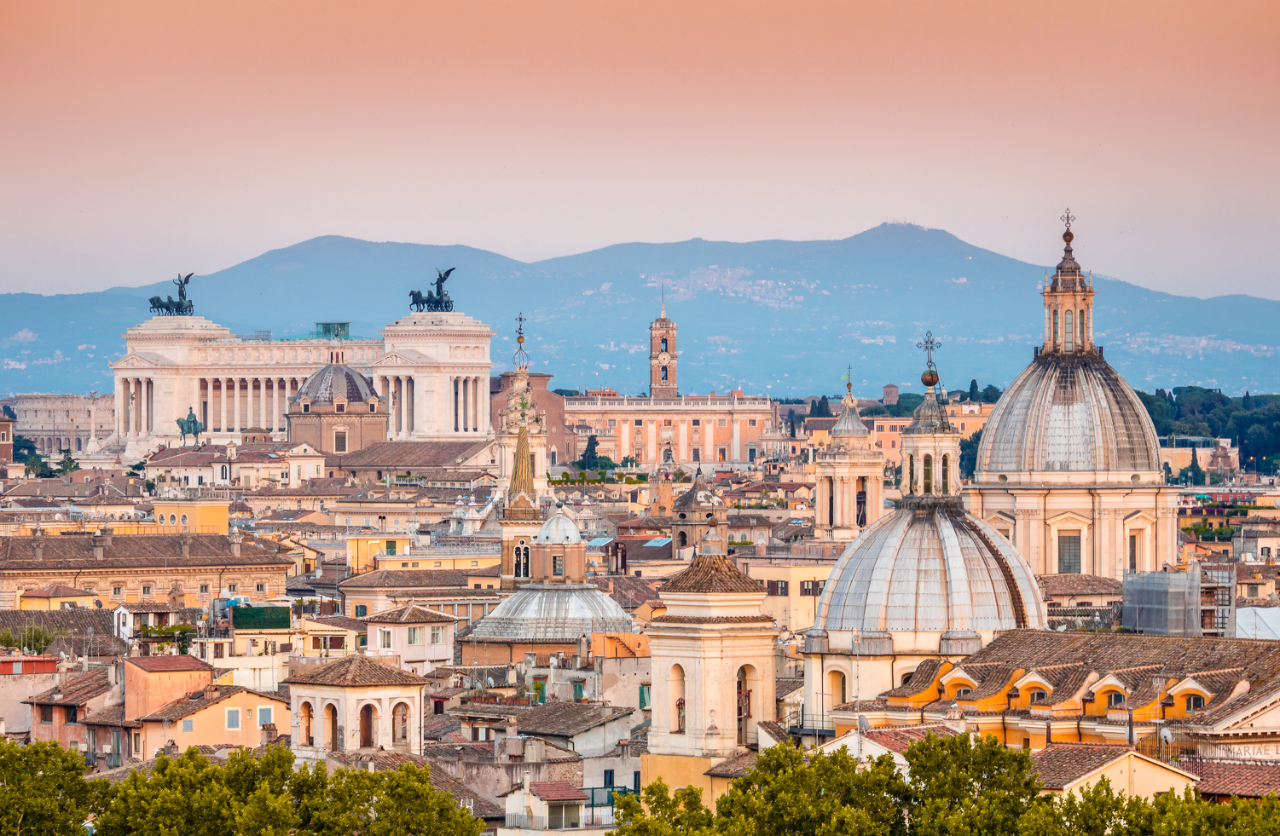
ROME, ITALY
Because of the circumstances surrounding the initial beginnings of the Order of St. Augustine, our friars have always had a special relationship with the papacy. ‘The peculiar influence of the Holy See in the founding of the Order directed its activities especially toward the service of the universal Church, and for this reason our Order has wished to render a particular devotion and loyalty to the Church and the papacy.’ Constitutions of the Order of St. Augustine 1, 6
Vatican City, officially the Stato della Città Vaticano, was established as an independent state in 1929 via the Lateran Treaty. It is the smallest sovereign state in the world with a population of only 800-900 people and an area of 121 acres. The Vatican is governed by the Holy See, the central governing body of the Catholic Church headed by the Pope and the Roman Curia. The Vatican does not collect taxes; it is supported economically by donations, postage stamps and souvenirs, museum admission fees, and publications sales.
Vatican City includes many sites, such as St. Peter’s Basilica, the Sistine Chapel, the Vatican Apostolic Library, and the Vatican Museums. Pope Alexander VII commissioned Gian Lorenzo Bernini to build the colonnade in St. Peter’s Square in 1656; it took eleven years to complete. The colonnade consists of 284 columns, 88 pillars arranged in 4 rows, and 140 statues of saints. St. Peter’s Square also includes a bronze sculpture called Angels Unawares by Timothy Schmalz installed in 2019 for the 105th 29 World Migrant and Refugee Day. Pope Francis said he wanted the sculpture to “remind everyone of the evangelical challenge of hospitality.” If you look closely, among the 140 statues of migrants and refugees – which Schmalz intended to match the number of saints in the colonnades – you might be able to spot Mother Cabrini!
The Vatican Museums are a vast complex in Vatican City, offering miles of wide- ranging historical, artistic and cultural itineraries of great interest: from Egyptian art to contemporary graphics. The Vatican became the pope’s official residence in the mid-15th century, a time when the Vatican Library and the Sistine Chapel were constructed. The stories of Moses and Christ were painted on the walls by Perugino and Botticelli, and the recently restored frescoes of Michelangelo in the ceiling of the Sistine Chapel were done by Michelangelo have regained their original colors.
Other notable works in the Vatican Museums include the Raphael Rooms, the Gallery of Maps, the Pinacoteca, the Carriage Pavilion, and the Bramante Staircase. There are 54 museums in total, containing the world’s largest collection of art that spans 9 miles. Each year, the Vatican Museums welcome an average of 6 million visitors.
Chiesa di Sant’Anna de’ Palafrenieri, the church that is now located within the Vatican, was constructed in the 16th century and began to be used in 1583. On May 30, 1929 Pius XI established the Pontifical Parish of Saint Anne in the Vatican, entrusting its pastoral care to the Augustinians. The first parish priest was Father Agostino Ruelli, appointed on August 7, 1929. On August 18 of that same year, the Augustinians commenced their ministerial service within the parish—a service that continues to this day on behalf of the Holy See, the City of Rome, and the entire Universal Church
Directly connected to the fourteenth century studium generale in Rome, the Augustinian Patristic Pontifical Institute is a pontifical institute in Rome under the Order of St. Augustine. The institute focuses on the study of patristic theology and the history and theology of the Church Fathers.
Located in the square of the same name, the Basilica of Sant'Agostino was one of the first Roman churches of the Renaissance, and its origins date back to the 14th century when the Augustinians decided to build a new structure for their convent. The new church, completed in 1420, however, was too small for the needs of the community and too low concerning the Tiber; so, it was rebuilt between 1479 and 1483 by Jacopo di Pietrasanta and Sebastiano Fiorentino, by order of Cardinal Guillaume d’Estouteville.
Built near via della Scrofa, it was demolished in 1746, when Luigi Vanvitelli enlarged the convent of Sant’Agostino. In 1756, the architect also radically transformed the interior of the church and the dome, the first Renaissance dome in Rome. He also added the lateral spirals of the façade and modified the 15th-century belfry into a square tower. The two-orders façade is covered with travertine blocks coming, according to tradition, from the Colosseum. The Latin cross interior is divided into three naves, with five chapels on each of the side aisles, a transept and an apse flanked by other chapels.
Entering, on the right is the famous "Madonna del Parto" (1516) by Jacopo Tatti known as "il Sansovino", a sculpture venerated as protecting women in childbirth and full of ex-voto. The central nave is framed by pillars supporting round arches, above which are 12 stories of the life of the Virgin Mary. On the third left pillar is a marble group representing “Madonna and Child with St. Anne” by Andrea Sansovino, around which all the poets of Rome used to affix their poems on the day dedicated to the saint. The same pillar is decorated with a fresco by Raphael, depicting the "Prophet Isaiah" (1512), flanked by two putti. In the first chapel on the left, there is the famous painting of the "Madonna of the Pilgrims" by Caravaggio (1604).
On the main altar, built in 1627 to a design by Bernini and made by Orazio Torriani, is the Byzantine icon "Virgin with Child" from the church of Santa Sofia in Constantinople. Of particular importance, the altarpiece depicting S. Agostino between S. Giovanni Battista and S. Paolo Eremita by Guercino and on the sides "S. Augustine washes the feet of the Redeemer" and St Augustine Defeating Heresy by Lanfranco, in the chapel of the right transept dedicated to the saint.
The church also houses some illustrious tombs: in addition to that of Santa Monica, cardinals Lorenzo and Renato Imperiali, the penultimate daughter of Lorenzo the Magnificent Contessina de 'Medici and Cardinal Girolamo Verallo. In the past, the remains of famous court ladies were also curiously present, such as Fiammetta, Cesare Borgia's favourite lover, Giulia Campana, Tullia d'Aragona and her sister Penelope. Today the tombs have all disappeared. The court ladies were regular frequenters of the Basilica and had dedicated seats in the front rows to prevent the believers from looking at them and be distracted during the religious functions.

The NCAA college basketball season tips off on an international stage, as Villanova and Notre Dame meet in an unprecedented college basketball showdown on November 1, 2026, at the Palazzo dello Sport in Rome. The men’s matchup will air live on FOX at 3:30 PM CST (9:30 AM ET), followed by the women’s game on FS1 at 6:00 PM CST (12:00 PM ET).
Inspired by the recent election of Pope Leo XIV, the first American-born Pope and a Villanova graduate, student-athletes from some of the United States’ top Catholic universities will travel to Rome and Vatican City for a one-of-a-kind international experience to begin their college hoops season.