GRADUATE PROGRAMS IN POLITICAL SCIENCE
At Villanova, graduate study in political science is shaped by thoughtful conversation, close faculty mentorship and real-world relevance. Our program trains students as social scientists, while deepening their understanding of the broader underpinnings and implications of politics.
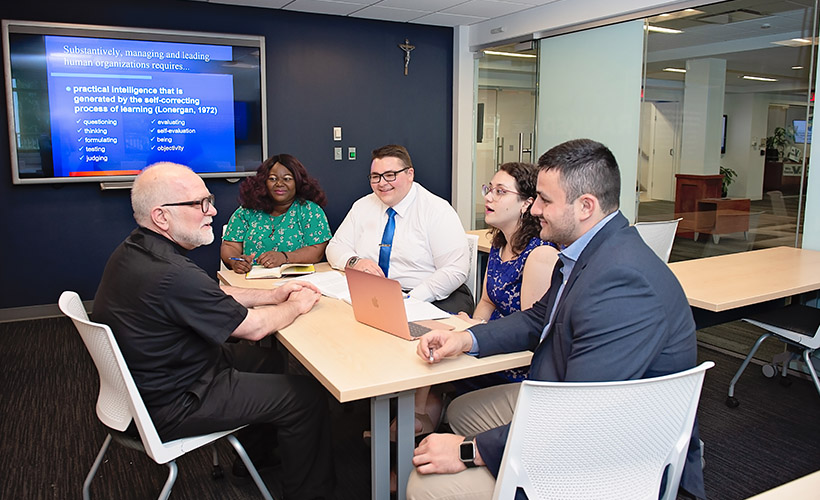
Our small, in-person, discussion-based seminars are taught by award-winning, widely published faculty who are deeply invested in students’ intellectual and professional development. Our political science graduate students develop substantiative expertise, research skills and data analysis capabilities that are applicable to a range of academic, political and policy contexts.
Each year, the department offers several full fellowships to the most promising incoming students. These fellowships are awarded on a competitive, merit basis. Funded students work closely with departmental faculty on original research, which can lead to conference presentations and co-authored publications.
Villanova’s Political Science graduate program stands out for many reasons, including:
- Public service and policy careers: Our program is well-suited for students who want to pursue careers in local, state and federal government, public policy, foreign affairs, intelligence and the non-profit sector. Students have the option to complement political science coursework with graduate classes in public administration and other disciplines, which allows them to tailor their coursework to their interests and goals.
- Doctoral study and academia: Students interested in pursuing a PhD receive strong preparation in the major subfields of political science, along with training in research design and methods, including data visualization and analysis. Graduates of our program have gone on to top-ranked doctoral programs in political science.
- Professional advancement: Educators, military personnel, law enforcement officers and professionals across a range of sectors use our program to deepen their expertise and enhance their careers. The program emphasizes critical reading, analytical skills and evidence-based written and oral communication.
- Networking: Students participate in annual alumni panels and receptions featuring graduates of the program and benefit from Villanova’s extensive alumni network and dedicated NovaNetwork platform, which provides opportunities for professional connections and mentorship.
- Graduate Certificates: Students may earn a certificate either as a stand-alone credential or alongside the MA. Certificates allow students to signal a concentration on their transcript and CV.
- Affordability: Our program delivers an outstanding education at a highly competitive cost compared to similar programs. The result is a strong return on investment offering exceptional value without compromise. Additionally, the program offers nine fully funded fellowships that cover the cost of tuition, and some funded positions also include a generous cost of living stipend. Read more about department and college-level funding.
WHY VILLANOVA POLITICAL SCIENCE?
The Political Science graduate faculty are actively engaged in research and deeply committed to teaching. They regularly publish in the discipline's top journals and with prestigious university presses. In recent years, faculty members have been awarded grants by the National Science Foundation, the Rockefeller Brothers Fund and the Fulbright Program. Political Science faculty members have also served as visiting scholars at Stanford University’s Center for Advanced Study in the Behavioral Sciences, the University of Notre Dame’s Kellogg Institute for International Studies and Notre Dame Institute for Advanced Studies, Princeton University and the Woodrow Wilson Center. Faculty members have also won major book and article awards.
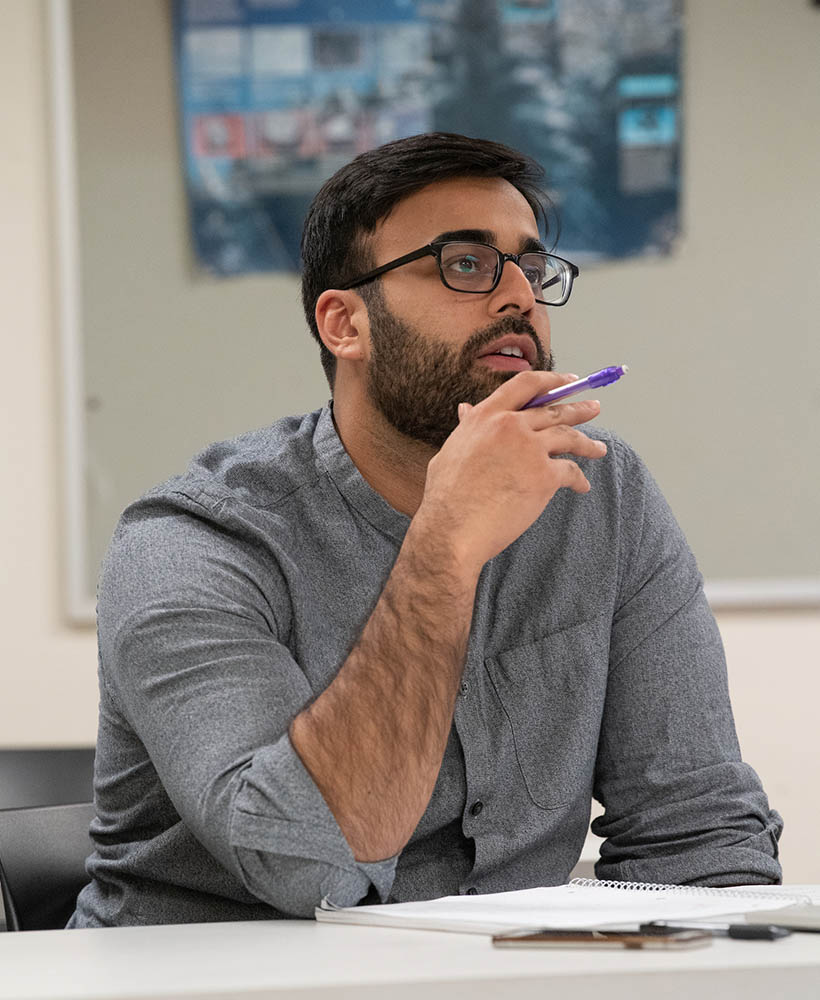
Our courses are small, discussion-based seminars, which are capped at 15 students. Faculty members closely guide student research and writing. Our departmental brown bag research workshops offer students an additional opportunity to interact with faculty and engage in intellectual discussion outside the classroom. The Graduate Director also helps PhD-bound students in selecting and applying to graduate programs. Our alumni connections are strong, and we often invite Villanova Political Science alumni to speak to current students about career paths and options.
Our program is flexible in terms of the degree requirements and the scheduling of courses. The Graduate Director individually meets with each student to discuss to ensure their course selection matches their overall academic and professional goals. Besides taking one course in each subfield and PSC 7000: Research Concepts and Approaches, students can concentrate in a particular subfield or take courses across the breadth of the discipline. Students also have the option of taking up to six credits (2 courses) in other Villanova graduate programs. Students can enroll in up to three courses per semester or can only take a single course if they want to do the program on a part-time basis. All courses are offered in the evening to accommodate working professionals.
The MA program offers students opportunities to partake in various aspects of scholarly research. Research Assistants are closely involved in faculty research projects, and in some cases, co-author conference papers or journal articles. The department runs a research workshop to which all graduate students are invited. The university also offers summer research fellowships and assists students in presenting their work at conferences. The Political Science Department regularly forwards announcements about lectures and conferences that occur at Temple University, the University of Pennsylvania and other research centers located in and around Philadelphia. In short, for highly motivated students, there are ample scholarly opportunities to augment and enrich their studies outside the classroom.
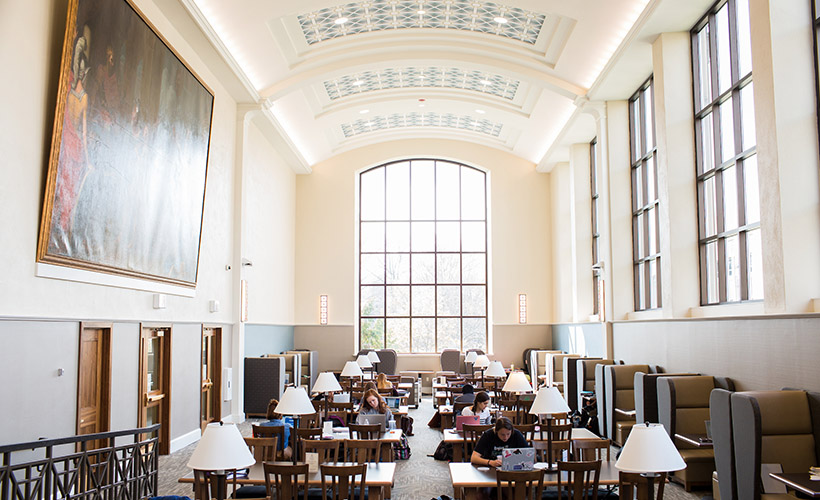
Beyond these scholarly opportunities, students are part of a vibrant graduate community within the Political Science Department and across the College of Liberal Arts and Sciences. Through graduate programming, events and shared spaces designed for studying, meeting and connecting, students have opportunities to build relationships with peers and become part of an active intellectual community. Read more about the Center for Graduate Research and Education.
Our program is ideal for students considering PhD programs, or who are interested in government service, journalism, the nonprofit sector, foreign service, or secondary education.
Fathe Allen
Senior Administrative Assistant
Department of Political Science
Villanova University
Please email any information regarding events, internships, and jobs for our Political Science Students to jessica.schwartz@villanova.edu. Thank you!