
Solar Déjà Vu: Eclipses, Like The One in August, Follow Predictable Cycles, Explains Villanova Astronomer
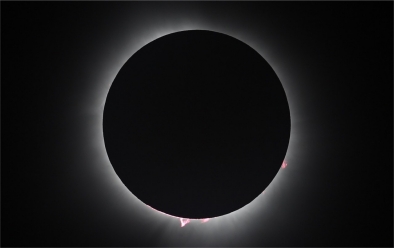
The 2024 total eclipse, captured in this photo by Andrej Prša, chair of the Department of Astrophysics and Planetary Science, belonged to Saros 139.
As the moon passes in front of the sun on August 12, 2026, viewers along the eclipse’s path of totality in Iceland, Greenland and Northern Spain will be treated to more than two minutes of daytime darkness.
For many, it will be their first experience in totality. For the eclipse itself, it’s just another slightly different chapter in a millennium-long rinse and repeat.
That’s because every eclipse belongs to what is called a saros series—a “family” of eclipses that follow a predictable schedule. A saros series begins and ends with partial eclipses near opposite poles of the Earth, and in between may feature annular, hybrid or total eclipses—like the kind occurring this August—across the world.
“Then the series will end,” said Frank Maloney, PhD, associate professor of Astrophysics and Planetary Science at Villanova University. “New saros series are always coming into being, and old ones fading from existence. While they are here, they usually have between 70-73 eclipses over a span of 1,200-1,300 years.”
Within the series is what is known as a saros cycle. It’s a period of roughly 18 years, 11 days and eight hours, when a natural synchronization of the moon’s three lunar phases arises. That synchronization can predict both lunar and solar eclipses, which follow very similar geometrics to the ones that precede and follow in their series.
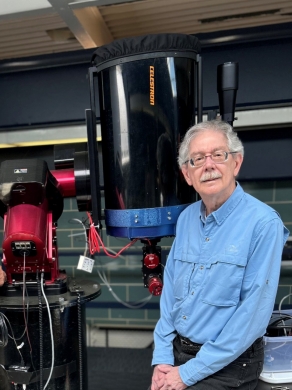
Dr. Maloney says that every fourth eclipse in a saros series follows a similar, but not exact, path.
But why, then, aren’t all eclipses in a series over the same viewing area? The answer lies more with the movement of the Earth than with the eclipse.
Within each series, the biggest cause of change from eclipse to eclipse comes from that last eight hours. It’s only the length of a workday, but each cycle, the Earth has rotated an additional 120 degrees from the previous. While the eclipse itself remains very similar to its predecessor and successor in the series, the viewing area does not.
“Every fourth eclipse, or roughly every 54 years, you are back to where you began,” said Dr. Maloney. “That fourth eclipse in a saros is referred to as an exeligmos. But even that eclipse won’t follow the exact same path for a few reasons, including slight variations in the moon’s orbital node and distance from Earth.”
Same region, but different track.
The August 2026 eclipse will pass over Greenland, Iceland and Northern Spain, but its exeligmos from July 10, 1972 passed over parts of Russia, Alaska and Northeast Canada. Ed Guinan, PhD, ’64 CLAS, professor of Astrophysics and Planetary Science, witnessed that one with a Villanova contingent on the Gulf of St. Lawrence in Nova Scotia. Fifty-four years from now, this eclipse will be only a partial one, as the saros series begins to wane.
The upcoming August event, in fact, is the penultimate of 10 total solar eclipses in Saros 126. The 10th will be in August 2044—the next one visible in the contiguous United States, seen in totality in parts of Montana, North Dakota and South Dakota.
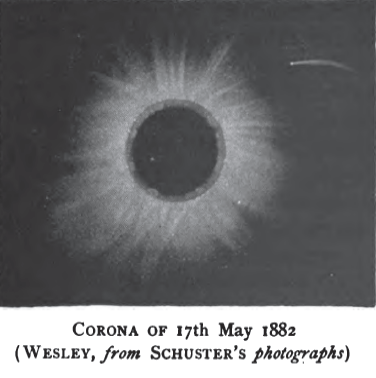
The August 2026 eclipse will be the ninth of 10 total eclipses in Saros 126. The first of those total eclipses was in 1882, and yielded an unexpected discovery a comet passing near the sun. (Photo courtesy of Wikimedia Commons)
Saros 126 began with a partial eclipse on March 10, 1179, and will end with another partial on May 3, 2459.
Humans understood these patterns long before this one began. In the first millennium BCE, the Chaldeans discovered the saros cycle by “carefully keeping record of observations” of eclipses over time, explained Dr. Maloney.
“Our lives are linked with the sun. To the ancients, having the sun disappear was believed to be a really bad thing, like a demon devouring it. That goes for lunar eclipses too, which caused the moon to turn red and really bother people. When they could begin to predict them, total eclipses ceased to be the powerfully bad omens that ancients believed they were. It was still a mystery as to why it happened, but at least it was predictable, which reduced people's anxieties.”
Now, the anxiety stemming from eclipse viewing is saved for the fierce competition for hotels along the path of totality and threats of cloudy weather.
“But don’t worry,” Dr. Maloney said. "If you miss one, you might be able to see it ‘nearby’ in another 54 years.”