
A Purposeful Papal Honor: Villanova University’s Pope Leo XIV Sustainability Medal
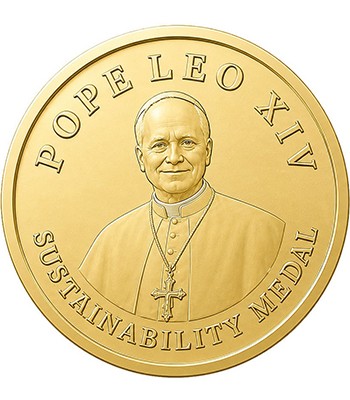
Note: On Oct. 11, 2026, Pope Leo XIV announced that he will undergo surgery in the coming days. As a result, he will be unable to attend the Medal Ceremony, which will proceed as scheduled. Villanova University joins the global Church in prayer for Pope Leo XIV, asking God to grant him strength, healing and a full recovery.
On Oct. 13, 2026, the Holy Father, Pope Leo XIV, will confer the inaugural Pope Leo XIV Sustainability Medal—a biennial award established by his alma mater, Villanova University, in his name.
For those Villanovans in attendance, the moment will surely evoke the swell of pride and emotion that swept over campus on May 8, 2025, when then-Cardinal Robert Prevost was elected to the papacy. However, the Ceremony will be much more than a celebration of the connection between an educational institution and its most prominent alumnus. It will directly address a major priority and area of spiritual concern for the Pope, the Vatican and the wider Church: the cause of sustainability.
What Is Sustainability?
Sustainability is the cultivation of a harmonious relationship between the natural environment, global communities and the worldwide economy. The most well-known definition comes from the United Nations Brundtland Commission, which described it as meeting “the needs of the present without compromising the ability of future generations to meet their own needs.”
In turn, sustainability covers a wide range of principles, programs and practices. Yet, while these efforts may differ in nature and scale, they all carry the same overarching intent: creating a better world mindfully.
“Sustainability is about managing for maximum benefits, and then also promoting a culture of care,” says Rev. John Abubakar, OSA, PhD, Chief Sustainability Officer at Villanova and a scholar specializing in human flourishing and nature’s health. “Oftentimes, when we think of care, we view it from a human point of view—one person caring for another. With sustainability, we expand the concept wider than that.”
Essentially, sustainability asks us to care beyond what we immediately see. It challenges us to think not only of our neighbors and neighborhoods, but to consider our actions’ effect on persons further afield, across the span of the globe and through decades yet to come.
The Catholic Church and Sustainability
While sustainability has gained increased attention in recent years, the papacy has a long and storied history of advocacy on its behalf. Since the Second Vatican Council, successive leaders of the Catholic Church have centered and uplifted the cause, seeing it as integral to defending the intrinsic dignity of humankind and all creation.
Saint Paul VI famously warned of the perils, both planetary and spiritual, of exploiting nature; Saint John Paul II defined our ecological crisis as a profound moral issue; and Pope Benedict XVI emphasized our responsibility to provide future generations with a healthy, livable environment. Perhaps most notably, Pope Francis published Laudato Si’, the first social encyclical dedicated to the natural world, which stressed that the cry of the Earth is inseparable from the cry of the poor.
As Father Abubakar explains, by virtue of such teachings, the Church has consistently served as a “moral conscience” for a world that often neglects sustainability-related issues. “It reminds us that there is life beyond the material—that the degree to which I am able to share, the degree to which I am able to be concerned and the degree to which I am able to feel the pain of another person best defines my humanity.”

As Villanova’s Chief Sustainability Officer, Father Abubakar oversees the actions the University is taking to achieve an ethos of sustainable living in every aspect of campus life.
Through his pontificate’s first year, Pope Leo XIV has already made his own contributions to this critical discourse. In his first social encyclical, Magnifica Humanitas, the Holy Father directly addressed the “enormous amounts of energy and water” demanded by Artificial Intelligence and advocated for “more sustainable technological solutions that reduce environmental impact.” He also formally launched the Borgo Laudato Si’ ecology project at Castel Gandolfo, an educational initiative inspired by Pope Francis’ call for the protection “of God’s handiwork,” and took steps toward establishing Vatican City as the world’s first carbon-neutral state.
“In his writings and his teachings, Pope Leo XIV has clearly shown his commitment to caring for our common home,” says Father Abubakar. “He has been able to articulate that interconnectedness, that responding to the cry of the poor and the cry of the Earth cannot be separated.”
Villanova and the Creation of the Pope Leo XIV Sustainability Medal
When Pope Leo XIV first emerged on the Loggia of the Blessings, declaring himself a “Son of Augustine,” the Villanova community was not only joyful, but emboldened.
As an institution grounded in the Augustinian Catholic tradition, the University has long recognized the sanctity of all creation, believing in the necessity of responsible environmental stewardship. Now, with the creation of the Pope Leo XIV Sustainability Medal, Villanova intends to play an integral role in advancing the global dialogue on this important subject.
By honoring a distinguished laureate whose life’s work reflects the respect for human dignity, community and ecology inherent in Scripture and Catholic Social Teaching, the University seeks not just to acknowledge an individual’s past accomplishments, but share stories of ingenuity, resilience and changemaking that might yet inspire.
In effect, the conferral of the Pope Leo XIV Sustainability Medal is as much an opportunity for reflection as it is a commendation of devotion and achievement—a chance to reconsider our daily routines and the consequences they carry for others and for our common home.
“We are creatures of habit, doing what every other person is doing,” says Father Abubakar. “So, by engaging with these concepts of care and of sustainability, we are trying to ask, ‘Can you look beyond what our culture teaches us?’”

As an Augustinian Catholic institution, Villanova seeks to foster both responsible stewardship of the environment and the flourishing of all human beings. By generating and advocating for sustainable action, the University is working to create a future that provides enough, for all, forever.
The occasion also offers an opportunity to deliberate on solutions for the most pressing challenges currently facing our world. In conjunction with the Medal Ceremony, the University is convening its 2026 International Sustainability Conference, assembling scholars, researchers, leaders and practitioners dedicated to exploring the intersections of sustainability, poverty and environmental health.
According to Father Abubakar, this event is not just an intellectual gathering. It is also “a profound spiritual encounter that transcends religious, cultural and philosophical boundaries. At its heart is the promotion of spiritual sustainability—the cultivation of inner well-being, meaning, purpose, compassion and a deep sense of connection with ourselves, one another and the natural world.”
Together, the Ceremony and Conference aim to do much more than recognize progress already made. They are intended to create a space for communication, coordination and, ultimately, impact, uniting people who approach sustainability from different disciplines, backgrounds and perspectives.
“It is time to move from commitment to action, and that is what we hope our Medal Ceremony and Conference will achieve—to bring people together and inspire hope,” says Father Abubakar. “There are many good things happening in the fields of environmentalism and sustainability, and when people get to gather, share and collaborate, they are much more encouraged to carry on.”