
Faculty Honored for their Excellence in Scholarship and Research
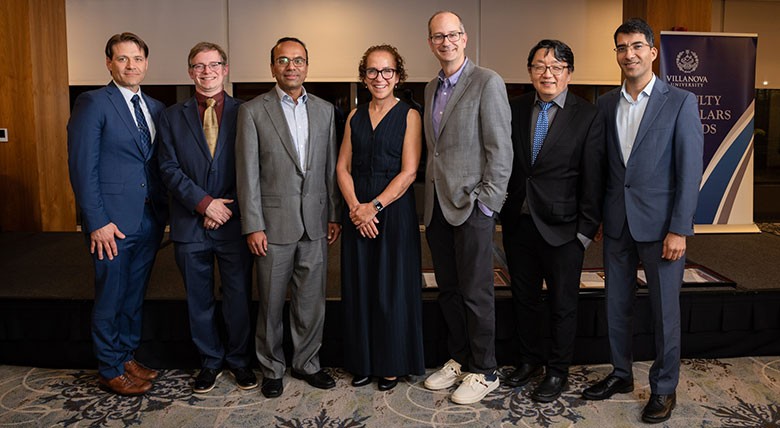
2026 Faculty Scholars Awards recipients (from L to R): David Chuss, PhD, Joey Neilsen, PhD, Pankaj Patel, PhD, Judith Giesberg, PhD, Kevin Minbiole, PhD, Qianhong Wu, PhD and Mojtaba Vaezi, PhD
Villanova celebrated its distinguished faculty members and their achievements in scholarship and research at the annual Faculty Scholars Awards on October 19. The four faculty honorees bring Villanova’s Augustinian Catholic mission to life, combining the best of what is known with the courage to explore the undiscovered.
The 2026 recipients of the Outstanding Faculty Research (Judith Giesberg, PhD and Pankaj Patel, PhD), University Scholarly Achievement (David Chuss, PhD) and Mid-Career Scholar (Joey Neilsen, PhD) awards were recognized for their contributions to their fields, the Villanova community and their impact on the student experience.
"These awards recognize the exceptional faculty whose dedication and groundbreaking research advance scholarship at Villanova," said Amanda M. Grannas, PhD, Vice Provost for Research and Chief Research Officer. "Their achievements extend beyond discovery and innovation, inspiring colleagues and students alike through their commitment to advancing knowledge and fostering a culture of inquiry."
In addition to the four honorees, Kevin Minbiole, PhD, Mojtaba Vaezi, PhD, Qianhong Wu, PhD and Sridhar Santhanam, PhD, were recognized for their recent patents.
2026 HONOREES
OUTSTANDING FACULTY RESEARCH AWARD RECIPIENTS
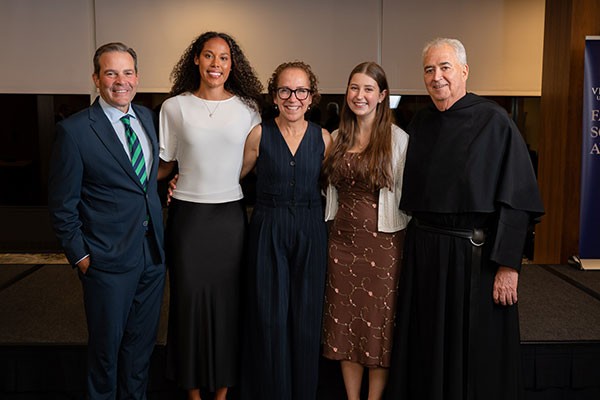
From L to R: Patrick G. Maggitti, PhD, Provost, Jalyn Colon ’28 CLAS, Judith Giesberg, PhD, Anna Guzda ’28 CLAS and the Rev. Peter M. Donohue, OSA, PhD, University President
Judith Giesberg, PhD
Robert M. Birmingham Chair in the Humanities
Professor of History
Director, Last Seen Project
College of Liberal Arts and Sciences
Judith Giesberg, PhD, received a Bachelor of Arts in History from Trinity University and a Master of Arts and PhD from Boston College. She holds the Robert M. Birmingham Chair in the Humanities and is a Professor of History. Her research focuses on the experience of civilians in the US Civil War, with particular focus on immigrant and poor women and free Blacks in the North.
Dr. Giesberg is the author of five books on the period: Civil War Sisterhood: The United States Sanitary Commission and Women’s Politics in Transition (2000), “Army at Home:” Women and the Civil War on the Northern Home Front (2009), Emilie Davis’s Civil War: The Diaries of a Free Black Woman in Philadelphia, 1863-1865 (2014) and Sex and the Civil War: Soldiers, Pornography, and the Making of Modern Morality (2017).
Her new book, Last Seen: The Enduring Search by Formerly Enslaved People to Find Their Lost Family, was published in 2025.
Giesberg lectures widely to genealogists, teachers, and interested members of the public at libraries, schools, museums, and churches. She received Villanova’s Tolle Lege Award for Teaching Excellence and the Veritas Award for Outstanding Scholarship.
Giesberg directs a digital project, Last Seen: Finding Family After Slavery, that is collecting, digitizing and transcribing information from wanted ads taken out by formerly enslaved people looking for family members lost to the domestic slave trade. This project was featured in, among other media outlets, the New York Times, Washington Post, CBS Evening News, and NPR’s All Things Considered. As of March 2026, the website (informationwanted.org) had been accessed more than 23 million times by over a million users.
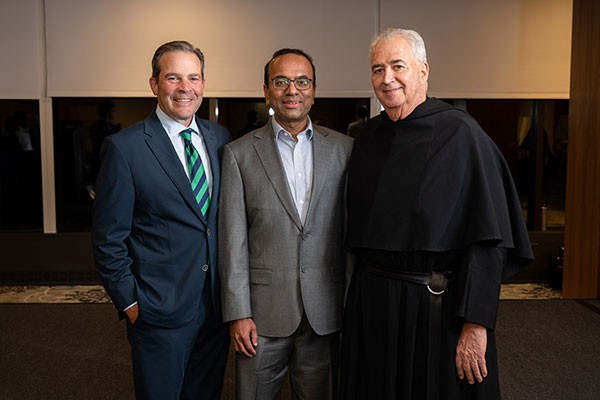
From L to R: Patrick G. Maggitti, PhD, Provost, Pankaj Patel, PhD and the Rev. Peter M. Donohue, OSA, PhD, University President
Pankaj Patel, PhD
Frank J. and Jane E. Ryan Endowed Chair
Professor, Strategy and Innovation
Villanova School of Business
Pankaj C. Patel, PhD, is the Frank J. and Jane E. Ryan Family Chair in Strategy and Innovation and Professor of Management, where he has been on the Management and Operations faculty since 2015. He previously taught at Ball State University and held visiting appointments at Luleå University of Technology in Sweden and NYU Abu Dhabi.
At Villanova, he has twice received the McDonough Family Faculty Award for excellence as a scholar-teacher (2017 and 2022) and the University’s Unitas Award (2020). His research has been funded by foundations and agencies across the US and Europe, including the Kamprad (IKEA) Family Foundation, Handelsbanken, Vinnova and the US State Department. He also works outside the classroom through consulting and technology-transfer projects in healthcare, manufacturing and defense, and teaches strategy in Villanova’s undergraduate, MBA and Executive MBA programs.
Outside of work, he is busy honing his paternal skills with his six-year-old, Vyom.
Dr. Patel’s research examines entrepreneurship, innovation and operations, with a particular focus on how firms and individuals create and capture value under uncertainty. His studies range widely — from patenting and technological search to self-employment, supply-chain resilience and the well-being of entrepreneurs. He has published more than 300 peer-reviewed articles, including work in Management Science, Academy of Management Journal, Strategic Management Journal, Journal of Applied Psychology and Organization Science. His scholarship has been cited more than 32,000 times, and a Stanford University study placed him among the top 1% of social scientists worldwide. He serves as senior editor of Entrepreneurship Theory and Practice and on the editorial boards of a dozen leading management journals. His research has been supported by nearly $2 million in grants from foundations and agencies across the United States and Europe.
UNIVERSITY SCHOLARLY ACHIEVEMENT AWARD RECIPIENT
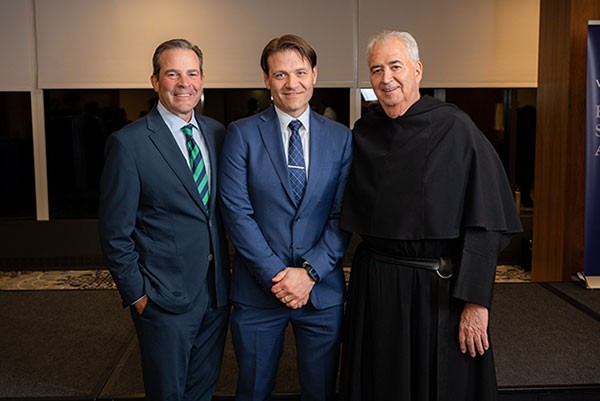
From L to R: Patrick G. Maggitti, PhD, Provost, David Chuss, PhD and the Rev. Peter M. Donohue, OSA, PhD, University President
David Chuss, PhD
Chair, Department of Physics
Professor
College of Liberal Arts and Sciences
David T. Chuss, PhD, earned a BS in Physics from Villanova University in 1995, an MS in Physics from The Pennsylvania State University in 1997, and a PhD in Physics from Northwestern University in 2002. Before joining the Villanova faculty in 2015, he served as an Astrophysicist at NASA’s Goddard Space Flight Center following a National Research Council Research Associateship.
Dr. Chuss’s research focuses on experimental astrophysics, with an emphasis on astronomical polarimetry and the development of instrumentation for observations spanning far-infrared through millimeter wavelengths. His work integrates polarization-sensitive detectors, innovative measurement techniques and novel optical components to address fundamental questions in cosmology and the interstellar medium. He has authored more than 80 refereed journal articles, including publications in The Astrophysical Journal and Applied Optics, and is a co-author of the book Astrophysical Polarimetry: Far-infrared through Millimeter Wavelengths.
He has held leadership roles in numerous national and international collaborations, including the Cosmology Large Angular Scale Surveyor (CLASS), HAWC+ on the Stratospheric Observatory for Infrared Astronomy (SOFIA) and other projects developing next-generation polarimetric instrumentation. His research has been supported by NASA and the National Science Foundation and has contributed to advances in detector technology, polarization modulation, calibration techniques, and astronomical data analysis.
Dr. Chuss’s research combines the development of novel polarimetric instrumentation with observations that address fundamental questions in cosmology and astrophysics. His work has enabled increasingly sensitive measurements of the polarization of the cosmic microwave background, providing constraints on the physics of the early universe, while also using farinfrared polarimetry to investigate the role of magnetic fields in the formation and evolution of molecular clouds and star-forming regions. His research program emphasizes close collaboration among faculty, postdoctoral researchers and undergraduate students, fostering the development of the next generation of experimental astrophysicists while advancing national and international
scientific collaborations.
UNIVERSITY MID-CAREER SCHOLAR AWARD
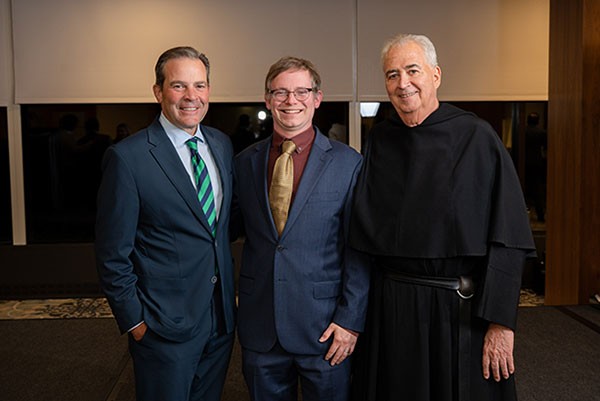
From L to R: Patrick G. Maggitti, PhD, Provost, Joey Neilsen, PhD and the Rev. Peter M. Donohue, OSA, PhD, University President
Joey Neilsen, PhD
Associate Professor, Physics
College of Liberal Arts and Sciences
Joey Neilsen, PhD, received a Bachelor of Arts in Physics and Mathematics from Kenyon College, and a PhD in Astronomy from Harvard University in 2011. After working as a postdoctoral researcher in the Chandra X-ray Observatory’s High-Energy Transmission Grating group at MIT, he won a prestigious NASA Einstein Postdoctoral Fellowship in 2012 to study at Boston University’s Institute for Astrophysical Research. In 2014, he returned to the MIT Kavli Institute for Astrophysics and Space Research with a NASA Hubble Postdoctoral Fellowship. He joined the Villanova faculty in 2017 and serves as an Associate Professor in the Department of Physics.
Dr. Neilsen is a member of the Event Horizon Telescope Collaboration (dedicated to acquiring images of supermassive black holes), where he co-leads the Multiwavelength Science Working Group. For their contributions toward the first images of black holes, Dr. Neilsen and his student Jadyn Anczarski ’20
CLAS won shares of the Breakthrough Prize in Fundamental Physics and the American Astronomical Society High Energy Astrophysics Division’s Bruno Rossi Prize, both awarded to the Collaboration in 2020. Dr. Neilsen is also a member of the Observatory Science Working Group for NICER, an X-ray telescope on board the International Space Station. In 2022, he was again honored with a share of the Bruno Rossi Prize, which was awarded to the NICER Science Team. He is an author or coauthor of nearly 130 publications, including seven in Nature and Science, and has brought over $2 million to the University in external grants.
Dr. Neilsen’s research program focuses on the physics of accretion—the process by which matter falls onto black holes and other massive objects—to discover how black holes influence and interact with their environments. As a member of the Event Horizon Telescope Collaboration, he uses NASA optical and X-ray telescopes for diagnostics of particle acceleration in relativistic jets from supermassive lack holes at the centers of galaxies. He also uses high-resolution X-ray spectroscopy to study outflowing “winds” from stellar-mass black holes (the collapsed remnants of individual stars). Dr. Neilsen’s research thus uses atomic physics to study matter in some of the strongest gravitational fields in the universe.
RECENT PATENTS AWARDED
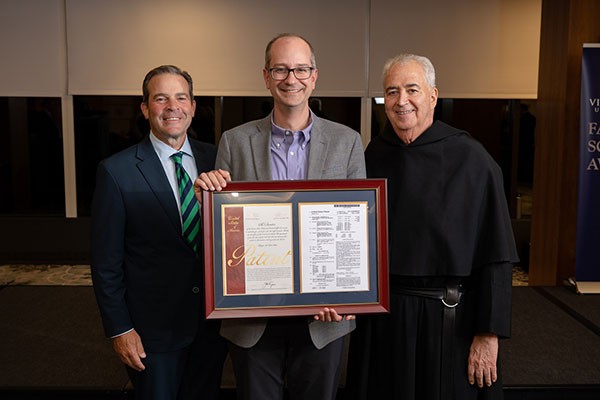
From L to R: Patrick G. Maggitti, PhD, Provost, Kevin Minbiole, PhD and the Rev. Peter M. Donohue, OSA, PhD, University President
Kevin Minbiole, PhD
Associate Dean of Research
Professor of Chemistry
College of Liberal Arts and Sciences
Co-Inventor
William Wuest, PhD
Professor, Georgia Research Alliance Distinguished Investigator
Department of Chemistry
College of Arts and Sciences
Emory University
Polycationic Amphiphiles as Antimicrobial Agents and Methods Using Same
Quaternary ammonium compounds (QACs) are widely used antimicrobial agents found in disinfectants, antiseptics and numerous consumer and industrial products. While effective, conventional QACs can be susceptible to bacterial resistance, a challenge that has grown with their widespread use and environmental persistence.
Through this patent, Kevin Minbiole, PhD, and William Wuest, PhD, address that need through a novel polycationic quaternary ammonium compound (multiQAC) platform. Unlike traditional QACs that typically contain a single quaternary ammonium group, the patented compounds incorporate two or three positively charged quaternary ammonium centers. This multicationic design is intended to enhance antimicrobial activity and help overcome resistance mechanisms that can limit the effectiveness of conventional disinfectants.
The technology demonstrated broad-spectrum antibacterial activity against both Grampositive and Gram-negative bacteria, including clinically significant resistant strains such as Staphylococcus aureus, Enterococcus faecalis, Escherichia coli, Pseudomonas aeruginosa, community-acquired MRSA (CA-MRSA) and hospital-acquired MRSA (HA-MRSA). Notably, the compounds maintained activity against QAC-resistant bacteria and were described in the patent as exhibiting a form of “resistance to resistance.”
In addition to antibacterial efficacy, the compounds demonstrated antibiofilm activity, including the ability to kill, disperse and eradicate established biofilms. By disrupting biofilm structures, the technology may improve the ability of antimicrobial agents to reach and eliminate microorganisms protected within these difficult-to-treat environments. The patent reports that certain multiQAC compounds achieved antimicrobial activity against Gram-negative bacteria and resistant MRSA strains that was up to 64 times greater than the commonly used monocationic antiseptic cetylpyridinium chloride (CPC).
With potential applications in disinfectants, antimicrobial coatings, antiseptics and other infection-control products, the technology represents a promising approach to combating antimicrobial resistance while delivering enhanced broad-spectrum antimicrobial performance. There remains a continuing need for novel antimicrobial agents that exhibit low toxicity profiles while maintaining activity against resistant bacterial strains. The present invention addresses this unmet need in the art.
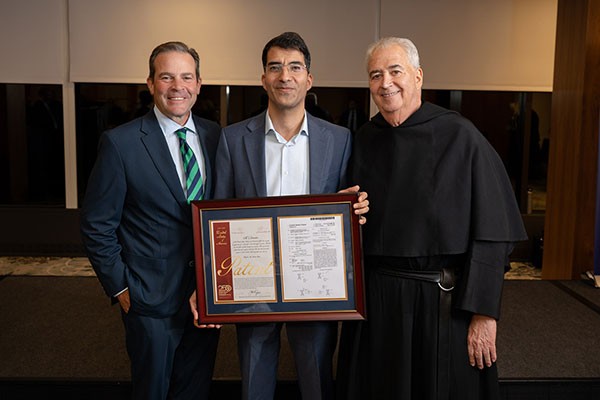
From L to R: Patrick G. Maggitti, PhD, Provost, Mojtaba Vaezi, PhD and the Rev. Peter M. Donohue, OSA, PhD, University President
Mojtaba Vaezi, PhD
Associate Professor
Department of Electrical and Computer Engineering
Director, Wireless Networking Laboratory
College of Engineering
Co-Inventor
Xinliang Zhang ’23 PhD
Systems and Methods of Joint Constellation and Precoding for MIMO Communication
Precoding and modulation are important modules in wireless transmissions. Precoding designs improve the spectral efficiency and system performance in multi-input multi-output (MIMO) systems. Modulation is the process of varying one or more properties (amplitude, phase, and/or frequency) of a carrier signal, with information, e.g., bits, to be transmitted. Existing modulation methods for wireless communication are primarily designed in a complexvalued plane, i.e., focusing on the in-phase and quadrature (I/Q) components. Current communication methods utilizing MIMO systems include separately designed modulations for each sub-channel and provide sub-optimal approaches for symbol error rate (SER) reduction due to independent design and the use of regular structures for symbols. This process introduces novel concepts to improve SER performance and enhance the efficiency of MIMO systems.
Mojtaba Vaezi, PhD and student co-inventor, Xinliang Zhang ’23 PhD, have developed an apparatus and method to improve bit error rates within wireless communications. Instead of traditional Euclidean distance, the Vaezi lab has implemented Mahalanobis distance (MD) to separate symbols within the constellation. Dr. Vaezi offers a unified approach that consists of designing constellations and precoding for all antennas simultaneously. Recent experiments conducted by Dr. Vaezi revealed a notable average efficiency improvement of approximately 35% in performance related to bit error rate (BER) across three test cases. This technology will be particularly effective in cases where BER is already skewed high.
The Vaezi system will allow for a hybrid/unified approach that generates constellation and precoding for all antennas of a MIMO system simultaneously. The multiplexing gain of multiple-input and multiple-output systems is used in this technology to enlarge the dimension of the constellation space, significantly improving SER performance on point-to-point transmissions.
The system includes a plurality of antennae and a transmitter communicatively coupled to the plurality of antennae. The transmitter is configured to receive digital data for transmission and to parse the digital data into data groups of a predetermined number of bits. Further, the transmitter is configured to apply a joint constellation and precoding process to the data groups and, based on the application of the joint constellation and producing process, generate corresponding transmit symbols.
The global MIMO market has been valued at $2.8 Bn in 2022 and is projected for significant, rapid growth to $77.1 Bn by 2030 at a Compound Annual Growth Rate (CAGR) of 51.5%. Significant investments in advancing communication technologies such as LTE and 6G drive this growth.
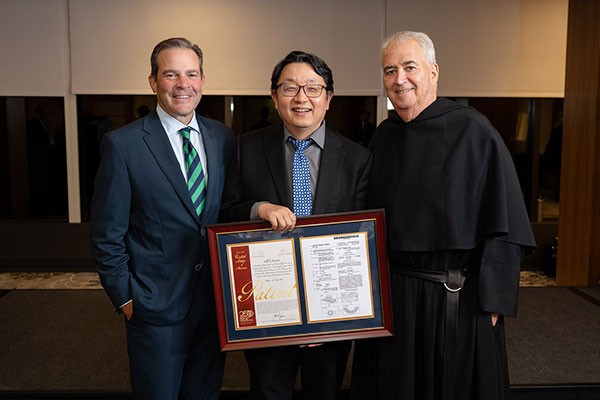
From L to R: Patrick G. Maggitti, PhD, Provost, Qianhong Wu, PhD and the Rev. Peter M. Donohue, OSA, PhD, University President
Qianhong Wu, PhD
Professor and Chair, Department of Mechanical Engineering
Director of the Cellular Biomechanics and Sports Science Laboratory
College of Engineering
Sridhar Santhanam, PhD
Vice Dean
Professor, Mechanical Engineering
Director, Laboratory for the Mechanics
of Materials and Processing
College of Engineering
Co-Inventors
Chandra Sehgal, PhD
Research Professor of Radiology
University of Pennsylvania
Bchara Sidnawi ’24 PhD
Diagnostic Tool for Quantitative Assessment of Brachial Artery Flow-Mediated Dilation
Cardiovascular health is closely linked to the condition and function of blood vessels. One commonly used method for evaluating vascular health is Flow-Mediated Dilation (FMD), a noninvasive test that measures how blood vessels respond to changes in blood flow. Although FMD has been associated with cardiovascular disease risk and other health conditions, its clinical usefulness has been limited by challenges in interpreting the results.
Dr. Qianhong Wu, Dr. Sridhar Santhanam and student co-inventors have developed a novel system and method for analyzing FMD test results that provides a more complete picture of vascular health. Unlike traditional approaches that primarily measure how much a blood vessel expands, the invention evaluates multiple aspects of vascular function and response. By examining additional indicators related to vessel health, the technology can help distinguish healthy blood vessels from those showing signs of impairment.
This biophysics-based approach offers a more comprehensive assessment of vascular function and has the potential to advance FMD from a tool used primarily in research to one with broader clinical applications. The technology could help healthcare providers better assess cardiovascular risk and monitor changes in vascular health over time.
The invention also has strong potential for integration into existing ultrasound systems. Because ultrasound is already widely used as a safe, noninvasive and cost-effective diagnostic tool, the technology could add valuable new capabilities without requiring significant changes to current clinical workflows.
Beyond cardiovascular disease assessment, the system may have applications in monitoring conditions associated with vascular dysfunction, including the long-term effects of COVID-19. Its ability to track subtle changes in blood vessel health may provide clinicians and researchers with new insights into disease progression and recovery.
The technology may also serve as a valuable tool in clinical research, enabling investigators to monitor vascular health over time in a simple and noninvasive manner. By improving the assessment of blood vessel function, this innovation has the potential to support the development of new therapies and advance the understanding of cardiovascular health.
Overall, the invention represents a significant advancement in vascular diagnostics, offering a more informative and practical approach to evaluating blood vessel health for both clinical and research applications.